answer.
Ask question
Login Signup
Ask question
All categories
  • English
  • Mathematics
  • Social Studies
  • Business
  • History
  • Health
  • Geography
  • Biology
  • Physics
  • Chemistry
  • Computers and Technology
  • Arts
  • World Languages
  • Spanish
  • French
  • German
  • Advanced Placement (AP)
  • SAT
  • Medicine
  • Law
  • Engineering
erastovalidia [21]
2 years ago
8

On a summer day in New Orleans, Louisiana, the pressure is 1 atm: the temperature is 32°C; and the relative humidity is 95 perce

nt. This air is to be conditioned to 24°C and 60 percent relative humidity. Determine the amount of cooling, in kJ, required and water removed, in kg, per 1000 m3 of dry air processed at the entrance to the system.
Engineering
1 answer:
FinnZ [79.3K]2 years ago
3 0

Answer:

Δw =7.95 kg/1000m^3

q = 62362.3 kg/1000m^3

Explanation:

To solve this problem we first need to use the psycrometric chart to determine the enthalpy h1, specific volume vi and absolute humidity col by using the given temperature T1 = 32°C and the relative humidity Ф1 = 95%.  

h_1 =  106.5 kJ/kg

v_1 = 0.91 m^3/kg

w_1 = 0.02905

We will also need the enthalpy h2 and the absolute humidity w_2 at the exit point. We will again use the pyscrometric chart and the given temperature T_2 = 24°C. From the problem we also know that the exit relative humidity is = 60%.  

h2 = 52.6 kJ/kg

w_2 = 0.01119

We need to express the final results in units per 1000 m^3. To do that we will need the mass m of this volume of air V and to calculate that we will use the given pressure p = 1 atm = 101.3 kPa.  

m = R_a*T_1/V.p

m = 1000*101.3/0.287*305K

m = 1157 kg

Because it is a closed system, the amount of water removed Δw can be calculated as:  

Δw =w_1 - w_2

Δw =0.02905- 0.01119

Δw =0.00687 kg/kg* 1157kg/1000m^3

Δw =7.95 kg/1000m^3

From the energy balance equation we can calculate the specific heat q removed from the air.  

q = h_1 - h_2

q = 106.5 kJ/kg - 52.6 kJ/kg

q = 53.9 kJ/kg * 1157kg/1000m^3

q = 62362.3 kg/1000m^3

You might be interested in
Identify an object in your house that contains a physical system and list three questions you could use to define the system
jonny [76]

Answer:

ALL CAREFULLY ANSWERED CORRECTLY

Explanation:

1) A loaf of Bread PHYSICAL SYSTEM

✓ How can the environment affect the edibility of the bread

✓ What are the constituents that makes up the bread

✓ What process is involved in these constituents mixing to form the loaf.

2) The law of thermodynamics makes us to understand that when heat/energy passes through a system, the systems internal energy changes with respect to the conservation of energy law. That is energy lost = energy gained. Typically, ice would melt in a cup of hot tea because of the thermal energy in the molecules of the hot tea. When you heat a material, you are adding thermal kinetic energy to its molecules and usually raising its temperature. The temperature of the ice raises due to the kinetic energy added to it and it melts to water.

3) The theory of systems view the world as a complex system of interconnected parts. If we consider the society; (financial systems, political systems, etc) we will agree that they individually have their own components and it's the summation of this components that makes the system, this implies that system thinking could be applicable in this kinda of systems as long as they are made up of components.

4) Technology has boosted every sector of our lives and it has the capacity to do more. Restricting it's importance to entertainment alone would be an underusing of its potentials. Engineering students infact should not need any drive to be encouraged about maximizing all it can do in shaping our world.

5) ~ Nature shows its splendid soul

~Never ceases to leave us in amazement

~And we are in love

4 0
2 years ago
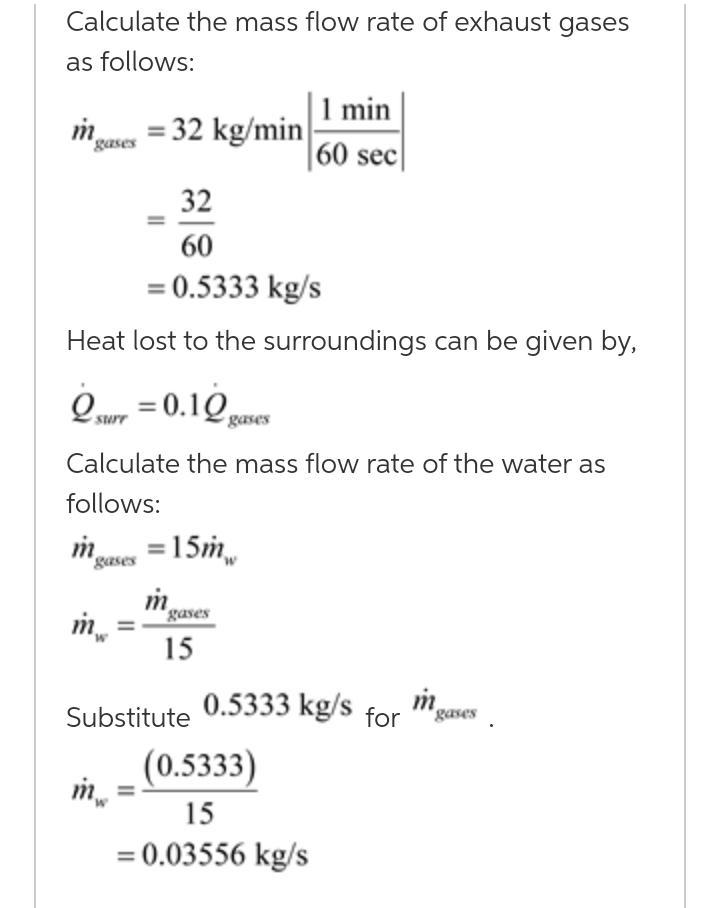
Hot exhaust gases of an internal combustion engine are to be used to produce saturated water vapor at 2 MPa pressure. The exhaus
Anastaziya [24]

Answer:

The flowrate of water is 0.03556kg/s

Explanation:

Exhaust gases inlet temperature T1=4000C

Water inlet temperature T3=150C Exit Pressure of water as saturated vapor P4=2MPa

Mass flow rate of exhaust gases Heat lost to the surroundings Qgases=32kg/min

Mass flow rate of exhaust gases is 15 times that of the water

Heat exchangers typically involve no work interactions (w = 0) and negligible...

7 0
2 years ago
Read 2 more answers
A solid cylinder is concentric with a straight pipe. The cylinder is 0.5 m long and has an outside diameter of 8 cm. The pipe ha
poizon [28]

Answer :  

The force needed to move the cylinder is 25.6 N

<h2>Further explanation  </h2>

Given that,  

Length of the cylinder, l = 0.5 m  

Outer diameter of the cylinder, d = 8 cm = 0.08 m  

Outer radius of the cylinder, r=0.04\ m  

Inside diameter of the pipe, d = 8.5 cm = 0.085 m  

Inside radius of the pipe, r=0.0425\ m  

Specific gravity of the oil, \rho=0.92  

Density of oil, d=\rho\times \rho_w

Kinematic viscosity of the oil, v=5.57\times 10^{-4}\ m^2/s  

Velocity of the cylinder, u = 1 m/s  

We need to find the force needed to move the cylinder. Let the force is F.  

Specific gravity is defined as the ratio of the density of the substance to the density of water.  

Kinematic viscosity is the acquired resistance of a fluid when there is no external force is acting except gravity. It is denoted by v.

Absolute viscosity is given by :

v=\dfrac{\mu}{d}

Where, d = density of oil

And d=\rho\times \rho_w (density of oil = specific gravity × density of water )

d=0.92\times 10^3\ kg/m^3

So,  

\mu=v\times d..............(1)

\mu=5.57\times 10^{-4}\ m^2/s\times 0.92\times 10^3\ kg/m^3

\mu=0.512\ Pa-s

The separation between the cylinder and pipe is given by :

dy=\dfrac{d_p-d_c}{2}=\dfrac{8.5-8}{2}=0.25\ cm=0.0025\ m

d_p\ and\ d_c are diameter of pipe and cylinder respectively.  

The mathematical expression for the Newton's law of viscosity can be written as:  

\tau\propto\dfrac{du}{dy}  

\tau=\mu\times \dfrac{du}{dy}..........(2)  

Where  

\tau = Shear stress, \tau=\dfrac{F}{A}............(3)  

\mu = viscosity  

\dfrac{du}{dy} = rate of shear deformation

On rearranging equation (1), (2) and (3) we get :  

\dfrac{F}{A}=v\times \rho\times \dfrac{du}{dy}...............(4)  

A is the area of the cylinder, A=2\pi rl  

Equation (4) becomes :  

F=v\times \rho\times \dfrac{du}{dy}\times 2\pi rl..............(5)

A=\pi d\times l

A=\pi \times 0.08\ m\times 0.5\ m

A=0.125\ m^2

Now, equation (5) becomes :

F=(v\times \rho)\times \dfrac{du}{dy}\times 2\pi rl

F=(0.512\ Pa-s)\times (\dfrac{1}{0.0025\ m})\times \times 0.125\ m^2

F = 25.6 N

<h2>Learn more  </h2>

Kinematic viscosity : brainly.com/question/12947932

<h2>Keyword :  </h2>

Specific gravity, Kinematic viscosity, Area of cylinder, fluid mass density.  

7 0
2 years ago
Water enters a centrifugal pump axially at atmospheric pressure at a rate of 0.12 m3
goldenfox [79]

Answer:

Water enters a centrifugal pump axially at atmospheric pressure at a rate of 0.12 m3/s and at a velocity of 7 m/s, and leaves in the normal direction along the pump casing, as shown in Fig. PI3-39. Determine the force acting on the shaft (which is also the force acting on the bearing of the shaft) in the axial direction.

Step-by-step solution:

Step 1 of 5

Given data:-

The velocity of water is .

The water flow rate is.

3 0
2 years ago
A hydraulic cylinder is to be used to move a workpiece in a manufacturing operation through a distance of 50 mm in 10 s. A force
svetlana [45]

Answer:

The answer to this question is 1273885.3 ∅

Explanation:

<em>The first step is to determine the required  hydraulic flow rate liquid if working pressure and  if a cylinder with a piston diameter of 100 mm is available.</em>

<em>Given that,</em>

<em>The distance = 50mm</em>

<em>The time t =10 seconds</em>

<em>The force F = 10kN</em>

<em>The piston diameter is = 100mm</em>

<em>The pressure = F/A</em>

<em> 10 * 10^3/Δ/Δ </em>

<em> P = 1273885.3503 pa</em>

<em>Then</em>

<em>Power = work/time  = Force * distance /time</em>

<em> = 10 * 1000 * 0.050/10</em>

<em>which is  =50 watt</em>

<em>Power =∅ΔP</em>

<em>50 = 1273885.3 ∅</em>

5 0
2 years ago
Other questions:
  • 3. (20 points) Suppose we wish to search a linked list of length n, where each element contains a key k along with a hash value
    7·1 answer
  • What is the PW (at i 5%) of SuperTool's new test equipment? The development cost is $1.2M. Net revenues will begin at $300,000 f
    9·1 answer
  • A single crystal of a metal that has the FCC crystal structure is oriented such that a tensile stress is applied parallel to the
    7·1 answer
  • The procedure for determining the presence of Non-Condensable Gasses in refrigerant contained in an external recovery tank utili
    5·2 answers
  • Identify the four engineering economy symbols and their values from the following problem statement. Use a question mark with th
    10·1 answer
  • Technician A says that weld-through primer can be removed from the immediate weld area to improve weld quality. Technician B say
    7·1 answer
  • A liquid with a specific gravity of 2.6 and a viscosity of 2.0 cP flows through a smooth pipe of unknown diameter, resulting in
    6·1 answer
  • Why is data driven analytics of interest to companies?
    9·1 answer
  • Find the velocity and rate of flow of water through a rectangular channel of 6m wide and 3m deep when it's running full. The cha
    13·1 answer
  • Problema sobre programacion orientada a objetos!!
    14·1 answer
Add answer
Login
Not registered? Fast signup
Signup
Login Signup
Ask question!