answer.
Ask question
Login Signup
Ask question
All categories
  • English
  • Mathematics
  • Social Studies
  • Business
  • History
  • Health
  • Geography
  • Biology
  • Physics
  • Chemistry
  • Computers and Technology
  • Arts
  • World Languages
  • Spanish
  • French
  • German
  • Advanced Placement (AP)
  • SAT
  • Medicine
  • Law
  • Engineering
Semmy [17]
2 years ago
7

Suppose that a wing component on an aircraft is fabricated from an aluminum alloy that has a plane-strain fracture toughness of

26.0 MPa (23.7 ksi ). It has been determined that fracture results at a stress of 112 MPa (16,240 psi) when the maximum internal crack length is 8.6 mm (0.34 in.). For this same component and alloy, compute the stress level at which fracture will occur for a critical internal crack length of 6.0 mm
Engineering
1 answer:
Orlov [11]2 years ago
8 0

Answer: 133.88 MPa approximately 134 MPa

Explanation:

Given

Plane strains fracture toughness, k = 26 MPa

Stress at which fracture occurs, σ = 112 MPa

Maximum internal crack length, l = 8.6 mm = 8.6*10^-3 m

Critical internal crack length, l' = 6 mm = 6*10^-3 m

We know that

σ = K/(Y.√πa), where

112 MPa = 26 MPa / Y.√[3.142 * 8.6*10^-3)/2]

112 MPa = 26 MPa / Y.√(3.142 * 0.043)

112 = 26 / Y.√1.35*10^-2

112 = 26 / Y * 0.116

Y = 26 / 112 * 0.116

Y = 26 / 13

Y = 2

σ = K/(Y.√πa), using l'instead of l and, using Y as 2

σ = 26 / 2 * [√3.142 * (6*10^-3/2)]

σ = 26 / 2 * √(3.142 *3*10^-3)

σ = 26 / 2 * √0.009426

σ = 26 / 2 * 0.0971

σ = 26 / 0.1942

σ = 133.88 MPa

You might be interested in
(3) Calculate the heat flux through a sheet of brass 7.5 mm (0.30 in.) thick if the temperatures at the two faces are 150°Cand 5
bezimeni [28]

Answer:

a.) 1.453MW/m2,  b.)  2,477,933.33 BTU/hr  c.) 22,733.33 BTU/hr  d.) 1,238,966.67 BTU/hr

Explanation:

Heat flux is the rate at which thermal (heat) energy is transferred per unit surface area. It is measured in W/m2

Heat transfer(loss or gain) is unit of energy per unit time. It is measured in W or BTU/hr

1W = 3.41 BTU/hr

Given parameters:

thickness, t = 7.5mm = 7.5/1000 = 0.0075m

Temperatures 150 C = 150 + 273 = 423 K

                        50 C = 50 + 273 = 323 K

Temperature difference, T = 423 - 323 = 100 K

We are assuming steady heat flow;

a.) Heat flux, Q" = kT/t

K= thermal conductivity of the material

The thermal conductivity of brass, k = 109.0 W/m.K

Heat flux, Q" = \frac{109 * 100}{0.0075} = 1,453,333.33 W/m^{2} \\ Heat flux, Q" = 1.453MW/m^{2} \\

b.) Area of sheet, A = 0.5m2

Heat loss, Q = kAT/t

Heat loss, Q = \frac{109*0.5*100}{0.0075} = 726,666.667W

Heat loss, Q = 726,666.667 * 3.41 = 2,477,933.33 BTU/hr

c.) Material is now given as soda lime glass.

Thermal conductivity of soda lime glass, k is approximately 1W/m.K

Heat loss, Q=\frac{1*0.5*100}{0.0075} = 6,666.67W

Heat loss, Q = 6,666.67 * 3.41 = 22,733.33 BTU/hr

d.) Thickness, t is given as 15mm = 15/1000 = 0.015m

Heat loss, Q=\frac{109*0.5*100}{0.015} =363,333.33W

Heat loss, Q = 363,333.33 * 3.41 = 1,238,966.67 BTU/hr

5 0
2 years ago
An automobile having a mass of 900 kg initially moves along a level highway at 100 km/h relative to the highway. It then climbs
creativ13 [48]

Answer:

ΔKE=-347.278 kJ

ΔPE= 441.45 kJ

Explanation:

given:

mass m=900 kg

the gravitational acceleration g=9.81 m/s^2

the initial velocity V_{1}=100 km/h-->100*10^3/3600=27.78 m/s

height above the highway h=50 m

h1=0m

the final velocity V_{F}=0 m/s

<u>To find:</u>

the change in kinetic energy ΔKE

the change in potential energy ΔPE

<u>assumption:</u>

We take the highway as a datum

<u>solution:</u>

ΔKE=5*m*(V_{F}^2-V_{1}^2)

      =-347.278 kJ

ΔPE=m*g*(h-h1)

      = 441.45 kJ

5 0
2 years ago
Convert 273.15 mL at 166.0 mm of Hg to its new volume at standard pressure.​
zloy xaker [14]

Answer:

(166.0 mm Hg) (273.15 mL) = (760.0 mm Hg) (x)

4 0
2 years ago
According to the video, what are some of the effects of the increase in the use of automated tools for Loading Machine Operators
Rudik [331]

sixteen is the answer to the question

8 0
2 years ago
Read 2 more answers
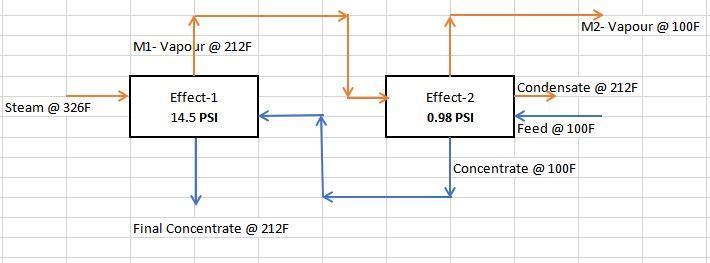
Evaporation in Double-Effect Reverse-Feed Evaporators. A feed containing 2 wt % dissolved organic solids in water is fed to a do
Ne4ueva [31]

Answer:

472,826 lb/hr

Explanation:

As per the given data:

Solids in feed= 2%

Solids in concentrate= 25%

HTA1 = HTA2 = 1000 ft^2

U1 = 500 Btu/ h ft^2 F & U2 = 700 Btu/ h ft^2 F

Overall material balance: Feed= Distillate + concentrate ----> Eq-1

Component balance: Feed * 0.02 = Distillate * 0 + concentrate * 0.25

Feed = 12.5 * concentrate ---> Eq-2

Boiling point rise = negligible, so solution & solvent vapor temperature will be same.

Assumed that the 1st effect is operating under atmospheric pressure (Boiling point - 212F).

As per the data:

Latent heat 212F = 300 Btu/lb

Latent heat 100F = 320 Btu/lb

As per material balance:

Vapor flowrate * latent heat = Overall HT coefficient * HTA * DT

1st effect: M-1= (500 * 1000 * (326-212)) / 300 = 190,000 lb/hr

2nd effect: M-2= (700*1000 * (212-100)) / 320 = 245,000 lb/hr

Distillate = M-1 + M-2 = 190,000+245,000 = 435,000 lb/hr

Substituting the above in Eq-1

Feed = 435,000 + concentrate

Substitute Eq-2 in the above

12.5 * concentrate = 435,000 + concentrate

Concentrate, L1 = 435,000/11.5 = 37826 lb /hr

Feed, F = 435,000 + 37826 = 472,826 lb/hr

1st effect operating pressure is not given, That may be the reason we are not getting the given answer. But procedure is right.

[ Find the figure in the attachment ]

5 0
2 years ago
Other questions:
  • Define a) Principal Plane b) Principal Stress c) anelasticity d) yield point e) ultimate tensile stress f) hardness g) toughness
    5·1 answer
  • 1. Which type of sketch most accurately represents what the finished product will look like?
    11·1 answer
  • Carbon dioxide gas enters a pipe at 3 MPa and 500 K at a rate of 2 kg/s. CO2 is cooled at constant pressure as it flows in the p
    10·1 answer
  • Air whose density is 0.082 lbm/ft3 enters the duct of an air-conditioning system at a volume flow rate of 450 ft3/min. If the di
    8·2 answers
  • 2.31 LAB: Simple statistics Part 1 Given 4 integers, output their product and their average, using integer arithmetic. Ex: If th
    5·2 answers
  • The rigid beam is supported by a pin at C and an A992 steel guy wire AB of length 6 ft. If the wire has a diameter of 0.2 in., d
    14·1 answer
  • a. (24 points) Describe the microstructure present in a 10110 steel after each step in each of the following heat treatments (no
    10·1 answer
  • The total floor area of a building, including below-grade space but excluding unenclosed areas, measured from the exterior of th
    8·1 answer
  • The typical Canadian worker is able to produce 100 board feet (a unit of measure) of lumber or 1000 light bulbs per year. The wo
    12·1 answer
  • What should always be done before beginning any diagnosis?
    9·1 answer
Add answer
Login
Not registered? Fast signup
Signup
Login Signup
Ask question!