answer.
Ask question
Login Signup
Ask question
All categories
  • English
  • Mathematics
  • Social Studies
  • Business
  • History
  • Health
  • Geography
  • Biology
  • Physics
  • Chemistry
  • Computers and Technology
  • Arts
  • World Languages
  • Spanish
  • French
  • German
  • Advanced Placement (AP)
  • SAT
  • Medicine
  • Law
  • Engineering
garik1379 [7]
2 years ago
9

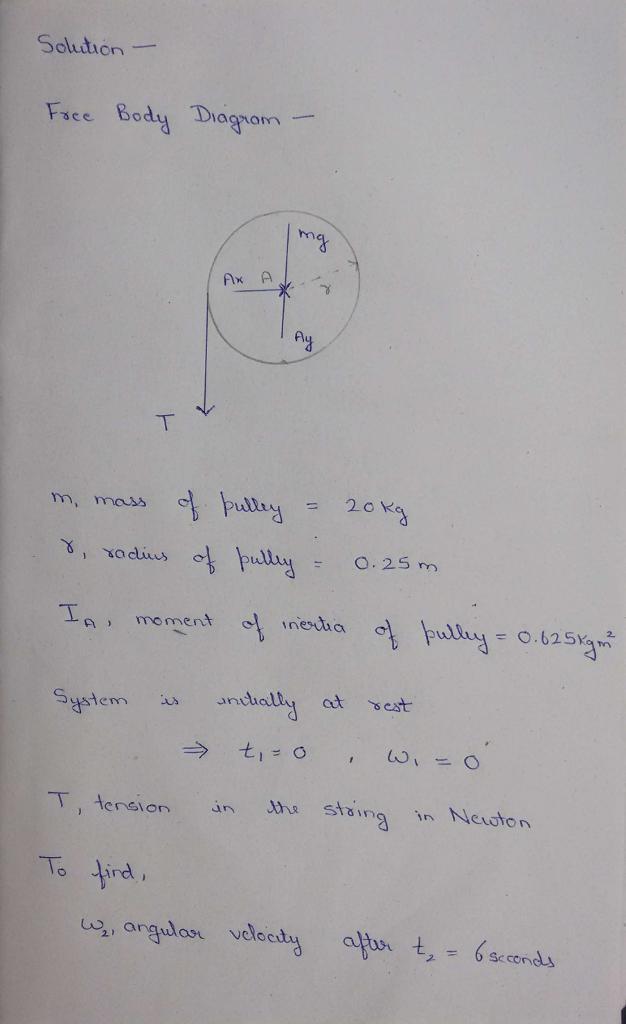
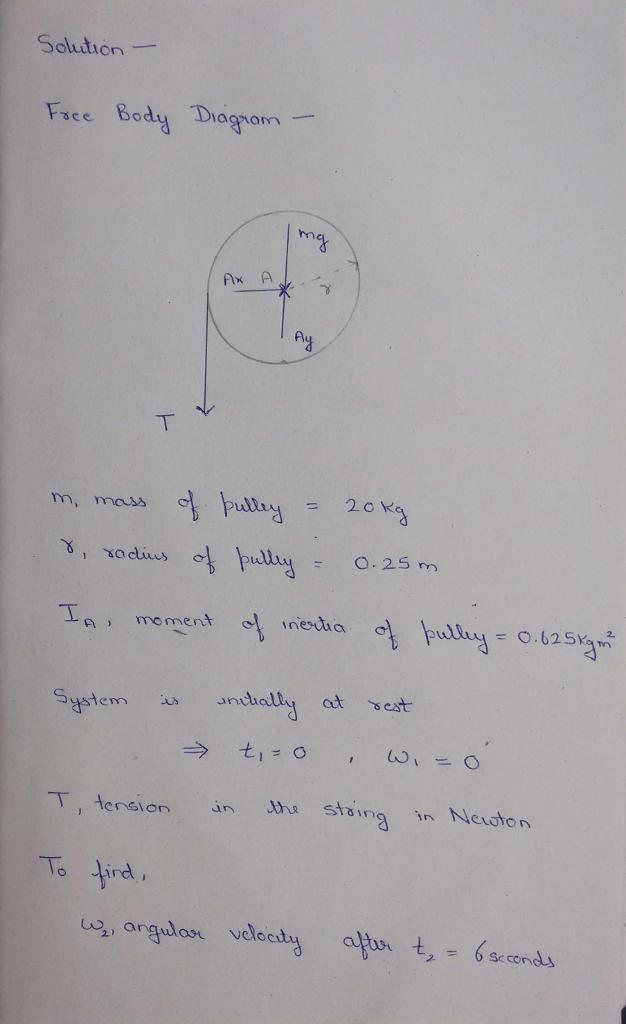
To be able to solve problems involving force, moment, velocity, and time by applying the principle of impulse and momentum to ri

gid bodies. The principle of impulse and momentum states that the sum of all impulses created by the external forces and moments that act on a rigid body during a time interval is equal to the change in the linear and angular momenta of the body during that time interval. In other words, impulse is the change in momentum. The greater the impulse exerted on a body, the greater the body’s change in momentum. For example, baseball batters swing hard to maximize the impact force and follow through to maximize the impact time. This principle holds true for both linear and angular impulse and momentum. For a rigid-body’s planar motion, the equations for the linear impulse and momentum in the x–y plane are given by m(vGx)1+∑∫t2t1Fxdt=m(vGx)2 m(vGy)1+∑∫t2t1Fydt=m(vGy)2 Similarly, the equation for the principle of angular impulse and momentum about the z axis, which passes through the rigid-body’s mass center G, is given by IGω1+∑∫t2t1MGdt=IGω2

Engineering
2 answers:
coldgirl [10]2 years ago
3 0

Answer:

see explaination

Explanation:

Please kindly check attachment for the step by step solution of the given problem.

The attached files has the solved problem.

dalvyx [7]2 years ago
3 0

Answer: 3.33T rad/s

Explanation:

here is a step by step explanation for the problem.

we have that the Moment of inertia of the pulley Ia = 0.225 Kg-m³

                                           Radius of the pulley r = 0.15m

                                           Mass of the pulley m = 20 Kg

we know that the torque acting on the pulley (Tr) = Iα

where α = Tr/ I

here, T is the tension of the cord,

also α is the angular acceleration ,

also, I is the moment of inertia and r is  the radius.

from 2nd rotational kinematics law;

ω₂ = ω₁ + αt .................. (1)

given that ω₂ and ω₁ is the final and inertia angular velocity, t is the time.

note: initial velocity (ω₁) is zero since system is at rest.

now from the expression in (1)

ω₂ = ω₁ + αt

= (0) + (Tr/I)t

ω₂ = (T(0.15) / 0.225 )*(5) = 3.33T rad/s

from this we can say that the angular velocity of the pulley is 3.33T rad/s at t = 5sec

cheers i hope this helps!!!!

You might be interested in
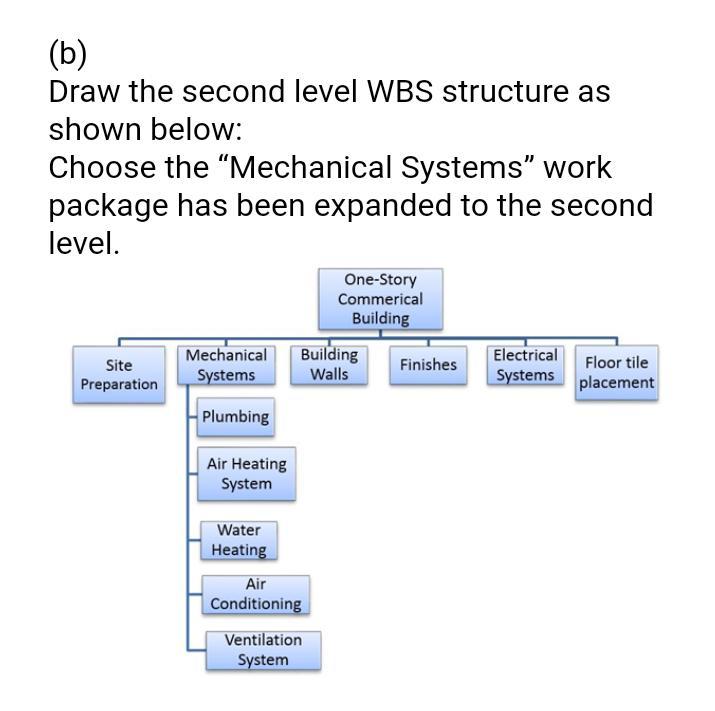
Develop a preliminary work breakdown structure (WBS) for a small one-story commercial building to be constructed on the site of
Zielflug [23.3K]

Answer:

The preliminary work breakdown structure will be divided into two steps, the first is to draw the first level and the second is to draw the second level.

Explanation:

Please look at attachment.

6 0
2 years ago
Read 2 more answers
Derive the probability that a receptor is occupied by a ligand using a model that treats the L ligands in solution as distinguis
love history [14]

that is the same thing as you are not going through this week or something

7 0
2 years ago
3.24 Program: Drawing a half arrow (Java) This program outputs a downwards facing arrow composed of a rectangle and a right tria
eimsori [14]

Answer:

Here is the JAVA program:

import java.util.Scanner; // to get input from user

public class DrawHalfArrow{ // start of the class half arrow

public static void main(String[] args) { // starts of main() function body

    Scanner scnr = new Scanner(System.in); //reads input

int arrowBaseHeight = 0; // stores the height of arrow base

int arrowBaseWidth  = 0; // holds width of arrow base

int arrowHeadWidth = 0; // contains the width of arrow head

// prompts the user to enter arrow base height, width and arrow head width

System.out.println("Enter arrow base height: ");

arrowBaseHeight = scnr.nextInt(); // scans and reads the input as int

System.out.println("Enter arrow base width: ");

arrowBaseWidth = scnr.nextInt();

/* while loop to continue asking user for an arrow head width until the value entered is greater than the value of arrow base width */

while (arrowHeadWidth <= arrowBaseWidth) {

    System.out.println("Enter arrow head width: ");

    arrowHeadWidth = scnr.nextInt(); }

//start of the nested loop

//outer loop iterates a number of times equal to the height of the arrow base

 for (int i = 0; i < arrowBaseHeight; i++) {

//inner loop prints the stars asterisks

      for (int j = 0; j <arrowBaseWidth; j++) {

          System.out.print("*");        } //displays stars

          System.out.println();          }

//temporary variable to hold arrowhead width value

int k = arrowHeadWidth;

//outer loop to iterate no of times equal to the height of the arrow head

for (int i = 1; i <= arrowHeadWidth; i++)

{     for(int j = k; j > 0; j--)     {//inner loop to print stars

       System.out.print("*");    } //displays stars

   k = k - 1;

   System.out.println(); } } } // continues to add more asterisks for new line

Explanation:

The program asks to enter the height of the arrow base, width of the arrow base and the width of arrow head. When asking to enter the width of the arrow head, a condition is checked that the arrow head width arrowHeadWidth should be less than or equal to width of arrow base arrowBaseWidth. The while loop keeps iterating until the user enters the arrow head width larger than the value of arrow base width.

The loop is used to output an arrow base of height arrowBaseHeight. So point (1) is satisfied.

The nested loop is being used which as a whole outputs an arrow base of width arrowBaseWidth. The inner loop draws the stars and forms the base width of the arrow, and the outer loop iterates a number of times equal to the height of the arrow. So (2) is satisfied.

A temporary variable k is used to hold the original value of arrowHeadWidth so that it keeps safe when modification is done.

The last nested loop is used to output an arrow head of width arrowHeadWidth. The inner loop forms the arrow head and prints the stars needed to form an arrow head. So (3) is satisfied.

The value of temporary variable k is decreased by 1 so the next time it enters  the nested for loop it will be one asterisk lesser.

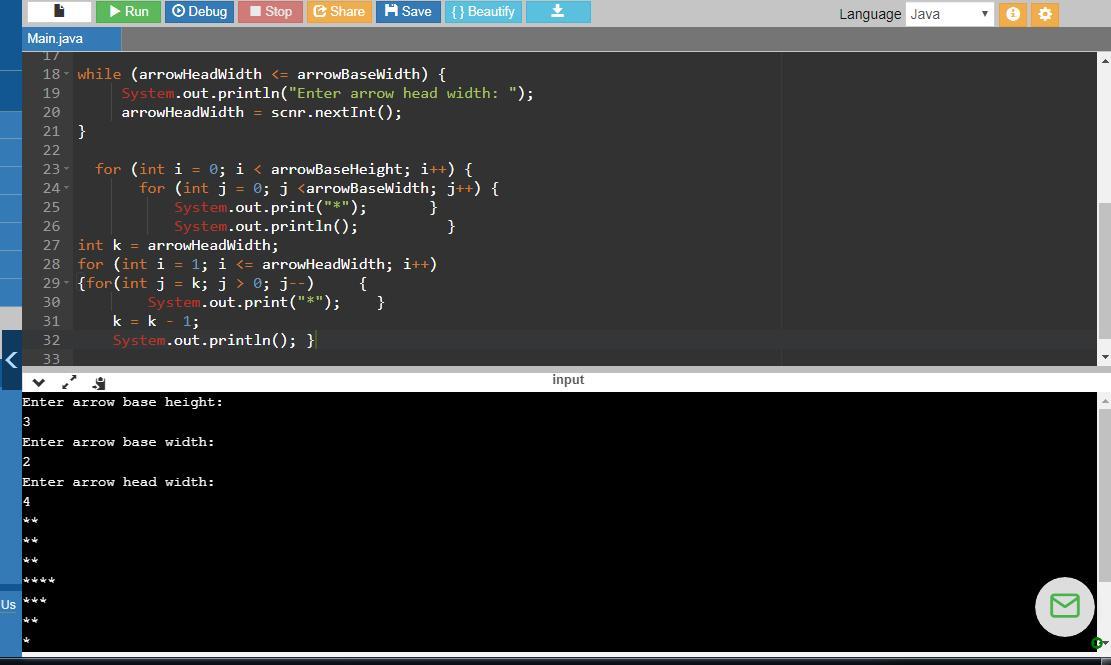
The screenshot of output is attached.
3 0
2 years ago
Same rule: If both players spend the same number of coins, player 2 gains 1 coin. Off-by-one rule: If the players do not spend t
Galina-37 [17]

Answer:

Check the explanation

Explanation:

1 -

public int getPlayer2Move(int round)

{

  int result = 0;


  //If round is divided by 3

  if(round%3 == 0) {

      result= 3;

  }

  //if round is not divided by 3 and is divided by 2

  else if(round%3 != 0 && round%2 == 0) {

      result = 2;

  }

  //if round is not divided by 3 or 2

  else {

      result = 1;

  }


  return result;

}

2-

public void playGame()

{


  //Initializing player 1 coins

  int player1Coins = startingCoins;


  //Initializing player 2 coins

  int player2Coins = startingCoins;


  for ( int round = 1 ; round <= maxRounds ; round++) {


      //if the player 1 or player 2 coins are less than 3

      if(player1Coins < 3 || player2Coins < 3) {

          break;

      }


      //The number of coins player 1 spends

      int player1Spends = getPlayer1Move();


      //The number of coins player 2 spends

      int player2Spends = getPlayer2Move(round);


      //Remaining coins of player 1

      player1Coins -= player1Spends;


      //Remaining coins of player 2

      player2Coins -= player2Spends;


      //If player 2 spends the same number of coins as player 2 spends

      if ( player1Spends == player2Spends) {

          player2Coins += 1;

          continue;

      }


      //positive difference between the number of coins spent by the two players

      int difference = Math.abs(player1Spends - player2Spends) ;


      //if difference is 1

      if( difference == 1) {

          player2Coins += 1;

          continue;

      }


      //If difference is 2

      if(difference == 2) {

          player1Coins += 2;

          continue;

      }


  }


  // At the end of the game

  //If player 1 coins is equal to player two coins

  if(player1Coins == player2Coins) {

      System.out.println("tie game");

  }

  //If player 1 coins are greater than player 2 coins

  else if(player1Coins > player2Coins) {

      System.out.println("player 1 wins");

  }

  //If player 2 coins is grater than player 2 coins

  else if(player1Coins < player2Coins) {

      System.out.println("player 2 wins");

  }

}

3 0
2 years ago
A plane wall of thickness 2L = 60 mm and thermal conductivity k= 5W/m.K experiences uniform volumetric heat generation at a rate
aniked [119]

Answer:

Explanation:

A plane wall of thickness 2L=40 mm and thermal conductivity k=5W/m⋅Kk=5W/m⋅K experiences uniform volumetric heat generation at a rateq  

˙

q

q

˙

​  

, while convection heat transfer occurs at both of its surfaces (x=-L, +L), each of which is exposed to a fluid of temperature T∞=20∘CT  

∞

​  

=20  

∘

C. Under steady-state conditions, the temperature distribution in the wall is of the form T(x)=a+bx+cx2T(x)=a+bx+cx  

2

 where a=82.0∘C,b=−210∘C/m,c=−2×104C/m2a=82.0  

∘

C,b=−210  

∘

C/m,c=−2×10  

4

C/m  

2

, and x is in meters. The origin of the x-coordinate is at the midplane of the wall. (a) Sketch the temperature distribution and identify significant physical features. (b) What is the volumetric rate of heat generation q in the wall? (c) Determine the surface heat fluxes, q

′′

x

(−L)q  

x

′′

​  

(−L) and q

′′

x

(+L)q  

x

′′

​  

(+L). How are these fluxes related to the heat generation rate? (d) What are the convection coefficients for the surfaces at x=-L and x=+L? (e) Obtain an expression for the heat flux distribution q

′′

x

(x)q  

x

′′

​  

(x). Is the heat flux zero at any location? Explain any significant features of the distribution. (f) If the source of the heat generation is suddenly deactivated (q=0), what is the rate of change of energy stored in the wall at this instant? (g) What temperature will the wall eventually reach with q=0? How much energy must be removed by the fluid per unit area of the wall (J/m2)(J/m  

2

) to reach this state? The density and specific heat of the wall material are 2600kg/m32600kg/m  

3

 and 800J/kg⋅K800J/kg⋅K, respectively.

6 0
2 years ago
Other questions:
  • You are working in a lab where RC circuits are used to delay the initiation of a process. One particular experiment involves an
    13·1 answer
  • What is the damped natural frequency (in rad/s) of a second order system whose undamped natural frequency is 25 rad/s and has a
    15·1 answer
  • The legend that Benjamin Franklin flew a kite as a storm approached is only a legend—he was neither stupid nor suicidal. Suppose
    5·1 answer
  • Problem 5) Water is pumped through a 60 m long, 0.3 m diameter pipe from a lower reservoir to a higher reservoir whose surface i
    13·1 answer
  • Your roommate wants to learn about organizational chart. You can tell her that these charts can tell you all of these about an o
    10·1 answer
  • 5 kg of steam contained within a piston-cylinder assembly undergoes an expansion from state 1, where the specific internal energ
    7·1 answer
  • Initialize the tuple team_names with the strings 'Rockets', 'Raptors', 'Warriors', and 'Celtics' (The top-4 2018 NBA teams at th
    5·1 answer
  • Technician A says that weld-through primer can be removed from the immediate weld area to improve weld quality. Technician B say
    7·1 answer
  • What ratio between differential gain and common-mode gain is called​
    9·1 answer
  • What is the linear distance traveled in one revolution of a 36-inch wheel
    6·1 answer
Add answer
Login
Not registered? Fast signup
Signup
Login Signup
Ask question!