answer.
Ask question
Login Signup
Ask question
All categories
  • English
  • Mathematics
  • Social Studies
  • Business
  • History
  • Health
  • Geography
  • Biology
  • Physics
  • Chemistry
  • Computers and Technology
  • Arts
  • World Languages
  • Spanish
  • French
  • German
  • Advanced Placement (AP)
  • SAT
  • Medicine
  • Law
  • Engineering
PSYCHO15rus [73]
2 years ago
8

Common additives to drinking water include elemental chlorine, chloride ions, and phosphate ions. Recently, reports of elevated

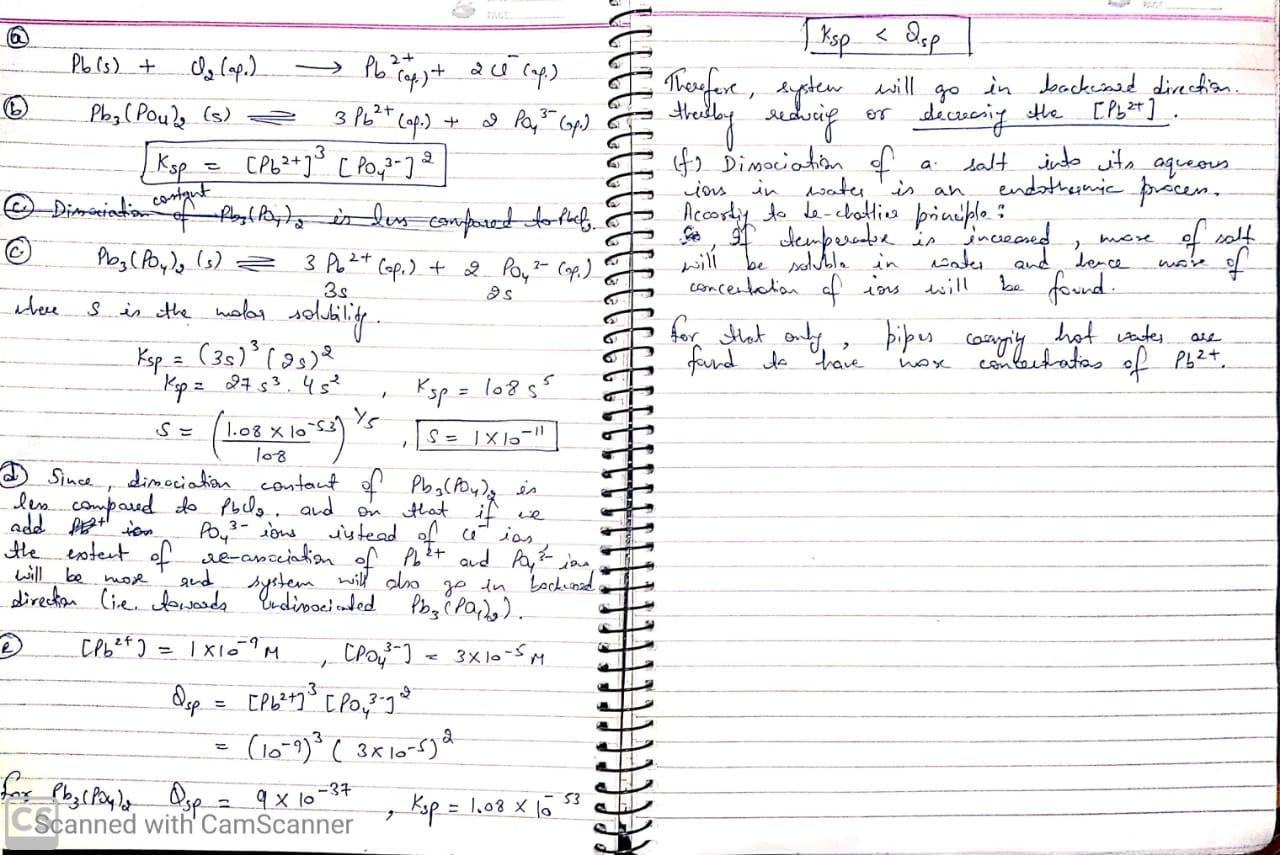
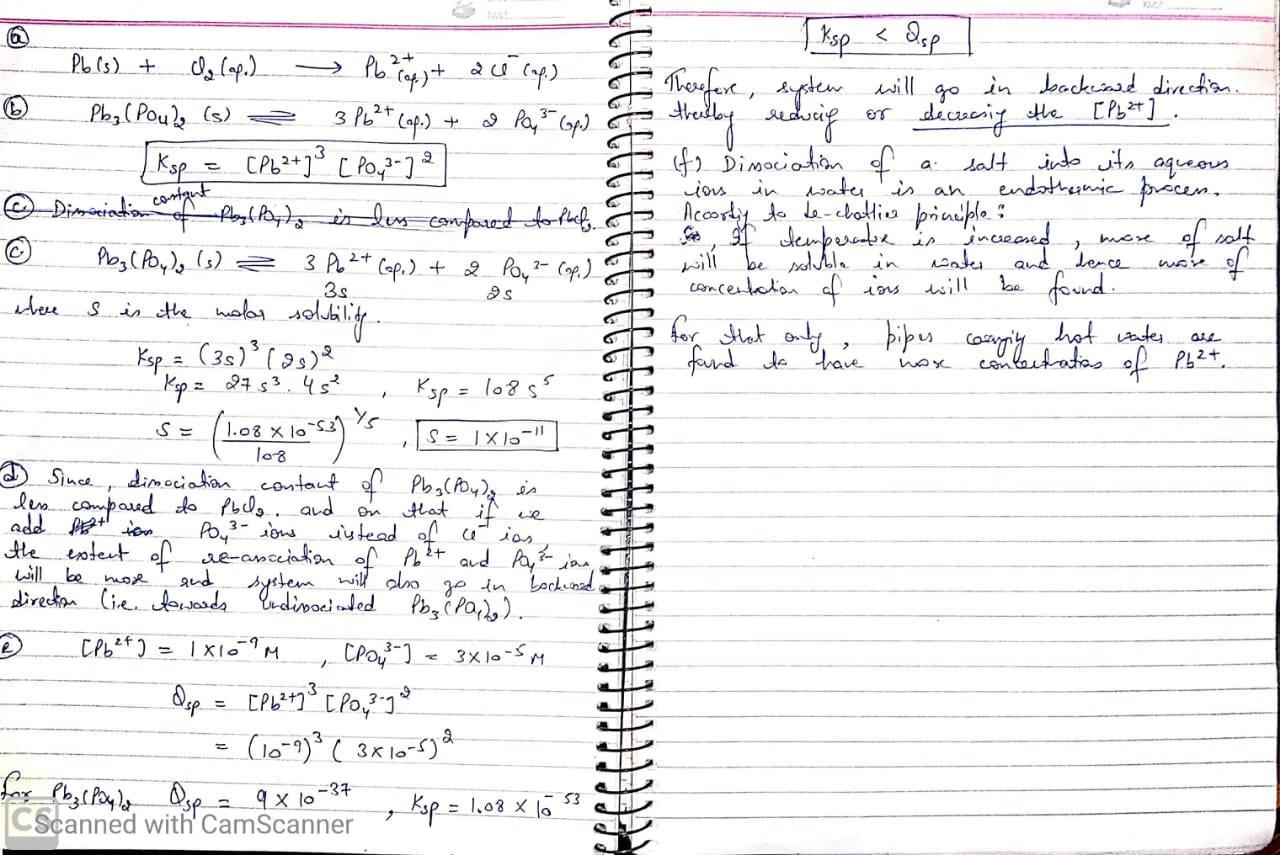
lead levels in drinking water have been reported in cities with pipes that contain lead, Pb(s). When Cl2(aq) flows through a metal pipe containing Pb(s), some of the lead atoms oxidize, losing two electrons each, and aqueous chloride ions form. (a) Write a balanced, net-ionic equation for the reaction between Pb(s) , and

Chemistry
1 answer:
NeX [460]2 years ago
8 0

Answer:

Check the explanation

Explanation:

Kindly check the attached image below to see the step by step explanation to the question above.

You might be interested in
Suppose you have two cubes of exactly the same volume. You weigh them and find a mass of 8.91g for one and 8.88g for the other c
Yuliya22 [10]
The two substances have different densities. Density can be affected by the temperature of a substance. Since they have to same volume but weigh differently, they have different densities. Remember, density = mass/volume
3 0
2 years ago
Read 2 more answers
A glass container was initially charged with 2.00 moles of a gas sample at 3.75 atm and 21.7 °C. Some of the gas was released as
finlep [7]

Answer:

0.521 moles still present in the container.

Explanation:

It is possible to answer this question by using the general gas law, that is:

PV = nRT

<em>Where P represents pressure of the gas, v its volume, n moles, R gas constant law and T absolute temperature (21.7°C + 273.15 = 294.85K)</em>

Replacing with values of the initial conditions of the container, its volume is:

V = nRT / P

V = 2.00mol*0.082atmL/molK*294.85K / 3.75atm

V = 12.9L

When some gas is released, absolute temperature is 28.1°C + 273.15 = 301.25K, the pressure is 0.998atm and <em>the volume of the container still constant. </em>Again, using general gas law:

PV / RT = n

0.998atm*12.9L / 0.082atmL/molK*301.25K = n

0.521 moles = n

<h3>0.521 moles still present in the container.</h3>

<em />

8 0
2 years ago
Diborane, B2H6 a possible rocket propellant, can be made by using lithium hydride (LiH): 6 LiH+ 2 BCl2àB2H6+ 6 LiCl . If you mix
Genrish500 [490]

Answer :

(a) Limiting reactant = LiH

(b) The excess reactant = BCl_3

(c) The percent of excess reactant is, 50.87 %

(d) The percent yield of B_2H_6 or percent conversion of LiH to B_2H_6 is, 38.80 %

(e) The mass of LiCl produced is, 1066.42 lb

Explanation : Given,

Mass of LiH = 200 lb = 90718.5 g

conversion used : (1 lb = 453.592 g)

Mass of BCl_3 = 1000 lb = 453592 g

Molar mass of LiH = 7.95 g/mole

Molar mass of BCl_3 = 117.17 g/mole

Molar mass of B_2H_6 = 27.66 g/mole

Molar mass of LiCl = 42.39 g/mole

First we have to calculate the moles of LiH and BCl_3.

\text{Moles of }LiH=\frac{\text{Mass of }LiH}{\text{Molar mass of }LiH}=\frac{90718.5g}{7.95g/mole}=11411.13moles

\text{Moles of }BCl_3=\frac{\text{Mass of }BCl_3}{\text{Molar mass of }BCl_3}=\frac{453592g}{117.17g/mole}=3871.23moles

Now we have to calculate the limiting and excess reagent.

The balanced chemical reaction is,

6LiH+2BCl_3\rightarrow B_2H_6+6LiCl

From the balanced reaction we conclude that

As, 6 moles of LiH react with 1 mole of BCl_3

So, 11411.13 moles of LiH react with \frac{11411.13}{6}=1901.855 moles of BCl_3

From this we conclude that, BCl_3 is an excess reagent because the given moles are greater than the required moles and LiH is a limiting reagent and it limits the formation of product.

Moles of remaining excess reactant = 3871.23 - 1901.855 = 1969.375 moles

Total excess reactant = 3871.23 moles

Now we have to determine the percent of excess reactant (BCl_3).

\% \text{ excess reactant}=\frac{\text{Moles of remaining excess reactant}}{\text{Moles of total excess reagent}}\times 100

\% \text{ excess reactant}=\frac{1969.375}{3871.23}\times 100=50.87\%

The percent of excess reactant is, 50.87 %

Now we have to calculate the moles of B_2H_6.

As, 6 moles of LiH react to give 1 mole of B_2H_6

So, 11411.13 moles of LiH react to give \frac{11411.13}{6}=1901.855 moles of B_2H_6

Now we have to calculate the mass of B_2H_6.

\text{Mass of }B_2H_6=\text{Moles of }B_2H_6\times \text{Molar mass of }B_2H_6

\text{Mass of }B_2H_6=(1901.855mole)\times (27.66g/mole)=52605.3093g

Now we have to calculate the percent yield of B_2H_6.

\%\text{ yield of }B_2H_6=\frac{\text{Actual yield of }B_2H_6}{\text{Theoretical yield of }B_2H_6}\times 100=\frac{20411.7g}{52605.3093g}\times 100=38.80\%

The percent yield of B_2H_6 or percent conversion of LiH to B_2H_6 is, 38.80 %

Now we have to calculate the moles of LiCl.

As, 6 moles of LiH react to give 6 mole of LiCl

So, 11411.13 moles of LiH react to give 11411.13 moles of LiCl

Now we have to calculate the mass of LiCl.

\text{Mass of }LiCl=\text{Moles of }LiCl\times \text{Molar mass of }LiCl

\text{Mass of }LiCl=(11411.13mole)\times (42.39g/mole)=483717.8007g=1066.42lb

The mass of LiCl produced is, 1066.42 lb

8 0
2 years ago
If an aqueous solution of urea n2h4co is 26% by mass and has density of 1.07 g/ml, calculate the molality of urea in the soln
Ksju [112]
Answer is: molality of urea is 5.84 m.

If we use 100 mL of solution:
d(solution) = 1.07 g/mL.
m(solution) = 1.07 g/mL · 100 mL.
m(solution) = 107 g.
ω(N₂H₄CO) = 26% ÷ 100% = 0.26.
m(N₂H₄CO) = m(solution) · ω(N₂H₄CO).
m(N₂H₄CO) = 107 g · 0.26.
m(N₂H₄CO) = 27.82 g.
1) calculate amount of urea:
n(N₂H₄CO) = m(N₂H₄CO) ÷ M(N₂H₄CO).
n(N₂H₄CO) = 27.82 g ÷ 60.06 g/mol.
n(N₂H₄CO) = 0.463 mol; amount of substance.
2) calculate mass of water:
m(H₂O) = 107 g - 27.82 g.
m(H₂O) = 79.18 g ÷ 1000 g/kg.
m(H₂O) = 0.07918 kg.
3) calculate molality:
b = n(N₂H₄CO) ÷ m(H₂O).
b = 0.463 mol ÷ 0.07918 kg.
b = 5.84 mol/kg.
5 0
2 years ago
Read 2 more answers
The statement that percent yield can never be greater than theoretical yield is another example of the ________.
Gnom [1K]
We can rephrase the statement with a little more specificity in order to understand the answer here.

The mass of the products can never be more than the The mass that is expected.
3 0
2 years ago
Other questions:
  • How does vegetation slow and prevent sediment loss?
    8·1 answer
  • A gram of gasoline produces 45.0kj of energy when burned. gasoline has a density of 0.77/gml . how would you calculate the amoun
    6·1 answer
  • How many flies can fit into a 10 oz coffee cup?
    12·1 answer
  • Calculate the maximum concentration (in m) of silver ions (ag+) in a solution that contains 0.025 m of co32-. the ksp of ag2co3
    7·1 answer
  • Argon has a completely filled p sublevel, giving it chemical stability. Potassium has one electron in the 4s sublevel and can ea
    8·1 answer
  • Reaction A has a high activation energy, whereas reacton B has a low activation energy. Which of the statements about reaction A
    12·1 answer
  • A blacksmith making a tool heats 525 grams of steel to 1230°C. After hammering the steel, she places it into a bucket of water t
    5·1 answer
  • Consider the following reaction at 298.15 K: Co(s)+Fe2+(aq,1.47 M)⟶Co2+(aq,0.33 M)+Fe(s) If the standard reduction potential for
    7·1 answer
  • Label each statement with its corresponding type of scientific knowledge. law theory fact hypothesis The melting point of ice is
    5·1 answer
  • Emma wants to go swimming the first day the pool opens in May, but she is worried it will be too cold since summer only just sta
    14·1 answer
Add answer
Login
Not registered? Fast signup
Signup
Login Signup
Ask question!