answer.
Ask question
Login Signup
Ask question
All categories
  • English
  • Mathematics
  • Social Studies
  • Business
  • History
  • Health
  • Geography
  • Biology
  • Physics
  • Chemistry
  • Computers and Technology
  • Arts
  • World Languages
  • Spanish
  • French
  • German
  • Advanced Placement (AP)
  • SAT
  • Medicine
  • Law
  • Engineering
Arlecino [84]
2 years ago
7

Tell me weather 16641 is a perfect square by division method an please show me the solution too​

Mathematics
2 answers:
Sergio039 [100]2 years ago
7 0

Answer:

Yes, the number 16,641 is a perfect square.

Step-by-step explanation:

16641 is the 129th perfect square number

__________________________________________

1 2 9    

1 1 66 41    

1        

22  66      

44      

249  22 41    

22 41    

258   0    


Number = 16641

Square Root = 129

________________________________

Step-1 :

Make pair of digits of given number starting with digit at one's place. Put bar on each pair.


1 66 41    

Step-2 :

Now we have to multiply a number by itself such that the product ≤ 1

Here 1×1=1≤1, So divisor is 1 and quotient is 1. Now do the division and get the remainder.

 1        

1 1 66 41    

1        

0        

Step-3 :

Now , we have to bring down 66 and quotient 1 is multiplied by 2 becomes 2, which is starting digit of new divisor

 1        

1 1 66 41    

1        

2  66      

Step-4 :

2 should be the digit at one's place of new divisor because when 22 is multiplied by 2 we get 44.

So new divisor is 22 and next digit of quotient is 2. Now do the division and get the remainder.

 1 2      

1 1 66 41    

1        

22  66      

44      

22      

Step-5 :

Now , we have to bring down 41 and quotient 12 is multiplied by 2 becomes 24, which is starting digit of new divisor

 1 2      

1 1 66 41    

1        

22  66      

44      

24  22 41    

Step-6 :

9 should be the digit at one's place of new divisor because when 249 is multiplied by 9 we get 2241.

So new divisor is 249 and next digit of quotient is 9. Now do the division and get the remainder.

 1 2 9    

1 1 66 41    

1        

22  66      

44      

249  22 41    

22 41    

0    

Answer: 129 (proof 129^2) = 16,641 or 129 x 129 = 16,641

______________________________

Second Solution shortcut:

A perfect square is a number that can be expressed as the product of two equal integers.

The only way to accurately calculate if a number is a perfect square is to find the factors. Before we go through the trouble of finding the factors, there is a quick trick you can use to help determine if you need even need to do the extra work.

Try these steps first:

A number that is a perfect square never ends in 2, 3, 7 or 8. If your number ends in any of those numbers, you can stop here because your number is not a perfect square.

Obtain the digital root of the number. The digital root essentially is the sum of all of the digits. If you're lost, don't worry, we'll go over each step in more detail below.

All possible numbers that are a perfect square have a digital root of 1, 4, 7, 9.

Let's try it...

Step 1:

What is the last number of 16,641? It is this number: 16641. The answer is 1. Is 1 in the list of numbers that are never perfect squares (2, 3, 7 or 8)?

Answer: NO, 1 is not in the list of numbers that are never perfect squares. Let's continue to the next step.

Step 2:

We now need to obtain the digital root of the number. Here's how you do it:

Split the number up and add each digit together:

1 + 6 + 6 + 4 + 1 = 18

If the answer is more than one digit, you would add each digit of the answer together again:

1 + 8 = 9

What is the digital root of number 16,641?

Answer: 9

Step 3:

So now we know the digital root of 16,641 is 9. Is 9 in the list of digital roots that are always a square root (1, 4, 7 or 9)?

Answer: YES, 9 is in the list of digital roots that are always perfect squares. We can conclude that 16,641 could be a perfect square!

Factoring

OK, so now we know that 16,641 could be a perfect square. We have to find the factors of the number to be sure.

Here are all of the factors of 16,641:

1 x 16,6413 x 5,5479 x 1,84943 x 387129 x 129

Highlighted in orange above is the factor combination that makes 16,641 a perfect square. Do you see why? A number can only be a perfect square if the product of two exactly the same numbers is equal to the original number.

Here's the proof: 129 x 129 = 16,641
Aleonysh [2.5K]2 years ago
4 0

Answer:

yes

Step-by-step explanation:

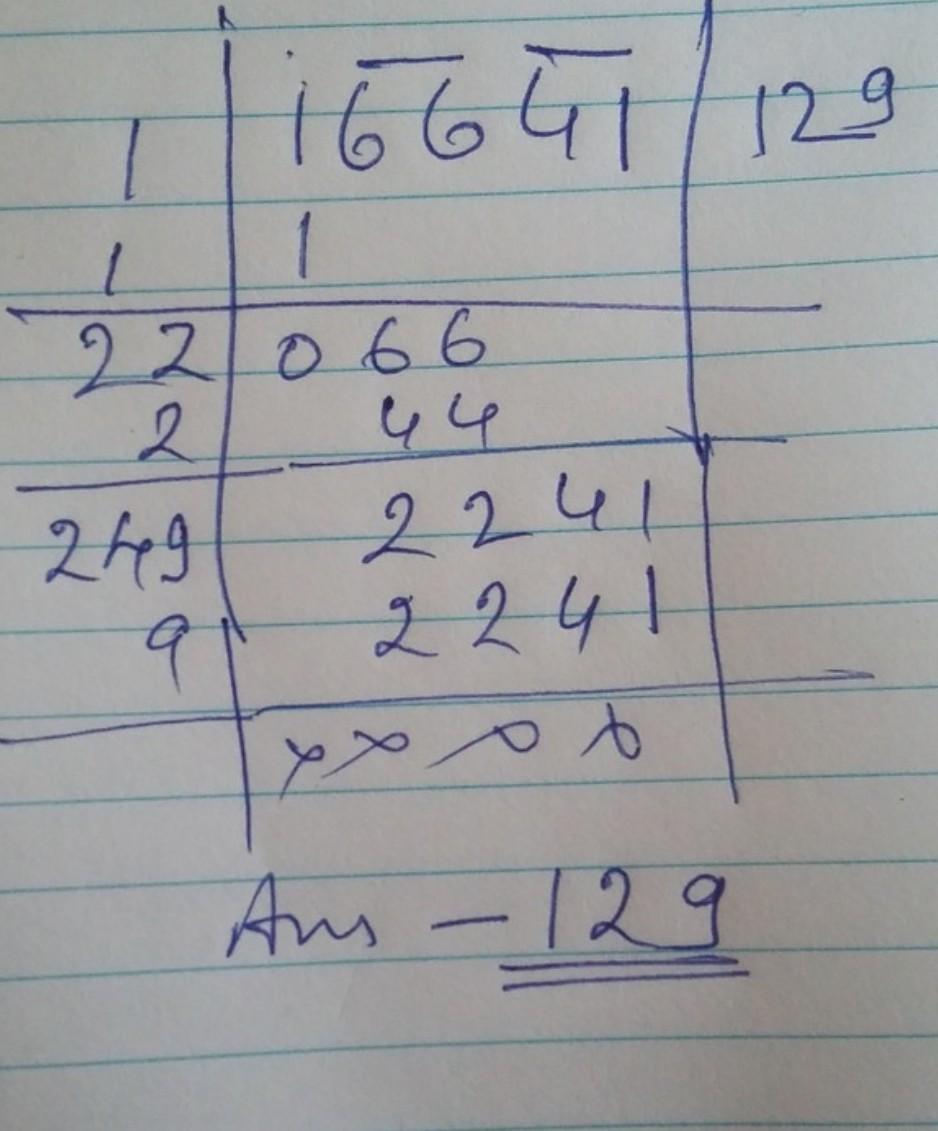
you see we need to make pairs and then we divide each one by square numbers and I have given picture

You might be interested in
Un globo busca aterrizar en medio de dos ciudades A y B, cuya distancia entre si es de 200 km. Si se mide el ángulo de elevación
scoundrel [369]

Answer:

h \approx 59.898\,km

Step-by-step explanation:

El diagrama trigonométrico que representa el enunciado es incluido abajo como adjunto. Las siguientes relaciones trigonométricas describen la localización del globo. (The trigonometric diagram representing the statement is included below as attachment. The following trigonometric relations describes the location of the balloon):

\tan 27^{\circ} = \frac{h}{x}

\tan 36^{\circ} = \frac{h}{200-x}

A continuación, se obtiene la distancia horizontal: (The horizontal distance is obtained hereafter):

x \cdot \tan 27^{\circ} = (200-x)\cdot \tan 36^{\circ}

x \cdot (\tan 27^{\circ} + \tan 36^{\circ})= 200\cdot \tan 36^{\circ}

x = \frac{200\cdot \tan 36^{\circ}}{\tan 27^{\circ}+ \tan 36^{\circ}}

x \approx 117.557\,km

La altura aproximada del globo es (The approximated height of the globe is):

h = x\cdot \tan 27^{\circ}

h \approx 59.898\,km

7 0
2 years ago
Wyatt solved the following equation:
NikAS [45]

Answer:

<u>Option B</u>

Step-by-step explanation:

The question is as following:

x+\frac{1}{2} (6x-4) =6

Step Work Justification

1 2x + 6x − 4 = 12

2 8x − 4 = 12

3 8x = 16

4 x = 2

Which of the following has all of the correct justifications Wyatt used to solve this equation?

A. Distributive property. 2. Combine like terms. 3. Addition property of equality. 4. Division property of equality.

B. Multiplication property of equality. 2. Combine like terms. 3. Addition property of equality. 4. Division property of equality.

C. Distributive property. 2. Combine like terms. 3. Subtraction property of equality. 4. Division property of equality.

D. Multiplication property of equality. 2. Combine like terms. 3. Subtraction property of equality. 4. Division property of equality

<u />

<u>The answer:</u>

Step Work Justification

multiply both sides by 2

1) 2x + 6x − 4 = 12 ⇒  {Multiplication property of equality}

{Combine like terms}

2) 8x − 4 = 12 ⇒

Adding 4 both sides

3) 8x = 16       ⇒ {Addition property of equality}

divide both sides by 8

4) x = 2           ⇒ {Division property of equality}

The answer is option B

(B) Multiplication property of equality. 2. Combine like terms. 3. Addition property of equality. 4. Division property of equality.

6 0
2 years ago
Julius earns $47,800 a year working for a delivery service. He is single and pays $2,152.60 in state income
ludmilkaskok [199]

Answer:

its the answer in photograph

8 0
2 years ago
Read 2 more answers
PI-3.
Fudgin [204]

Answer:

A. $301

B. $721

Step-by-step explanation:

Let $x be the amount of money they raised.

Rowena tried to put the $1 bills into two equal piles and found one left over at the end, then

x=2q_1+1

Polly tried to put the $1 bills into three equal piles and found one left over at the end, then

x=3q_2+1

Frustrated, they tried 4, 5, and 6 equal piles and each time had $1 left over, then

x=4q_3+1\\ \\x=5q_4+1\\ \\x=6q_5+1

Finally Rowena put all the bills evenly into 7 equal piles, and none were left over, then

x=7q_6

This means x-1 is divisible by 2, 3, 4, 5 and 6 without remainder, so

x-1=2\cdot 3\cdot 2\cdot 5n=60n

Hence,

x=60n+1, \ n\in N

The smallest amount of money they could have raised is $301, because

x=60\cdot 5+1=301 is divisible by 7.

Now, the number x=60n+1 should be divisible by 7 and must be greater than 500.

So,

60n+1>500\\ \\60n>499\\ \\n>8

When n = 9,

x=60\cdot 9+1=541 is not divisible by 7.

When n = 10,

x=60\cdot 10+1=601 is not divisible by 7.

When n = 11,

x=60\cdot 11+1=661 is not divisible by 7.

When n = 12,

x=60\cdot 12+1=721 is divisible by 7.

B. The least amount of money they could have raised is $721

7 0
2 years ago
Read 2 more answers
Which function has the domain x&gt;or= -11
iogann1982 [59]
I'm assuming this is multiple choice and you forgot to post the answers. I'll take a guess and say it probably looks something like this:
y = \sqrt{x + 11}
Because you can't take the square root of a negative number without getting an imaginary result, resulting in the function having a closed domain limit.
6 0
2 years ago
Other questions:
  • A plane flew for 4 hours heading south and for 6 hours heading east. If the total distance traveled was 3,370 miles, and the pla
    9·1 answer
  • Mr. Scruggs got some money for his birthday. He spent 1/5 of it on dog treats. Then he divided the remainder equally among his t
    7·1 answer
  • Solve the equation using square roots. 7x2 + 6 = 13
    5·2 answers
  • A group of entomologists has determined that the population of ladybugs at a local park can be modeled by the equation y = − 1.4
    12·1 answer
  • What is the sum of the polynomials?<br><br> (7x3 – 4x2) + (2x3 – 4x2)
    10·1 answer
  • Olivia drives 90 miles in 2 hours. She drives 225 miles in 5 hours. She writes an equation in the form y=mx to represent the num
    5·1 answer
  • Which is the best estimate of StartRoot 47 EndRoot to the nearest tenth?
    14·2 answers
  • Removing which point from the coordinate plane would make the graph a function of x? On a coordinate plane, points are at (negat
    7·2 answers
  • Find the derivative of the vector function r(t)=ta×(b+tc), where a=⟨2,−3,4⟩, b=⟨−4,5,−1⟩, and c=⟨−2,−1,5⟩.
    12·1 answer
  • (i)Express 2x² – 4x + 1 in the form a(x+ b)² + c and hence state the coordinates of the minimum point, A, on the curve y= 2x² 4x
    9·1 answer
Add answer
Login
Not registered? Fast signup
Signup
Login Signup
Ask question!