answer.
Ask question
Login Signup
Ask question
All categories
  • English
  • Mathematics
  • Social Studies
  • Business
  • History
  • Health
  • Geography
  • Biology
  • Physics
  • Chemistry
  • Computers and Technology
  • Arts
  • World Languages
  • Spanish
  • French
  • German
  • Advanced Placement (AP)
  • SAT
  • Medicine
  • Law
  • Engineering
andrey2020 [161]
2 years ago
12

Which is an issue that governments must consider before passing conservation policies? urbanization implications cost to impleme

nt conservation policies desertification implications cost to implement deforestation
Chemistry
2 answers:
bixtya [17]2 years ago
8 0

Answer:

urbanization implications

environmental implications

benefit versus the cost

Explanation:

Conservation involves preservation of organisms and their natural habitat to encourage biodiversity and reduces the risk of extinction.

Urbanization involves the loss of organism’s natural habitat due to deforestation and building of more structures such as buildings and road structures.Government must consider before passing conservation policies if the urbanization will have a bigger impact than conservation.

Environmental implications is also taken into account as the environment is where we live and makes it very important to ensure there are no negative effects.

The benefit and cost are weighed and the one with a lower cost and higher benefit is usually embraced.

Tanya [424]2 years ago
8 0

Answer:

B) Cost to implement conservation policies

Explanation:

i took the test edg2020

You might be interested in
PLEASE ASSIST MEEEEEEE!!!!!!!!! 40 POINTS
lana66690 [7]

Answer:

Wavelength of this beam of light: \rm 4.39\times 10^{-7}\; m.

Explanation:

The speed of light in vacuum is approximately \rm 2.998\times 10^{8}\;m \cdot s^{-1}.

Light behaves like a wave. The wavelength of a wave is equal to the distance that it travels (in the given medium) in each period of oscillation.

On the other hand, the frequency of a wave is the number of periods in unit time. 1\rm \; Hz means one oscillation per second. The frequency of this particular wave is \rm 6.83\times 10^{14}\; Hz. In other words, there are 6.83\times 10^{14} oscillations in each second.

The period of oscillation will be equal to

\displaystyle t = \frac{1}{f} = \frac{1}{\rm 6.83\times 10^{14}\; s^{-1}}.

In that period of time, a beam of light in vacuum would have traveled  

\displaystyle \rm 2.998\times 10^{8}\; m\cdot s^{-1} \times \frac{1}{\rm 6.83\times 10^{14}\; s^{-1}} = 4.39\times 10^{-7}\; m.

In other words, if this beam of light of frequency \rm 6.83\times 10^{14}\; Hz is in vacuum, its wavelength will be equal to \rm 4.39\times 10^{-7}\; m.

8 0
2 years ago
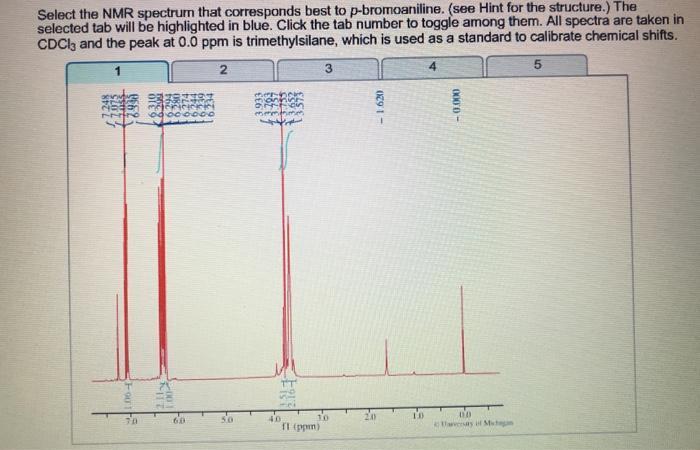
Select the NMR spectrum that corresponds best to p-bromoaniline. (see Hint for the structure.) The selected tab will be highligh
lana [24]

Answer:

The NMR spectrum that corresponds best to p-bromoaniline  is the one that is attached in the image below.

Explanation:

For the p-bromoaniline 3 types of hydrogen are observed. The first signal that appears at 3.7 ppm would be from the hydrogens of the NH2 group, the hydrogens in ortho position with respect to the NH2 group give a double at approximately 6.54 ppm, and finally the characteristic 7.21 ppm signal is observed for the hydrogens in meta position with with respect to the NH2 group.

7 0
2 years ago
How many hydrogen molecules are there in 1 ton of hydrogen?​
zaharov [31]
Hydrogen gas(H2) has a molar mass of 2 g. Molar mass of a substance is defined as the mass of 1 mole of that substance. And by 1 mole it is meant a collection of 6.022*10^23 particles of that substance.

So number of moles of H2 are 0.5 in this case. And thus it means there are (6.022*10^23)*0.5 particles( here they are molecules) in 1g of H2.
6 0
2 years ago
Large sharks eat many other marine life animals. The sharks and the animals they eat are all part of which level of organization
Sladkaya [172]

Answer:

the answer is ecosystem i believe.

8 0
2 years ago
Read 2 more answers
Marianne designs an experiment involving electrically charged objects. She wants to know which objects will be attracted to a ne
svet-max [94.6K]

Answer:

When one object is rubbed against another, static electricity can be created. This is because the rubbing creates a negative charge that is carried by electrons. The electrons can build up to produce static electricity. For example, when you shuffle your feet across a carpet, you are creating many surface contacts between your feet and the carpet, allowing electrons to transfer to you, thereby building up a static charge on your skin. When you touch another person or an object, you can suddenly discharge the static as an electrical shock.

Similarly, when you rub a balloon on your head it causes opposite static charges to build up both on your hair and the balloon. Consequently, when you pull the balloon slowly away from your head, you can see these two opposite static charges attracting one another and making your hair stand up.

Materials

• Balloon

• An object made out of wool (such as a sweater, scarf, blanket or ball of yarn)

• Stopwatch

• A wall

• A partner (optional)

Preparation

• Blow up the balloon and tie off the end.

• Have your partner prepare to use the stopwatch.

Procedure

• Hold the balloon in a way that your hand covers as little of its surface area as possible, such as by using only your thumb and pointer finger or by gripping the balloon by its neck where it is tied off.

• Rub the balloon on the woolly object once, in one direction.

• Hold the balloon up on the wall with the side that was rubbed against the wool facing the wall, then release it. Does the balloon stay stuck on the wall? If the balloon stays stuck, have your partner immediately start the stopwatch to time how long the balloon remains bound to the wall. If the balloon does not stick, move to the next step.

• Touch the balloon to a metal object. Why do you think this is important to do?

• Repeat the above process but each time increase the number of times you rub the balloon on the woolly object. Rub the balloon in the same direction each time. (Do not rub the balloon back and forth.)

Observations and results

In general, did the balloon stick to the wall for a longer amount of time as you increased the number of times you rubbed the balloon on the woolly object?

Wool is a conductive material, which means it readily gives away its electrons. Consequently, when you rub a balloon on wool, this causes the electrons to move from the wool to the balloon's surface. The rubbed part of the balloon now has a negative charge. Objects made of rubber, such as the balloon, are electrical insulators, meaning that they resist electric charges flowing through them. This is why only part of the balloon may have a negative charge (where the wool rubbed it) and the rest may remain neutral.

When the balloon has been rubbed enough times to gain a sufficient negative charge, it will be attracted to the wall. Although the wall should normally have a neutral charge, the charges within it can rearrange so that a positively charged area attracts the negatively charged balloon. Because the wall is also an electrical insulator, the charge is not immediately discharged. However, because metal is an electrical conductor, when you rub the balloon against metal the extra electrons in the balloon quickly leave the balloon and move into the metal so the balloon is no longer attracted and does not adhere.

HOPE IT HELPS

PLEASE MARK ME BRAINLIEST

6 0
2 years ago
Read 2 more answers
Other questions:
  • An iron atom has a mass of ×9.2710−23g and a cooking pot has a mass of 0.500kg
    12·2 answers
  • A molecular biologist measures the mass of Cofactor A in an average yeast cell. The mass is 77.91pg. What is the total mass in m
    15·1 answer
  • Observation And Assessment
    11·1 answer
  • According to the kinetic theory, collisions between molecules in a gas _____.
    12·2 answers
  • What mass of carbon dioxide (co2) can be produced from 86.17 grams of c6h14 and excess oxygen?
    15·1 answer
  • What is the [h3o+] for a solution at 25°c that has poh = 5.640?
    12·1 answer
  • A 10.0 g sample of LiOH is dissolved in 120.00 g of water at 23.0°C in a coffee-cup calorimeter with a heat capacity of 100 J/Â
    9·1 answer
  • 3. What is the volume of a salt crystal measuring 2.44 x 10-2 m by 1.4 x 10-3 m by 8.4 x 10-3 m?
    5·1 answer
  • If K3PO4= 0.250M, how many grams of K3PO4 are in 750.0ml of solution? Remember that M is the same as mol/L. Answer: 39.8g
    14·1 answer
  • 36g of KOH dissolved in 800mL of water. What is the molality of the solution?
    14·1 answer
Add answer
Login
Not registered? Fast signup
Signup
Login Signup
Ask question!