answer.
Ask question
Login Signup
Ask question
All categories
  • English
  • Mathematics
  • Social Studies
  • Business
  • History
  • Health
  • Geography
  • Biology
  • Physics
  • Chemistry
  • Computers and Technology
  • Arts
  • World Languages
  • Spanish
  • French
  • German
  • Advanced Placement (AP)
  • SAT
  • Medicine
  • Law
  • Engineering
Anvisha [2.4K]
2 years ago
5

A 50 Hz, four pole turbo-generator rated 100 MVA, 11 kV has an inertia constant of 8.0 MJ/MVA. (a) Find the stored energy in the

rotor at synchronous speed. (b) If the mechanical input is suddenly raised to 80 MW for an electrical load of 50 MW, find rotor acceleration, neglecting mechanical and electrical losses. (c) If the acceleration calculated in part(b) is maintained for 10 cycles, find the change in torque angle and rotor speed in revolutions per minute at the end of this period.
Engineering
1 answer:
raketka [301]2 years ago
4 0

Given Information:

Frequency = f = 60 Hz

Complex rated power = G = 100 MVA

Intertia constant = H = 8 MJ/MVA

Mechanical power = Pmech = 80 MW

Electrical power = Pelec = 50 MW

Number of poles = P = 4

No. of cycles = 10

Required Information:

(a) stored energy = ?

(b) rotor acceleration = ?

(c) change in torque angle = ?

(c) rotor speed = ?

Answer:

(a) stored energy = 800 Mj

(b) rotor acceleration = 337.46 elec deg/s²

(c) change in torque angle (in elec deg) = 6.75 elec deg

(c) change in torque angle (in rmp/s) = 28.12 rpm/s

(c) rotor speed = 1505.62 rpm

Explanation:

(a) Find the stored energy in the rotor at synchronous speed.

The stored energy is given by

E = G \times H

Where G represents complex rated power and H is the inertia constant of turbo-generator.

E = 100 \times 8 \\\\E = 800 \: MJ

(b) If the mechanical input is suddenly raised to 80 MW for an electrical load of 50 MW, find rotor acceleration, neglecting mechanical and electrical losses.

The rotor acceleration is given by

$ P_a = P_{mech} - P_{elec} = M \frac{d^2 \delta}{dt^2}  $

Where M is given by

$ M = \frac{E}{180 \times f} $

$ M = \frac{800}{180 \times 50} $

M = 0.0889 \: MJ \cdot s/ elec \: \: deg

So, the rotor acceleration is

$ P_a = 80 - 50 = 0.0889 \frac{d^2 \delta}{dt^2}  $

$  30 = 0.0889 \frac{d^2 \delta}{dt^2}  $

$   \frac{d^2 \delta}{dt^2} = \frac{30}{0.0889}  $

$   \frac{d^2 \delta}{dt^2} = 337.46 \:\: elec \: deg/s^2 $

(c) If the acceleration calculated in part(b) is maintained for 10 cycles, find the change in torque angle and rotor speed in revolutions per minute at the end of this period.

The change in torque angle is given by

$ \Delta  \delta = \frac{1}{2} \cdot \frac{d^2 \delta}{dt^2}\cdot (t)^2 $

Where t is given by

1 \: cycle = 1/f = 1/50 \\\\10 \: cycles = 10/50 = 0.2  \\\\t = 0.2 \: sec

So,

$ \Delta  \delta = \frac{1}{2} \cdot 337.46 \cdot (0.2)^2 $

$ \Delta  \delta = 6.75 \: elec \: deg

The change in torque in rpm/s is given by

$ \Delta  \delta = \frac{337.46 \cdot 60}{2 \cdot 360\circ  }   $

$ \Delta  \delta =28.12 \: \: rpm/s $

The rotor speed in revolutions per minute at the end of this period (10 cycles) is given by

$ Rotor \: speed = \frac{120 \cdot f}{P}  + (\Delta  \delta)\cdot t  $

Where P is the number of poles of the turbo-generator.

$ Rotor \: speed = \frac{120 \cdot 50}{4}  + (28.12)\cdot 0.2  $

$ Rotor \: speed = 1500  + 5.62  $

$ Rotor \: speed = 1505.62 \:\: rpm

You might be interested in
In Lab 7, we worked through a program that displayed the homeless shelter occupancy over time. The same approach can be used for
Bezzdna [24]

Answer:

Explanation:

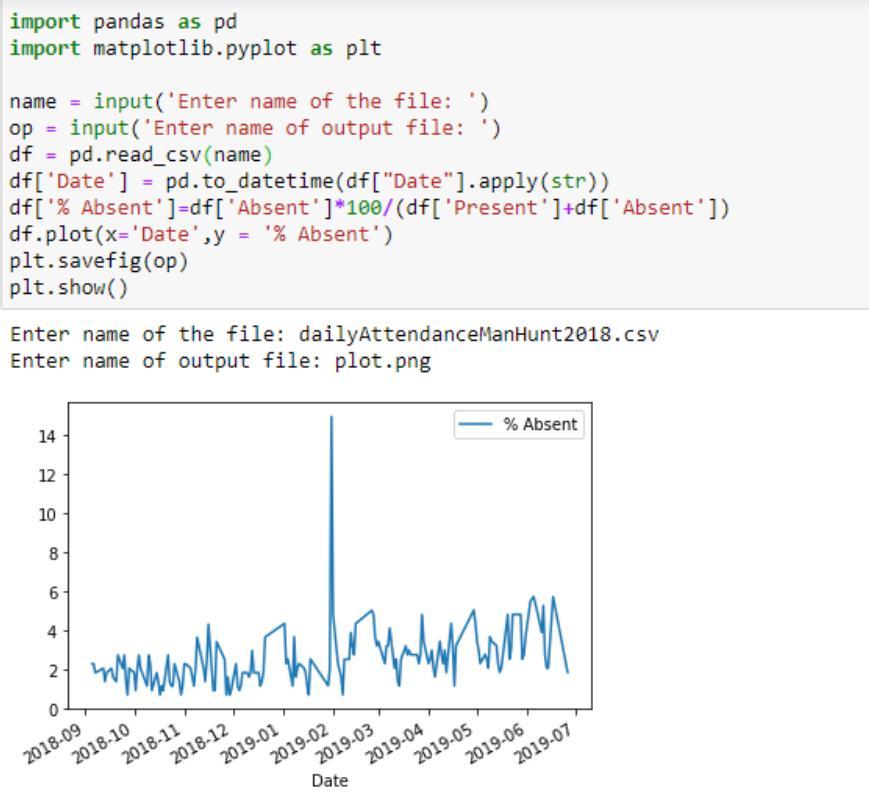
The python code to generate this is quite simple to run.

i hope you understand everything written here, you can as well try out other problems to understand better.

First to begin, we import the package;

Code:

import pandas as pd

import matplotlib.pyplot as plt

name = input('Enter name of the file: ')

op = input('Enter name of output file: ')

df = pd.read_csv(name)

df['Date'] = pd.to_datetime(df["Date"].apply(str))

plt.plot(df['Date'],df['Absent']/(df['Present']+df['Absent']+df['Released']),label="% Absent")

plt.legend(loc="upper right")

plt.xticks(rotation=20)

plt.savefig(op)

plt.show()

This should generate the data(plot) as seen in the uploaded screenshot.

thanks i hope this helps!!!

6 0
2 years ago
A certain full-wave rectifier has a peak output voltage of 30 V. A 50 mF capacitor-input filter is connected to the rectifier. C
Minchanka [31]

Answer:

Peak to peak Ripple voltage 8.33mV

DC output voltage =19.11 V

Explanation:

Peak voltage( Vp)= 30v

Load resistance =600 ohms

Capacitor filter = 50mF

Frequency of supply = 120Hz

The peak to peak Ripple is not only dependent on the capacitor value but also on the frequency and load current.

To calculate the,

Peak to peak ripple = I (load)/f×c

I (load) = loadd current = 30/600 = 0.05 A

Peak to peak ripple = 0.05/6

= 8.33mV

The average Dc output voltage for a full wave rectifier is double that of a half wave rectifier.

The DC output voltage is equal to 0.637Vp assuming no losses.

Vdc= 0.637 × 30

Vdc =19.11V

5 0
2 years ago
A solid steel shaft has to transmit 100 kW at 160 RPM. Taking allowable shear stress at 70 Mpa, find the suitable diameter of th
MA_775_DIABLO [31]

Answer:

The diameter of the shaft is 80.5 mm.

Explanation:

Torsion equation is applied for the diameter of the solid shaft.

Step1

Given:

Power of the shaft is 100 kw.

Revolution per minute is 160 RPM.

Allowable shear stress is 70 Mpa.

Maximum torque is 20% more than the mean torque.  

Step2

Mean torque is calculated as follows:

P=T\omega

P=T(\frac{2\pi N}{60})

100\times 1000=T(\frac{2\pi 160}{60})

T=5968.31 N-m

Step3

Maximum torque is calculated as follows:

T_{max}=(1+\frac{20}{100})T

T_{max}=1.2T

T_{max}=1.2\times 5968.31

T_{max}=7161.97 N-m

Step4

Apply torsional equation for diameter of shaft as follows:

\tau _{max}=\frac{T_{max}}{\frac{\pi d^{3}}{16}}

70\times 10^{6}=\frac{7161.97}{\frac{\pi d^{3}}{16}}

d^{3}=5.211\times 10^{-4}

d=0.0805 m

or,

d=80.5 mm

Thus, the diameter of the shaft is 80.5 mm.

7 0
2 years ago
A 10-ft-long simply supported laminated wood beam consists of eight 1.5-in. by 6-in. planks glued together to form a section 6 i
ruslelena [56]

Answer:

point B where Q_B = 101.25 \ in^3  has the largest Q value at section a–a

Explanation:

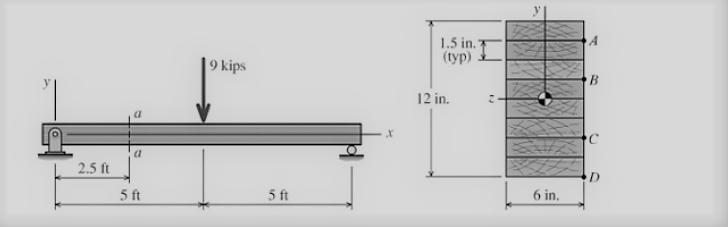
The missing diagram that is suppose to be attached to this question can be found in the attached file below.

So from the given information ;we are to determine the  point that  has the largest Q value at section a–a

In order to do that; we will work hand in hand with the image attached below.

From the image attached ; we will realize that there are 8 blocks aligned on top on another in the R.H.S of the image with the total of 12 in; meaning that each block contains 1.5 in each.

We also have block partitioned into different point segments . i,e A,B,C, D

For point A ;

Let Q be the moment of the Area A;

SO ; Q_A = Area \times y_1

where ;

y_1 = (6 - \dfrac{1.5}{2})

y_1 = (6- 0.75)

y_1 = 5.25 \  in

Q_A =(L \times B)  \times y_1

Q_A =(6 \times 1.5)  \times 5.25

Q_A =47.25 \ in^3

For point B ;

Let Q be the moment of the Area B;

SO ; Q_B = Area \times y_2

where ;

y_2 = (6 - \dfrac{1.5 \times 3}{2})

y_2= (6 - \dfrac{4.5}{2}})

y_2 = (6 -2.25})

y_2 = 3.75 \ in

Q_B =(L \times B)  \times y_1

Q_B=(6 \times 4.5)  \times 3.75

Q_B = 101.25 \ in^3

For point C ;

Let Q be the moment of the Area C;

SO ; Q_C = Area \times y_3

where ;

y_3 = (6 - \dfrac{1.5 \times 2}{2})

y_3 = (6 - 1.5})

y_3= 4.5 \  in

Q_C =(L \times B)  \times y_1

Q_C =(6 \times 3)  \times 4.5

Q_C=81 \ in^3

For point D ;

Let Q be the moment of the Area D;

SO ; Q_D = Area \times y_4

since there is no area about point D

Area = 0

Q_D =0 \times y_4

Q_D = 0

Thus; from the foregoing ; point B where Q_B = 101.25 \ in^3  has the largest Q value at section a–a

3 0
2 years ago
Write multiple if statements: If carYear is before 1968, print "Probably has few safety features." (without quotes). If after 19
Rzqust [24]

Answer:

The solution code is written in Python

  1. if(carYear < 1968):
  2.    print("Probably has few safety features.\n")
  3. if(carYear > 1971):
  4.    print("Probably has head rests\n")
  5. if(carYear > 1991):
  6.    print("Probably has anti-lock brakes.\n")
  7. if(carYear > 2000):
  8.    print("Probably has tire-pressure monitor.\n")

Explanation:

To create if statement, we just use the keyword "if" and joined with an operator either < (before) or > (after). Then we can use the print function to display the message based on the condition that met.

3 0
2 years ago
Other questions:
  • Which of the two materials (brittle vs. ductile) usually obtains the highest ultimate strength and why?
    5·1 answer
  • Oil with a density of 850 kg/m3 and kinematic viscosity of 0.00062 m2 /s is being discharged by a 5 mm diameter, 40 m long horiz
    13·1 answer
  • Air at 40°C flows over a long, 25-mm-diameter cylinder with an embedded electrical heater. In a series of tests, measurements we
    11·1 answer
  • Define a named tuple Player that describes an athlete on a sports team. Include the fields name, number, position, and team.
    15·1 answer
  • Plutonium isotopes undergo decay, producing heat. Plutonium isotope 239 (Pu-239) has 1.9 watts per kilogram [W/kg] of decay heat
    15·1 answer
  • Refrigerant-134a enters a diffuser steadily as saturated vapor at 600 kPa with a velocity of 160 m/s, and it leaves at 700 kPa a
    10·2 answers
  • Question 1 : Replacement [42 Pts] Consider the following page reference string:
    15·2 answers
  • 1. A four-lane freeway (two lanes in each direction) is located on rolling terrain and has 12-ft lanes, no lateral obstructions
    7·1 answer
  • Technician A says the small base circuit of a transistor controls current flow. Technician B says the small emitter circuit cont
    15·1 answer
  • A golfer and her caddy see lightning nearby. the golfer is about to take his shot with a metal club, while her caddy is holding
    12·1 answer
Add answer
Login
Not registered? Fast signup
Signup
Login Signup
Ask question!