answer.
Ask question
Login Signup
Ask question
All categories
  • English
  • Mathematics
  • Social Studies
  • Business
  • History
  • Health
  • Geography
  • Biology
  • Physics
  • Chemistry
  • Computers and Technology
  • Arts
  • World Languages
  • Spanish
  • French
  • German
  • Advanced Placement (AP)
  • SAT
  • Medicine
  • Law
  • Engineering
BARSIC [14]
2 years ago
6

A diameter shaft contains a deep U-shaped groove that has a radius at the bottom of the groove. The maximum shear stress in the

shaft must be limited to . If the shaft rotates at a constant angular speed of , determine the maximum power that may be delivered by the shaft.
Engineering
1 answer:
sergejj [24]2 years ago
8 0

Answer:

hello your question lacks the required figures here is the complete question

A 1.25-in diameter shaft contains a 0.25-in deep U-shaped groove that has a 1/8-in radius at the bottom of the groove. The maximum shear stress in the shaft must be limited to 12000 psi . If the shaft rotates at a constant angular speed of 6Hz , determine the maximum power that may be delivered by the shaft.

Answer: max power delivered by shaft = 4.045 hp

Explanation:

Determine The maximum power that can be delivered by the shaft

using the given data

diameter of shaft ( D ) = 1.25 inches

depth of U-shaped groove = 0.25 inches

radius of U-shaped groove = 1/8 inches = 0.125 inches

maximum shear stress in shaft = 12000 psi

shaft angular speed at frequency of  6 Hz

firstly calculate

The minor diameter (d) = 1.25 - 2(0.25 ) = 0.5 inches

Ratio = radius of groove / minor diameter = 0.125 / 0.75 = 0.167

Ratio, = diameter of shaft / minor diameter = 1.25 / 0.75 = 1.667

k = 1.39 from stress concentration factors graph

calculate the maximum shear stress produced by the torque in the minor diameter of the shaft

<em>Tmax</em> = \frac{Tc}{J}  -----------equation 1

where Tc = 16T

J = \pi d^{3}

equation 1 becomes( Tmax )  =  \frac{16*T}{\pi *0.75^3}

also <em>Tmax</em> = K * <em>Tmin -------- equation 2</em>

<em>      </em> 1.39 * \frac{16*T}{\pi *0.75^3 } \leq  1200

      T ≤ 715.122 Ib-in

      Tmax = 59.593 Ib-ft ( max shear stress )

Finally calculate the max power transmitted by the shaft

P max = 2\pifTmax = 2\pi * 6 * 59.593

therefore Pmax = 2246.6 Ib-ft/s

                           = 4.045 hp

<em />

You might be interested in
Six years ago, an 80-kW diesel electric set cost $160,000. The cost index for this class of equipment six years ago was 187 and
exis [7]

Answer:

new boiler total cost = $229706.825

new boiler total cost = $127512

Explanation:

given data

power p1 = 80 kW

cost C = $160000

cost index CI 1 = 187

cost index CI 2= 194

cost capacity factor f = 0.6

power p2 = 120 kW

current cost = $18000

to find out

total cost and cost of 40 kW

solution

we consider here CN cost for new boiler and CO cost for old boiler

and x is capacity of new boiler

first we find old boiler current cost that is

current cost CO = C × \frac{CI 1 }{CI 2 }   .............1

put here value

current cost = 160000 × \frac{194 }{187 }

new current cost = $165989.304

and

use here power sizing technique for 124 kW

CN/CO = (\frac{p2}{p1} )^{f}    ...............2

put here value and find CN

CN/CO = (\frac{p2}{p1} )^{f}  

CN / 165989.304 = (\frac{120}{80} )^{0.6}  

CN = 211706.825

so new cost = $211706.825

so

total cost for new boiler is

total cost = new cost + current cost

total cost = 211706.825 + 18000

new boiler total cost = $229706.825

and

for 40 kW new cost will be

use equation 2

CN/CO = (\frac{p2}{p1} )^{f}

CN / 165989.304 = (\frac{40}{80} )^{0.6}  

CN = 109512

so new cost is $109512

so

total cost for new boiler is

total cost = new cost + current cost

total cost = 109512 + 18000

new boiler total cost = $127512

7 0
2 years ago
A group of statisticians at a local college has asked you to create a set of functions that compute the median and mode of a set
iVinArrow [24]

Answer:

Functions to create a median and mode of a set of numbers

Explanation:

def median(list):

   if len(list) == 0:

       return 0

   list.sort()

   midIndex = len(list) / 2

   if len(list) % 2 == 1:

       return list[midIndex]

   else:

       return (list[midIndex] + list[midIndex - 1]) / 2

def mean(list):

   if len(list) == 0:

       return 0

   list.sort()

   total = 0

   for number in list:

       total += number

   return total / len(list)

def mode(list):

   numberDictionary = {}

   for digit in list:

       number = numberDictionary.get(digit, None)

       if number == None:

           numberDictionary[digit] = 1

       else:

           numberDictionary[digit] = number + 1

   maxValue = max(numberDictionary.values())

   modeList = []

   for key in numberDictionary:

       if numberDictionary[key] == maxValue:

           modeList.append(key)

   return modeList

def main():

   print "Mean of [1, 2, 3, 4, 5, 6, 7, 8, 9, 10]: ", mean(range(1, 11))

   print "Mode of [1, 1, 1, 1, 4, 4]:", mode([1, 1, 1, 1, 4, 4])

   print "Median of [1, 2, 3, 4]:", median([1, 2, 3, 4])

main()

3 0
2 years ago
Read 2 more answers
A distância entre duas retas reversas é a medida de um segmento orientado que *?
Agata [3.3K]

Answer:

Fatec – SP) Seja A um ponto pertencente à reta r, contida no plano α. É verdade que:

a) existe uma única reta que é perpendicular à reta r no ponto A.

b) existe uma única reta, não contida no plano α, que é paralela à reta r.

c) existem infinitos planos distintos entre si, paralelos ao plano α, que contém a reta r.

d) existem infinitos planos distintos entre si, perpendiculares ao plano α e que contêm a reta r.

e) existem infinitas retas distintas entre si, contidas no plano α e que são paralelas à reta r.

2. (UF – AL) Classifique como verdadeira ou falsa cada uma das afirmativas abaixo.

1) Duas retas que não têm pontos com

8 0
2 years ago
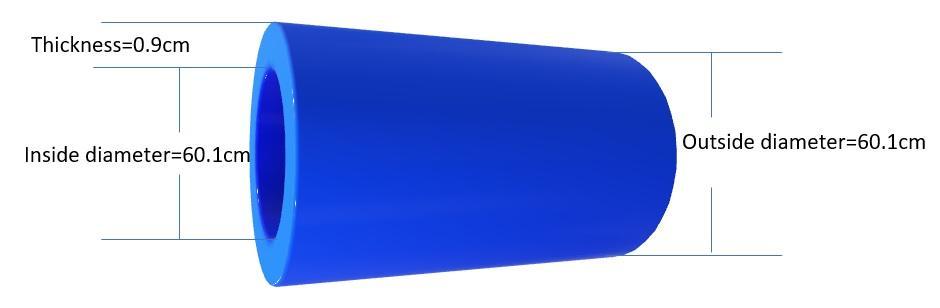
Water is flowing in a metal pipe. The pipe OD (outside diameter) is 61 cm. The pipe length is 120 m. The pipe wall thickness is
Yuki888 [10]

Answer:

1113kN

Explanation:

The ouside diameter OD of the pipe is 61cm and the thickness T is 0.9cm, so the inside diameter ID will be:

Inside Diameter = Outside Diameter - Thickness

Inside Diameter = 61cm - 0.9cm = 60.1cm

Converting this diameter to meters, we have:

60.1cm*\frac{1m}{100cm}=0.601m

This inside diameter is useful to calculate the volume V of water inside the pipe, that is the volume of a cylinder:

V_{water}=\pi  r^{2}h

V_{water}=\pi (\frac{0.601m}{2})^{2}*120m

V_{water}=113.28m^{3}

The problem gives you the water density d as 1.0kg/L, but we need to convert it to proper units, so:

d_{water}=1.0\frac{Kg}{L}*\frac{1L}{1000cm^{3}}*(\frac{100cm}{1m})^{3}

d_{water}=1000\frac{Kg}{m^{3}}

Now, water density is given by the equation d=\frac{m}{V}, where m is the water mass and V is the water volume. Solving the equation for water mass and replacing the values we have:

m_{water}=d_{water}.V_{water}

m_{water}=1000\frac{Kg}{mx^{3}}*113.28m^{3}

m_{water}=113280Kg

With the water mass we can find the weight of water:

w_{water}=m_{water} *g

w_{water}=113280kg*9.8\frac{m}{s^{2}}

w_{water}=1110144N

Finally we find the total weight add up the weight of the water and the weight of the pipe,so:

w_{total}=w_{water}+w_{pipe}

w_{total}=1110144N+2500N

w_{total}=1112644N

Converting this total weight to kN, we have:

1112644N*\frac{0.001kN}{1N}=1113kN

7 0
2 years ago
Oliver is designing a new children’s slide to increase the speed at which a child can descend. His first design involved steel b
AVprozaik [17]

Answer:

The correct option is;

A) Steel becomes too hot in the Sun and can burn the children

Explanation:

The properties of steel includes;

Low specific heat capacity, high thermal and electrical toughness, high hardness, high tensile strength, high yield strength, appreciable elongation, high fatigue strength, can easily corrode, high malleability and ability to creep

Therefore, due to the low specific heat capacity, which is 0.511 J/(g·°C) and high conductivity of steel which is about 32 W/(m·k), the temperature of the steel can rapidly rise and the hot steel surface can readily conduct the heat, (due to the temperature difference) to other bodies that come in contact

8 0
2 years ago
Other questions:
  • Define a function pyramid_volume with parameters base_length, base_width, and pyramid_height, that returns the volume of a pyram
    10·1 answer
  • Steam at 40 bar and 500o C enters the first-stage turbine with a volumetric flow rate of 90 m3 /min. Steam exits the turbine at
    9·1 answer
  • With thermodynamics, one cannot determine ________.
    14·1 answer
  • Argon contained in a closed, rigid tank, initially at 33.7°C, 2.1 bar, and a volume of 4.2 m3, is heated to a final pressure of
    12·1 answer
  • Milton has been tracking the migrating patterns of whales in the northwest Atlantic Ocean for five years. He knows where and whe
    5·2 answers
  • An airplane in level flight at an altitude h and a uniform speed v passes directly over a radar tracking station A. Calculate th
    5·1 answer
  • Complete the following sentence.
    5·1 answer
  • 1. A _____ is applied to a wall or roof rafters to add strength and keep the building straight and plumb.
    9·1 answer
  • A rectangular channel 3.0 m wide has a flow rate of 5.0 m3/s with a normal depth of 0.50 m. The flow then encounters a dam that
    9·1 answer
  • Mr. Ray deposited $200,000 in the Old and Third National Bank. If the bank pays 8% interest, how much will he have in the accoun
    10·2 answers
Add answer
Login
Not registered? Fast signup
Signup
Login Signup
Ask question!