answer.
Ask question
Login Signup
Ask question
All categories
  • English
  • Mathematics
  • Social Studies
  • Business
  • History
  • Health
  • Geography
  • Biology
  • Physics
  • Chemistry
  • Computers and Technology
  • Arts
  • World Languages
  • Spanish
  • French
  • German
  • Advanced Placement (AP)
  • SAT
  • Medicine
  • Law
  • Engineering
Ludmilka [50]
2 years ago
13

Today is your 20th birthday, and your parents just gave you $5,000 that you plan to use to open a stock brokerage account. You p

lan to add $500 to the account each year on your birthday. Your first $500 contribution will come one year from now on your 21st birthday. Your 45th and final $500 contribution will occur on your 65th birthday. You plan to withdraw $5,000 from the account five years from now on your 25th birthday to take a trip to Europe. You also anticipate that you will need to withdraw $10,000 from the account 10 years from now on your 30th birthday to take a trip to Asia. You expect that the account will have an average annual return of 12%. How much money do you anticipate that you will have in the account on your 65th birthday, following your final contribution
Business
1 answer:
Alex Ar [27]2 years ago
5 0

Answer:

You anticipate that you will have $432,522 in the account on your 65th birthday, following your final contribution.


Explanation:

To calculate this, we use the formula for calculating the future value (FV) and FV of ordinary annuity as appropriate as given below:

FVd = D * (1 + r)^n ......................................................................... (1)

FVo = P * {[(1 + r)^n - 1] ÷ r} ...................... (2)

Where,

FVd = Future value of initial deposit or balance amount as the case may be = ?

FVo = FV of ordinary annuity starting from a particular year = ?

D = Initial deposit = $5,000

P = Annual deposit =s $500

r = Average annual return = 12%, or 0.12

n = number years = to be determined as necessary

a) FV in five years from now

n = 5 for FVd

n = 4 for FVo

Substituting the values into equations (1) and (2), we have:

FVd = $5,000 * (1 + 0.12)^5 = $8,812

FVo = $500 * {[(1 + 0.12)^4 - 1] ÷ 0.12} = $2,390

FV5 = Total FV five years from now = $8,812 + $2,390 = $11,201

FVB5 = Balance after $5,000 withdrawal  in year 5 = $11,201 - $5,000 = $6,201.

b) FV in 10 years from now

n = 10 - 5 = 5 for both FVd and FVo

Using equations (1) and (2), we have:

FV of FVB5 = $6,201 * (1 + 0.12)^5 = $10,928

FVo = $500 * {[(1 + 0.12)^5 - 1] ÷ 0.12} = $3,176

FV10 = Total FV 10 years from now = $10,928 + $3,176 = $14,104

FVB10 = Balance after $10,000 withdrawal  in year 10 = $14,104 - $10,000 = $4,104

c) FV in 45 years from now

n = 45 - 10 = 35 for both FVd and FVo

Using equations (1) and (2), we have:

FV of FVB10 = $4,104 * (1 + 0.12)^35 = $216,690

FVo = $500 * {[(1 + 0.12)^35 - 1] ÷ 0.12} = $215,832

FV45 = Total FV 45 years from now = $216,690 + $215,832 = $432,522

Conclusion

Therefore, you anticipate that you will have $432,522 in the account on your 65th birthday, following your final contribution.
You might be interested in
While viewing businesses in terms of customer needs can suggest additional growth opportunities, a ________ definition tends to
Vladimir [108]

Answer:

B) target market

Explanation:

Target market -

It is the group of customers , who are specifically targeted by the company to sell the goods and services , is known as target market .

The company usually directs its attention towards these people , while producing the goods and services .

The target market depends on the income , lifestyle and location of the consumer .

Hence , from the question , the correct term for the given information is target market .

6 0
2 years ago
Cordell Inc. experienced the following events in 2018, its first year of operation:
olga_2 [115]

Answer:

Cordell Inc.

a. Events that result in revenue or expense recognition:

2. Performed services on account for $82,000.

5. Paid $53,000 cash for other operating expenses.

6. Performed services for $19,000 cash.

7. Recognized $3,500 of accrued utilities expense at the end of the year.

b. The amount of net income reported on the 2018 income statement:

$44,500

c. The events that affect the statement of cash flows:

1. Received $40,000 cash from the issue of common stock.

3. Paid a $6,000 cash dividend to the stockholders.

4. Collected $76,000 of the accounts receivable.

5. Paid $53,000 cash for other operating expenses.

6. Performed services for $19,000 cash.

d. The amount of cash flow from operating activities reported on the 2018 statement of cash flows:

$42,000

Explanation:

Data and Calculations:

a) Revenue

Event 2.  $82,000

Event 5.   (53,000)

Event 6.     19,000

Event 7.     (3,500)

b) Net Income $44,500

c) Cash flow from operating activities:

Event 4. Collection from Accounts Receivable $76,000

Event 5. Payment for operating expenses      ($53,000)

Event 6. Cash Receipts for services                  $19,000

d) Net Cash from operating activities               $42,000

6 0
2 years ago
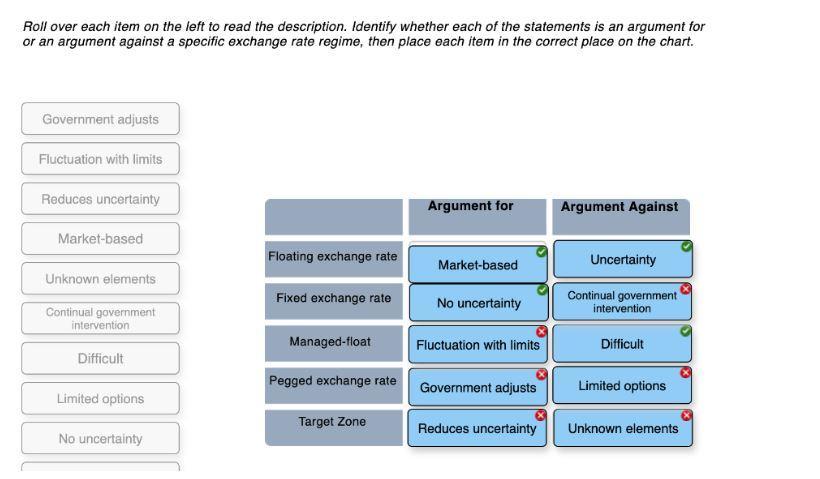
Roll over each item on the left to read the description. Identify whether each of the statements is an argument for or an argume
Naya [18.7K]

Answer:

<u>Floating exchange rate</u>

Here the market decides the value of the currency as it trade freely in the market based on supply and demand.

Argument For;

Market Based - It is market based therefore it reflects the true value of the currency.

Argument Against;

Uncertainty -  As it trades according to the whims of supply and demand, telling which direction it will go in terms of value is a difficult undertaking therefore financial decisions based on such are riskier.

<u>Fixed exchange rate</u>

Here the value of the currency is fixed either to the value of another currency or to the price of gold.

Argument For;

No Uncertainty -  As the currency is tied to another currency which is usually more stable or gold, the rate of the currency is more predictable.

Argument Against;

Unknown Elements

<u>Managed float</u>

In this exchange rate regime, the Central bank of a country intervenes in the Foreign exchange market to push or pull the currency in the direction that it prefers.

Argument For;

Government intervention - The Government Intervention ensures that the currency's value remains stable as well as allowing the Central bank to maintain a good balance of payments.

Argument Against;

Difficult - Maintaining the currency within the band preferred in a difficult undertaking that requires constant intervention in the Forex market.

<u>Pegged exchange rate</u>

The Central bank in this instance pegs the currency to a basket of currencies after setting an exchange rate it would prefer and then intervenes in forex market to keep it that way.

Argument For;

Reduces uncertainty - The movement of the currency is more predictable due to it being pegged to a basket of currencies.

Argument Against;

Continual government intervention - As this requires the currency to remain at a certain value, the government will keep intervening to ensure that it stays at that exact level.

<u>Target zone</u>

Here the Central Bank allows the currency to fluctuate on the market albeit with limits placed on how much it can do so.

Argument For;

Fluctuation with limits - By combining fixed regimes with floating regimes, the currency can maintain a semblance of true value whilst still be less uncertain.

Argument Against;

Limited options.

4 0
2 years ago
Who moved from rural villages into towns, where they specialized in a particular trade and produced superior quality products?
zlopas [31]
<span>This is a phenomenon described by Christian McLean's law as rural flight. Advancement of agricultural equipment have often made farmers to leave smaller villages to bigger towns where there are more better equipped farms and farmers after the end of world War 2 felts the need for specialist services focusing on planting just a particular type of crop and getting better results as old methods were not yielding enough harvest.</span><span />
3 0
2 years ago
Read 2 more answers
Jervis sells $75,000 of its accounts receivable to Northern Bank in order to obtain necessary cash. Northern Bank charges a 5% f
Natasha2012 [34]

Answer:

Debit cash by $71,250, factoring expense by $3,750 and credit account receivable by $75,000.

Explanation:

Step 1 of 2

Calculate the amount of factoring fee.

Factoring fee = 5% ×Account Receivable

=5%×$75,000

=$3,750

​

Step 2 of 2. Journey record. Image attached.

Debit cash by $71,250, factoring expense by $3,750 and credit account receivable by $75,000.

4 0
2 years ago
Other questions:
  • Select the correct answer.
    8·2 answers
  • The following information pertains to Ortiz Company. Assume that all balance sheet amounts represent both average and ending bal
    15·1 answer
  • When the price of erasers increases from $1.50 to $2.50, the quantity demanded of pencils is unchanged. The cross-price elastici
    14·1 answer
  • Marigold Corp. reported the following year-end information: beginning work in process inventory, $90000; cost of goods manufactu
    8·1 answer
  • Assume that Pope Enterprises held a $10,000, 10 percent, six-month note signed by Mary Drew. On December, 1, 2015, the maturity
    8·1 answer
  • Glascro Company manufactures skis. The management accountant wants to calculate the fixed and variable costs associated with the
    15·1 answer
  • The Southern Division manager of Texcaliber Inc. is growing concerned that the division will not be able to meet its current per
    11·1 answer
  • Requirement 2. Discuss some possible causes of the variances you have calculated. Can you make any possible connection between t
    7·1 answer
  • Recher Corporation uses part Q89 in one of its products. The company's Accounting Department reports the following costs of prod
    13·1 answer
  • Perteet Corporation's relevant range of activity is 6,300 units to 12,500 units. When it produces and sells 9,400 units, its ave
    13·1 answer
Add answer
Login
Not registered? Fast signup
Signup
Login Signup
Ask question!