answer.
Ask question
Login Signup
Ask question
All categories
  • English
  • Mathematics
  • Social Studies
  • Business
  • History
  • Health
  • Geography
  • Biology
  • Physics
  • Chemistry
  • Computers and Technology
  • Arts
  • World Languages
  • Spanish
  • French
  • German
  • Advanced Placement (AP)
  • SAT
  • Medicine
  • Law
  • Engineering
Brums [2.3K]
2 years ago
15

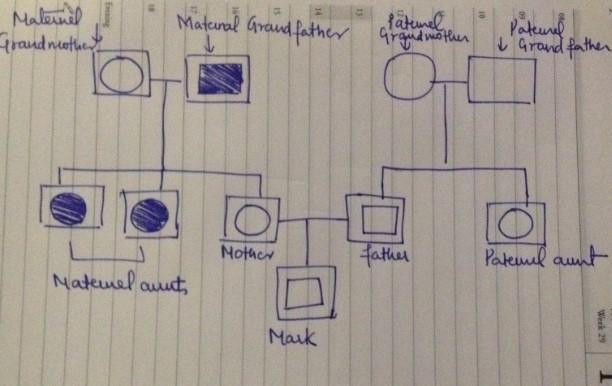
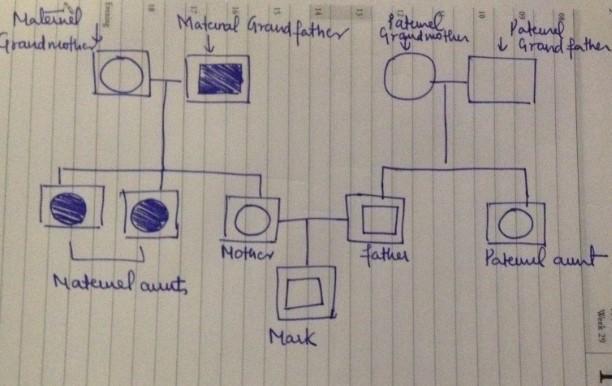
Huntington's disease, which causes degeneration of neurons, runs in Mark's family. Huntington's is a heritable autosomal dominan

t genetic disease, in an autosomal dominant disease, only one abnormal allele is required to cause the disease in offspring. However, it is possible not all offspring will receive the abnormal allele from an affected heterozygous parent.
Family members that have the disease include Mark's maternal grandfather and Mark's maternal aunts. Mark's maternal grandmother does not have the disease.
Because symptoms of Huntington's disease do not appear until later in life, genetic testing is necessary to determine whether a younger individual possesses the allele for the disease. These tests determined that Mark's mother does not carry the allele for Huntington's disease.
Mark's paternal aunt suggested that Mark create a pedigree to track the disease in his family. Use the symbols provided to complete the pedigree. Each symbol may be used more than once.

Biology
1 answer:
Stella [2.4K]2 years ago
3 0

Answer:

As it is given that Mark's paternal grandmother and grandfather does not carry the disease. The symbols on the right side of the Punnett represent Mark's paternal family. If both his paternal grandparents are unaffected then his father and paternal aunt are also not affected by the disease.

His maternal grandfather is affected as mentioned and also his maternal aunts are affected. Mark's mother is unaffected as she does not have the disease-causing alleles determined by genetic testing.

Both of the marks parents are unaffected which indicates that marks also do not carry the allele of the disease.

You might be interested in
Which of the following statements is true regarding the complexity of biological systems
Leto [7]

The correct answer is option B

Biological systems can be defined as the complex system in which the function of a component is dependent on the functioning of the other components. By knowing the function of each component one can get an insight into the structure and organization of the living system. The different components of the biological systems are interconnected and they function accordingly.

7 0
2 years ago
Read 2 more answers
The diagram shows the thermohaline circulation, also know as the ocean's conveyor belt.
DanielleElmas [232]

Answer:

The statement that is true about red currents in the thermohaline circulation is that  water in the red currents contain less salt (option A).

Explanation:

Thermohaline circulation is a concept used in oceanography, referring to the oceanic circulation that depends on factors such as surface heat and salinity, as well as the density gradient that they determine.

On a map, the different currents that are part of the thermohaline circulation are usually represented with blue and red lines, where:

  • <em>The blue lines represent deep, cold, dense and higher salinity currents.</em>
  • <em>The red lines represent surface currents, warm, with less salt content, so they are less dense.</em>

The red currents (see image) represented on the map have less salt content, compared to the currents represented in blue.

Learn more:

Thermohaline circulation brainly.com/question/8369487

4 0
2 years ago
Read 2 more answers
Dr. Kettlewelll predicted that clean forests would have _____________ colored moths, and polluted forests would have _________ c
Mashcka [7]

Answer:

Kettlewell thought that if natural selection caused the change in the moth population, the following must be true: Heavily polluted forests will have mostly dark peppered moths. Clean forests will have mostly light peppered moths. Dark moths resting on light trees are more likely than light moths to be eaten by birds.

4 0
2 years ago
G protein‑coupled receptors (GPCRs) and receptor tyrosine kinases (RTKs) are two basic receptor types by which cells transduce s
elena-s [515]
<h2>GPCRs,RTKs</h2>

Explanation:

G Protein Coupled Receptors(GPCRs) are more common and found in almost all eukaryotes whereas Receptor Tyrosine Kinases(RTKs) are second largest family of receptors that relay signal from cell surface to the interior

  1. G protein coupled receptors(GPCRs) interacts with the ligand activated GPCR and phosphorylates its intracellular domain.This process of phosphorylation can terminate signal or desensitize receptor
  2. Autophosphorylation of receptor can initiate signal in case of Receptor Tyrosine Kinases(RTKs);Autophosphorylation is a feature of RTKs in which receptor dimerization activates intrinsic tyrosine kinase activity by which they phosphorylate its own tyrosine residue on cytosolic phase
  3. Seven transmembrane helices can be seen in case of G protein-coupled receptors(GPCRs);transmembrane protein of it consists of single polypeptide and spans the membrane 7 times
  4. Insulin receptor is a part of Insulin Signalling which comes under RTKs;Insulin receptor always exist in case of dimeric form
  5. Epinephrine receptor is an example of GPCRs;Epinephrine is an endocrine hormones produced in stress condition
  6. Transmembrane protein of GPCR activates G protein,activated G protein binds with effector enzyme and activate it;effector enzyme further can produce or destroy secondary messenger
5 0
2 years ago
please help :) good morning :) For which of these questions could a testable hypothesis be developed? Check all that apply. Do c
Olin [163]

Answer:

peace be upon you dear

Explanation:

The sinus node signals the heart to speed up during exercise or in situations that are stressful, frightening or exciting. For example, a 10- to 15-minute brisk walk typically elevates the heart rate to 110 to 120 beats per minute

8 0
2 years ago
Other questions:
  • Jimmy has always been told that if you have chicken pox once, you will not get the disease again. He had chicken pox when he was
    11·2 answers
  • A average sneeze travels at about 100 miles an hour. Rebecca designs an experiment to increase the speed of sneezes. She subject
    15·2 answers
  • Muscle cells contain numerous __________ to serve their high demand for atp.
    8·1 answer
  • Mario hears his brother open the door, so he turns toward the door to say hello. Which best describes the signals moving through
    10·2 answers
  • Matt suffered slight burns in an accident. When the skin burns, it loses some of its functions. First-degree burns affect the to
    14·2 answers
  • How does the hydroelectric dam pictured here impact the environment?
    5·2 answers
  • Bilateral symmetry in the animal kingdom is best correlated with
    11·1 answer
  • People utilize plants to meet many everyday needs, including food, fiber, and building materials. However, not many of the over
    11·1 answer
  • Snakes, dogs, and humans have a vertebral column. Snakes and dogs have tails, and humans have vestigial tailbones. Dogs and huma
    10·1 answer
  • 3. From problem 2, suppose another boy, Boy C pulls the heavy cabinet with 5 N
    11·1 answer
Add answer
Login
Not registered? Fast signup
Signup
Login Signup
Ask question!