answer.
Ask question
Login Signup
Ask question
All categories
  • English
  • Mathematics
  • Social Studies
  • Business
  • History
  • Health
  • Geography
  • Biology
  • Physics
  • Chemistry
  • Computers and Technology
  • Arts
  • World Languages
  • Spanish
  • French
  • German
  • Advanced Placement (AP)
  • SAT
  • Medicine
  • Law
  • Engineering
mina [271]
2 years ago
4

A simple ideal Rankine cycle which uses water as the working fluid operates its condenser at 408C and its boiler at 3008C. Calcu

late the work produced by the turbine, the heat supplied in the boiler, and the thermal efficiency of this cycle when the steam enters the turbine without any superheating
Engineering
1 answer:
Morgarella [4.7K]2 years ago
8 0

Answer:

871.8008 KJ/kg

2573.42085 KJ/kg

0.3743

Explanation:

Solution:-

- We are to analyze an ideal Rankine cycle, where the condenser and boiler operating temperatures are defined.

- We start of by evaluating the properties of water at each state before and after the process.

State 1: Condenser Exit / Pump Inlet

           T1 = 40°C   ---> P1,sat = 7.3851 KPa , v1 = vf = 0.001008 m^3/kg

            sat liquid         h1 = hf = 167.53 KJ/kg , s1 = sf = 0.5724 KJ/kg.K

            P1 = condenser pressure

State 2: Pump Exit / Boiler Inlet

           P2 = P3 = Psat,300°C = 8587.9 KPa


Process 1: " Isentropic Compression - constant volume "

The work done by pump in the compression process is:

          wp = v1* ( P2 - P1 )

          wp = ( 0.001008 ) * ( 8587.9 - 7.3851 )

          wp = 8.64915 KJ /kg

Determine the enthalpy at " State 2 " by energy balance on pump ( control  Volume) :

          h2 = h1 + wp

          h2 = 167.53 + 8.64915

          h2 = 176.17915 KJ/kg

State 3: Boiler Exit / Turbine Inlet

          T1 = 300°C   ---> P3,sat = 8587.9 KPa

           sat vapor         h3 = hg =  2749.6 KJ/kg , s3 = sg =  5.7059 KJ/kg.K

           P3 = Boiler pressure

Process 2: " Heat Addition - constant pressure "

The heat supplied in the boiler is:

          qb = h3 - h2

          qp = ( 2749.6 - 176.17915 )

          qb = 2573.42085 KJ /kg    .... Answer ( b )

State 4: Turbine Exit / Condenser Inlet ( Isentropic )

          P4 = P1 = 7.3851 KPa         ..... sfg = 7.685 KJ/kg.K

          s4 = s3 = 5.7059 KJ/kg.K       sf = 0.5716994 KJ/kg.K

                                                           hf = 170.32524 KJ/kg

                                                          hfg = 2406.11 KJ/kg

Process 3: Isentropic Expansion - Determine the quality of liquid-vapor mixture phase ( x ) at state (4):


          x = (s4 - sf) / sfg

          x = (5.7059 - 0.5716994) / 7.685

          x = 0.66808

          h4 = hf + x*hfg

          h4 = 170.32524 + 0.66808*2406.11

          h4 = 1777.79920 KJ/kg

- The work-done by the turbine in the isentropic expansion process ( wt ) is:

          wt = h3 - h4

          wt = 2749.6 - 1777.7992

          wt = 971.8008 KJ/kg   ... Answer ( a )

- To determine the thermal efficiency ( nth ) of the rankine cycle. We need to determined the net work produced by the cycle ( wn ). The net work is the energy balance between the isentropic compression ( work done - pump ) and isentropic expansion ( work produced - turbine ):

          wn = wt - wp

          wn = 971.8008 - 8.64915

          wn = 963.15165 KJ/kg

- The thermal efficiency of a power cycle is the ratio of net work-produced ( wn ) and the heat supplied to the working fluid in the boiler ( qb ) as follows:

         nth = wn / qb

         nth = 963.15165 / 2573.42085

         nth = 0.3743    ..... Answer ( c )

You might be interested in
Let Deterministic Quicksort be the non-randomized Quicksort which takes the first element as a pivot, using the partition routin
juin [17]

Answer:

Answer for the question:

Let Deterministic Quicksort be the non-randomized Quicksort which takes the first element as a pivot, using the partition routine that we covered in class on the quicksort slides. Consider another almost-best case for quicksort, in which the pivot always splits the arrays 1/3: 2/3, i.e., one third is on the left, and two thirds are on the right, for all recursive calls of Deterministic Quicksort. (a) Give the runtime recurrence for this almost-best case. (b) Use the recursion tree to argue why the runtime recurrence solves to Theta (n log n). You do not need to do big-Oh induction. (c) Give a sequence of 4 distinct numbers and a sequence of 13 distinct numbers that cause this almost-best case behavior. (Assume that for 4 numbers the array is split into 1 element on the left side, the pivot, and two elements on the right side. Similarly, for 13 numbers it is split with 4 elements on the left, the pivot, and 8 elements on the right side.)

is given in the attachment.

Explanation:

Download pdf
3 0
2 years ago
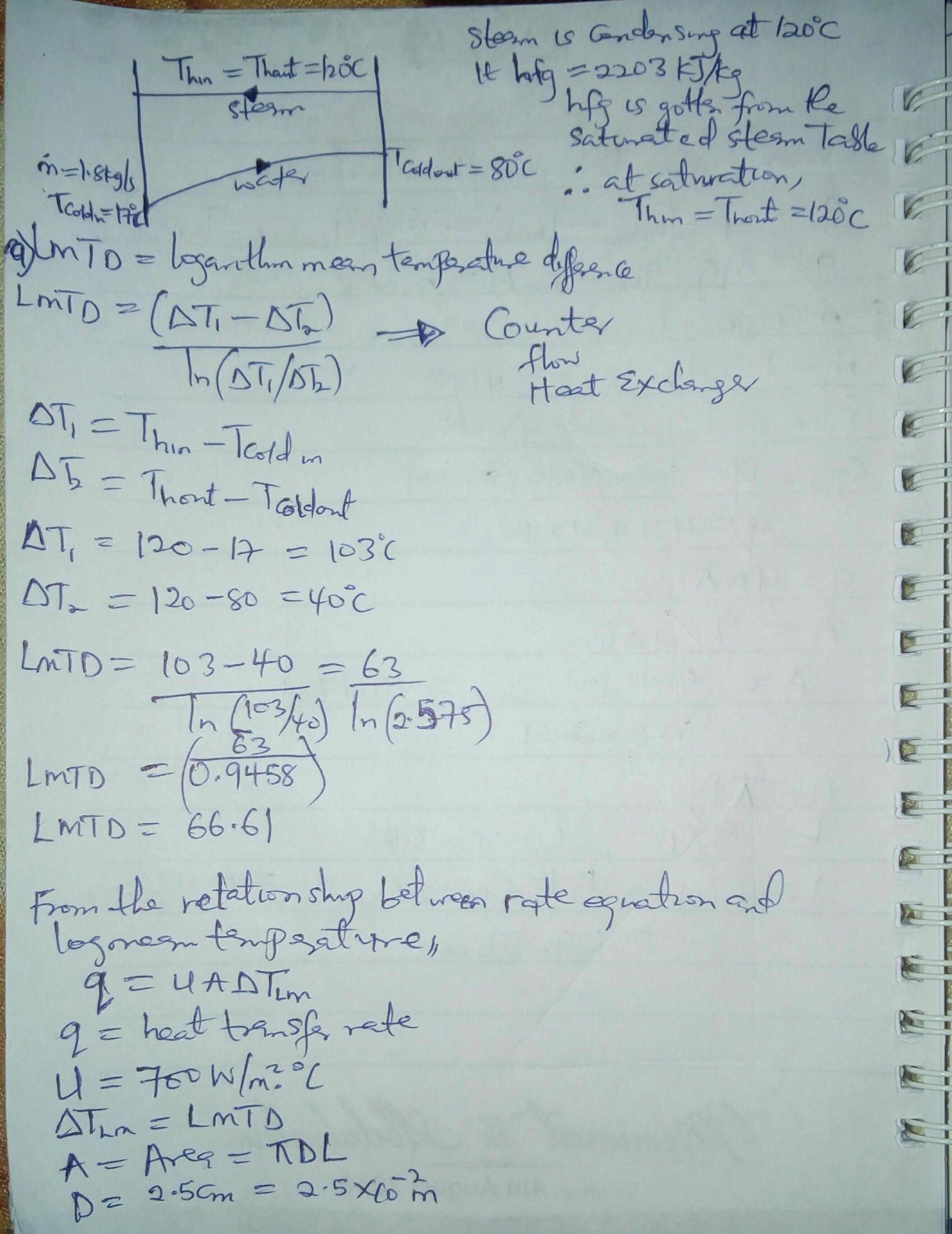
Water (cp = 4180 J/kg·°C) enters the 2.5 cm internal diameter tube of a double-pipe counter-flow heat exchanger at 17°C at a rat
aksik [14]

Answer:

Length = 129.55m, 129.55m

Explanation:

Given:

cp of water = 4180 J/kg·°C

Diameter, D = 2.5 cm

Temperature of water in =  17°C

Temperature of water out = 80°C

mass rate of water =1.8 kg/s.

Steam condensing at 120°C

Temperature at saturation = 120°C

hfg of steam at 120°C = 2203 kJ/kg

overall heat transfer coefficient of the heat exchanger = 700 W/m2 ·°C

U = 700 W/m2 ·°C

Since Temperature of steam is at saturation,

temperature of steam going in = temperature of steam out = 120°C

Energy balance:

Heat gained by water = Heat loss by steam

Let specific capacity of steam = 2010kJ/Kg .°C

Find attached the full solution to the question.

3 0
2 years ago
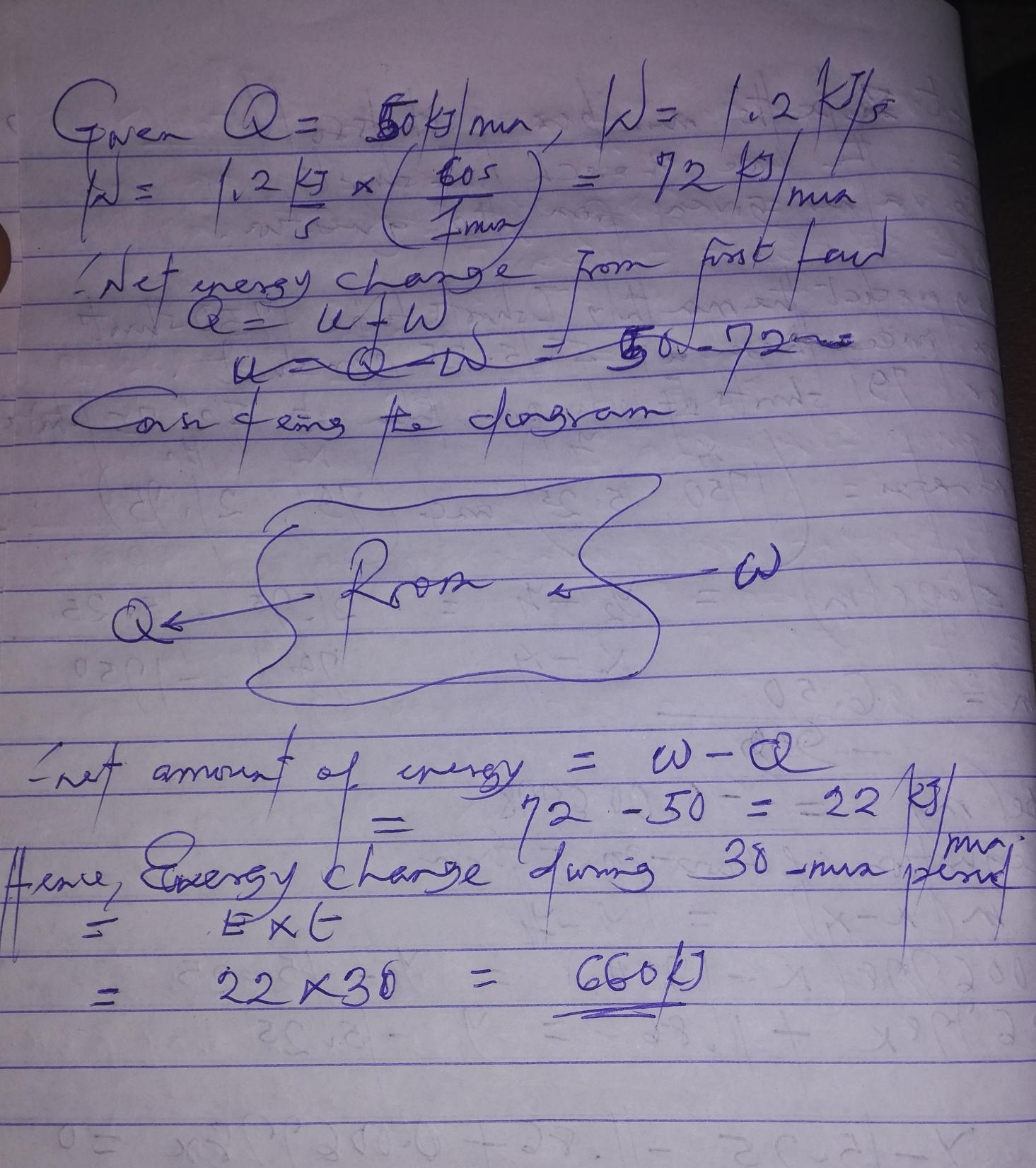
The air contained in a room loses heat to the surroundings at a rate of 50 kJ/min while work is supplied to the room by computer
Artemon [7]

Answer:

net amount of energy change of the air in the room during a 30-min period = 660KJ

Explanation:

The detailed calculation is as shown in the attached file.

4 0
2 years ago
Read 2 more answers
If water molecules pass through a membrane with a steady state flux of 220 mole/(m2 day), how long will it take, in hours, for 0
goblinko [34]

Answer:

<em>0.0386 hr</em>

<em></em>

Explanation:

Area = 565 cm^2 = 0.0565 m^2  (1 cm^2 = 0.0001 m^2)

flux state rate = 220 mole/m^2-day

<em>There are 24 hrs in a day,</em> therefore rate in hrs will be

220/24 = 9.17 mole/m^2-hr

mass of water = 0.4 kg

molar mass of water = (1 x 2) + 16 = 18 kg/mole

therefore,

<em>mole of water = mass of water/molar mass of water</em>

mole of water = 0.4/18 = 0.02 mole

<em>mole flux = mole/area</em> = 0.02/0.0565 = 0.354 mol/m^2

<em>time that will be taken will be for water to pass = mole flux/mole flux rate</em>

time = 0.354/9.17 = <em>0.0386 hr</em>

7 0
2 years ago
Bananas are to be cooled from 28°C to 12°C at a rate of 1140 kg/h by a refrigerator that operates on a vapor-compression refrige
Lera25 [3.4K]

Answer:

A) COP = \frac{16.97}{9.8} = 1.731

B) P_{IN} = 0.4763

C) Second law efficiency 4.85%

exergy destruction for the cycle = 9.3237 kW

Explanation:

Given data:

T_1 = 28 degree celcius

T_2 = 12 degree celcius

\dot m = 1140 kg/h

Power to refrigerator = 9.8 kW

Cp = 3.35 kJ/kg degree C

A) Q = \dot m Cp \Delta T

        = 1140 \times 3.35\times (28-12) = 61,104 kJ/h

Q_{abs} = 61,104 kJ/h = 16.97 kJ/sec

COP = \frac{16.97}{9.8} = 1.731

b)

COP ∝ \frac{1}{P_{in}}

P_{in} wil be max when COP maximum

taking surrounding temperature T_H = 20 degree celcius

COP_{max} = \frac{T_L}{T_H- T_L} = \frac{285}{293 - 285} = 35.625

we know that

COP = \frac{heat\ obsorbed}{P_{in}}

P_{IN} = \frac{16.97}{35.62} = 0.4763

c) second law efficiency

\eta_{11} = \frac{COP_R}{(COP)_max} = \frac{1.731}{35.625} = 4.85\%

exergy destruction os given as X = W_{IN} - X_{Q2}

                                                         = 9.8 - 0.473 = 9.3237 kW

8 0
2 years ago
Other questions:
  • The wall of drying oven is constructed by sandwiching insulation material of thermal conductivity k = 0.05 W/m°K between thin me
    8·1 answer
  • An optical mouse originally cost $31.85. Before it was removed from the store, it underwent the following changes in price. 27%
    8·2 answers
  • If the electric field just outside a thin conducting sheet is equal to 1.5 N/C, determine the surface charge density on the cond
    9·1 answer
  • Define a function pyramid_volume with parameters base_length, base_width, and pyramid_height, that returns the volume of a pyram
    10·1 answer
  • An art collector is bidding on a statue that would complete a collection he is trying to assemble. The statue is being sold in a
    9·1 answer
  • 4-6. A vertical cylindrical storage vessel is 10 m high and 2 m in diameter. The vessel contains liquid cyclohexane currently at
    10·1 answer
  • 6.8.1: Function pass by pointer: Transforming coordinates. Define a function CoordTransform() that transforms its first two inpu
    9·1 answer
  • A pipe is insulated such that the outer radius of the insulation is less than the critical radius. Now the insulation is taken o
    11·1 answer
  • Five Kilograms of continuous boron fibers are introduced in a unidirectional orientation into of an 8kg aluminum matrix. Calcula
    9·1 answer
  • Q10. Select the correct option for the following questions – (10 points, 2 each) a. After an edge dislocation has passed through
    15·1 answer
Add answer
Login
Not registered? Fast signup
Signup
Login Signup
Ask question!