answer.
Ask question
Login Signup
Ask question
All categories
  • English
  • Mathematics
  • Social Studies
  • Business
  • History
  • Health
  • Geography
  • Biology
  • Physics
  • Chemistry
  • Computers and Technology
  • Arts
  • World Languages
  • Spanish
  • French
  • German
  • Advanced Placement (AP)
  • SAT
  • Medicine
  • Law
  • Engineering
svet-max [94.6K]
2 years ago
10

Liquidated damages are intended to represent anticipated losses to the owner based upon circumstances existing at the time the c

ontract was made. List at least five types of potential losses to the owner that would qualify for determination of such potential losses.
Engineering
1 answer:
Ganezh [65]2 years ago
4 0

Answer:

1. Loss of income.

2. Rental costs.

3. Utility bills.

4. Loss of rent.

5. Storage costs.

Explanation:

Liquidated damages can be defined as pre-determined damages or clauses that are highlighted or indicated at the time of entering into a contract between a contractor and a client which is mainly based on evaluation of the actual loss the client may incur should the contractor fail to meet the agreed completion date.

Generally, liquidated damages are meant to be fair rather than being a penalty or punitive to the defaulter. It is usually calculated on a daily basis for the loss.

When entering into a contract with another, liquidated damages are intended to represent anticipated losses to the owner based upon circumstances existing at the time the contract was made.

Listed below are five (5) types of potential losses to the owner that would qualify for determination of such potential losses;

1. Loss of income.

2. Rental costs.

3. Utility bills.

4. Loss of rent.

5. Storage costs.

You might be interested in
Annealing is a process by which steel is reheated and then cooled to make it less brittle. Consider the reheat stage for a 100-m
kodGreya [7K]

Complete question is;

Annealing is a process by which steel is reheated and then cooled to make it less brittle. Consider the reheat stage for a 100 mm thick plate (ρ = 7830 kg/m3, Cp = 550 J/kg K, k = 48 W/m K). The plate initially is at 200 °C and is to be heated to a minimum temperature of 550 °C. Heating is effected in a gas-fired furnace where the products of combustion at T∞ = 800 °C maintain a convection heat transfer coefficient of h = 250 W/m.K on both surfaces of the plate. How long should the plate be left in the furnace?

Answer:

860 seconds

Explanation:

We are given;

Initial Temperature; Ti = 200 °C

Minimum Temperature; T_i = 550 °C

T∞ = 800 °C

convection coefficient; h = 250 W/m².K

ρ = 7830 kg/m³

Cp = 550 J/kg K

k = 48 W/m K

Plate thickness = 100mm

Thus,L = 100/2 = 50mm = 0.05 m

Let's find the biot number from the formula;

Bi = hL/K

Bi = (250 × 0.05)/48

Bi = 0.2604

Now, lowest temperature in the slab is given as;

θ_o = (T_o - T∞)/(T_i - T∞)

θ_o = (550 - 800)/(200 - 800)

θ_o = 0.4167

Now, from online tables calculation, we can find the root of the biot number.

Thus, root of the biot number Bi = 0.2604 is;

ζ1 = 0.488 rad

Also, C1 is gotten as 1.0396

Now,formula for thermal diffusivity is;

α = k/ρc

α = 48/(7830 × 550)

α = 1.115 × 10^(-5) m²/s

Also, from online tables, f(ζ1) = 0.401

Thus, we can find the time the plate should the plate be left in the furnace from;

-(ζ1)²(αt/L²) = In 0.401

-(ζ1)²(αt/L²) = -0.9138

t = (-0.9138 × 0.05²)/-(0.488² × 1.115 × 10^(-5))

t ≈ 860 s

8 0
2 years ago
Poles are values of Laplace transform variable, s, that make denominator of transfer function zero. Zeros are values of Laplace
Ostrovityanka [42]

Answer:

Zero 1 = -1

Zero 2 = -3

Pole 1 = 0

Pole 2 = -2

Pole 3 = -4

Pole 4 = -6

Gain = 4

Explanation:

For any given transfer function, the general form is given as

T.F = k [N(s)] ÷ [D(s)]

where k = gain of the transfer function

N(s) is the numerator polynomial of the transfer function whose roots are the zeros of the transfer function.

D(s) is the denominator polynomial of the transfer function whose roots are the poles of the transfer function.

k [N(s)] = 4s² + 16s + 12 = 4[s² + 4s + 3]

it is evident that

Gain = k = 4

N(s) = (s² + 4s + 3) = (s² + s + 3s + 3)

= s(s + 1) + 3 (s + 1) = (s + 1)(s + 3)

The zeros are -1 and -3

D(s) = s⁴ + 12s³ + 44s² + 48s

= s(s³ + 12s² + 44s + 48)

= s(s + 2)(s + 4)(s + 6)

The roots are then, 0, -2, -4 and -6.

Hope this Helps!!!

3 0
2 years ago
Oliver is designing a new children’s slide to increase the speed at which a child can descend. His first design involved steel b
AVprozaik [17]

Answer:

The correct option is;

A) Steel becomes too hot in the Sun and can burn the children

Explanation:

The properties of steel includes;

Low specific heat capacity, high thermal and electrical toughness, high hardness, high tensile strength, high yield strength, appreciable elongation, high fatigue strength, can easily corrode, high malleability and ability to creep

Therefore, due to the low specific heat capacity, which is 0.511 J/(g·°C) and high conductivity of steel which is about 32 W/(m·k), the temperature of the steel can rapidly rise and the hot steel surface can readily conduct the heat, (due to the temperature difference) to other bodies that come in contact

8 0
2 years ago
The 30-kg gear is subjected to a force of P=(20t)N where t is in seconds. Determine the angular velocity of the gear at t=4s sta
tatyana61 [14]

Answer:

\omega =\frac{24}{1.14375}=20.983\frac{rad}{s}

Explanation:

Previous concepts

Angular momentum. If we consider a particle of mass m, with velocity v, moving under the influence of a force F. The angular  momentum about point O is defined as the “moment” of the particle’s linear momentum, L, about O. And the correct formula is:

H_o =r x mv=rxL

Applying Newton’s second law to the right hand side of the above equation, we have that r ×ma = r ×F =

MO, where MO is the moment of the force F about point O. The equation expressing the rate of change  of angular momentum is this one:

MO = H˙ O

Principle of Angular Impulse and Momentum

The equation MO = H˙ O gives us the instantaneous relation between the moment and the time rate of change of angular  momentum. Imagine now that the force considered acts on a particle between time t1 and time t2. The equation MO = H˙ O can then be integrated in time to obtain this:

\int_{t_1}^{t_2}M_O dt = \int_{t_1}^{t_2}H_O dt=H_0t2 -H_0t1

Solution to the problem

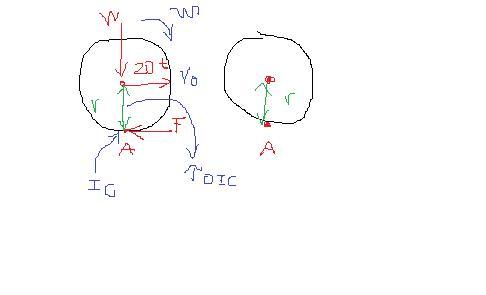
For this case we can use the principle of angular impulse and momentum that states "The mass moment of inertia of a gear about its mass center is I_o =mK^2_o =30kg(0.125m)^2 =0.46875 kgm^2".

If we analyze the staritning point we see that the initial velocity can be founded like this:

v_o =\omega r_{OIC}=\omega (0.15m)

And if we look the figure attached we can use the point A as a reference to calculate the angular impulse and momentum equation, like this:

H_Ai +\sum \int_{t_i}^{t_f} M_A dt =H_Af

0+\sum \int_{0}^{4} 20t (0.15m) dt =0.46875 \omega + 30kg[\omega(0.15m)](0.15m)

And if we integrate the left part and we simplify the right part we have

1.5(4^2)-1.5(0^2) = 0.46875\omega +0.675\omega=1.14375\omega

And if we solve for \omega we got:

\omega =\frac{24}{1.14375}=20.983\frac{rad}{s}

8 0
2 years ago
Write a function: def solution (S) that, given a string S of letters "L" and "R", denoting the types of shoes in line (left or r
denpristay [2]

Answer:

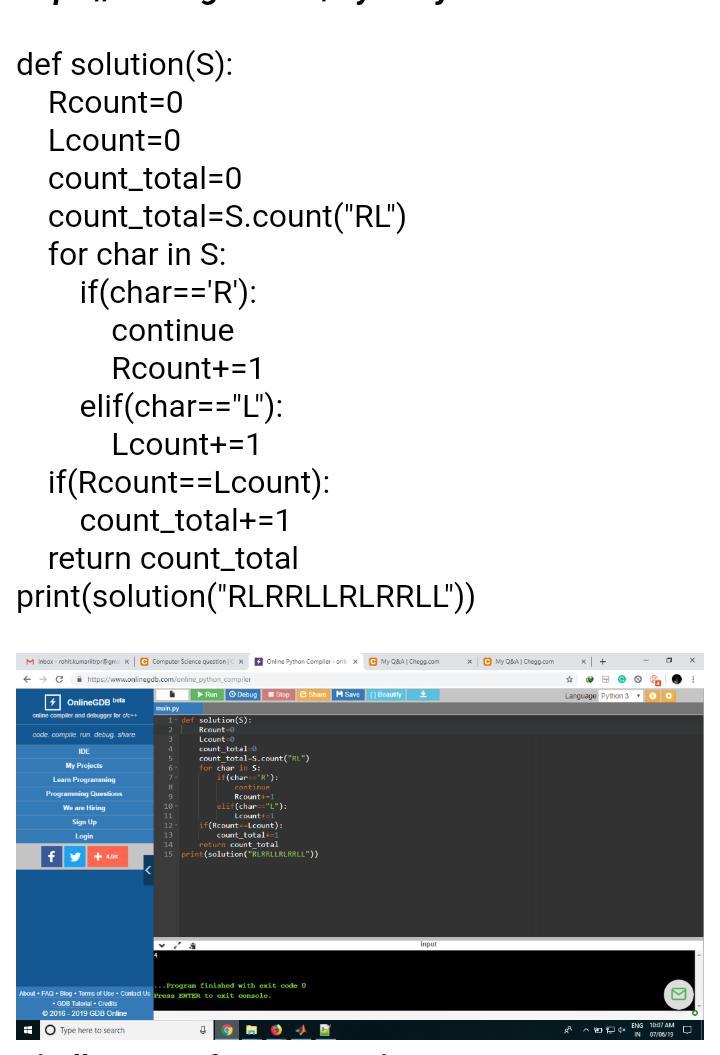
Please look at attachment. Thanks

3 0
2 years ago
Read 3 more answers
Other questions:
  • What can your employer do to protect you from overhead power lines?
    8·1 answer
  • Steam flows at steady state through a converging, insulated nozzle, 25 cm long and with an inlet diameter of 5 cm. At the nozzle
    11·1 answer
  • Let Deterministic Quicksort be the non-randomized Quicksort which takes the first element as a pivot, using the partition routin
    13·1 answer
  • Flow and Pressure Drop of Gases in Packed Bed. Air at 394.3 K flows through a packed bed of cylinders having a diameter of 0.012
    8·1 answer
  • A 5-cm-diameter shaft rotates at 4500 rpm in a 15-cmlong, 8-cm-outer-diameter cast iron bearing (k = 70 W/m·K) with a uniform cl
    10·1 answer
  • A thin-walled tube with a diameter of 6 mm and length of 20 m is used to carry exhaust gas from a smoke stack to the laboratory
    7·1 answer
  • An inventor claims to have developed an engine that does not use fuel but operates as a power cycle at steady state while receiv
    10·2 answers
  • Refrigerant-134a is compressed from 2 bar, saturated vapor, to 10 bar, 90o C in a compressor operating at steady state. The mass
    11·1 answer
  • An equation used to evaluate vacuum filtration is Q = ΔpA2 α(VRw + ARf) , Where Q ≐ L3/T is the filtrate volume flow rate, Δp ≐
    13·1 answer
  • A rectangular channel 3.0 m wide has a flow rate of 5.0 m3/s with a normal depth of 0.50 m. The flow then encounters a dam that
    9·1 answer
Add answer
Login
Not registered? Fast signup
Signup
Login Signup
Ask question!