answer.
Ask question
Login Signup
Ask question
All categories
  • English
  • Mathematics
  • Social Studies
  • Business
  • History
  • Health
  • Geography
  • Biology
  • Physics
  • Chemistry
  • Computers and Technology
  • Arts
  • World Languages
  • Spanish
  • French
  • German
  • Advanced Placement (AP)
  • SAT
  • Medicine
  • Law
  • Engineering
motikmotik
2 years ago
15

A generator operating at 50 Hz delivers 1 pu power to an infinite bus through a transmission circuit in which resistance is igno

red. A fault takes place reducing the maximum power transferable to 0.5 pu whereas before the fault, this power was 2.0 pu and after the clearance of the fault, it is 1.5 pu. Using equal area criterion, determine the critical clearing angle.

Engineering
1 answer:
olga55 [171]2 years ago
3 0

Answer:

critical clearing angle = 70.3°

Explanation:

Generator operating at = 50 Hz

power delivered = 1 pu

power transferable when there is a fault = 0.5 pu

power transferable before there is a fault = 2.0 pu

power transferable after fault clearance = 1.5 pu

using equal area criterion to determine the critical clearing angle

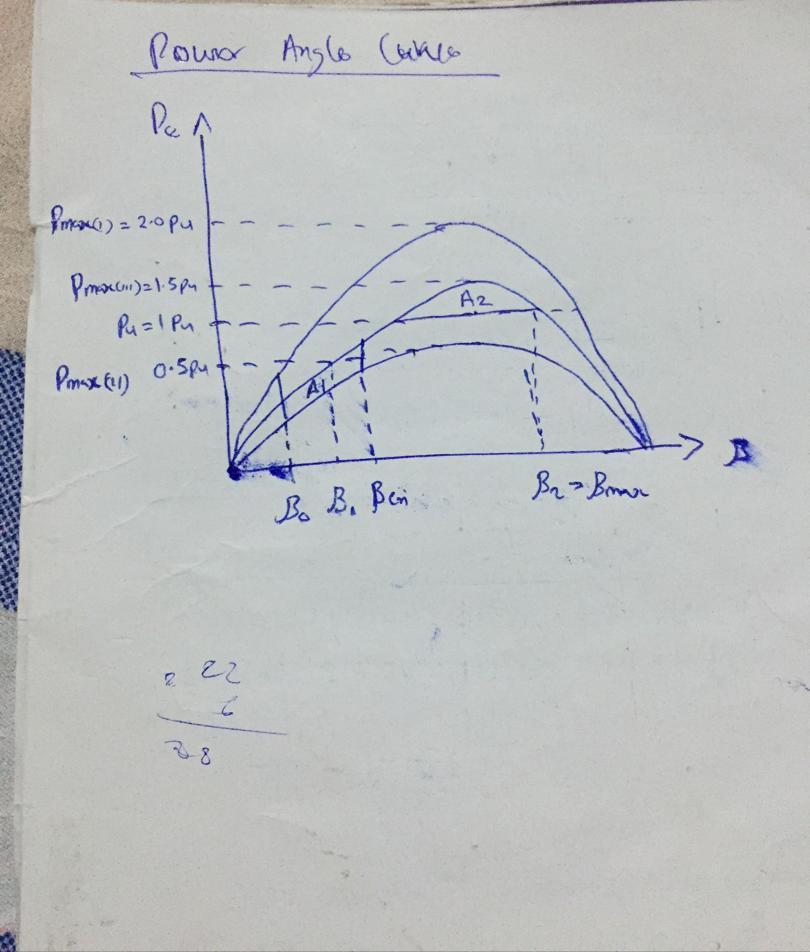
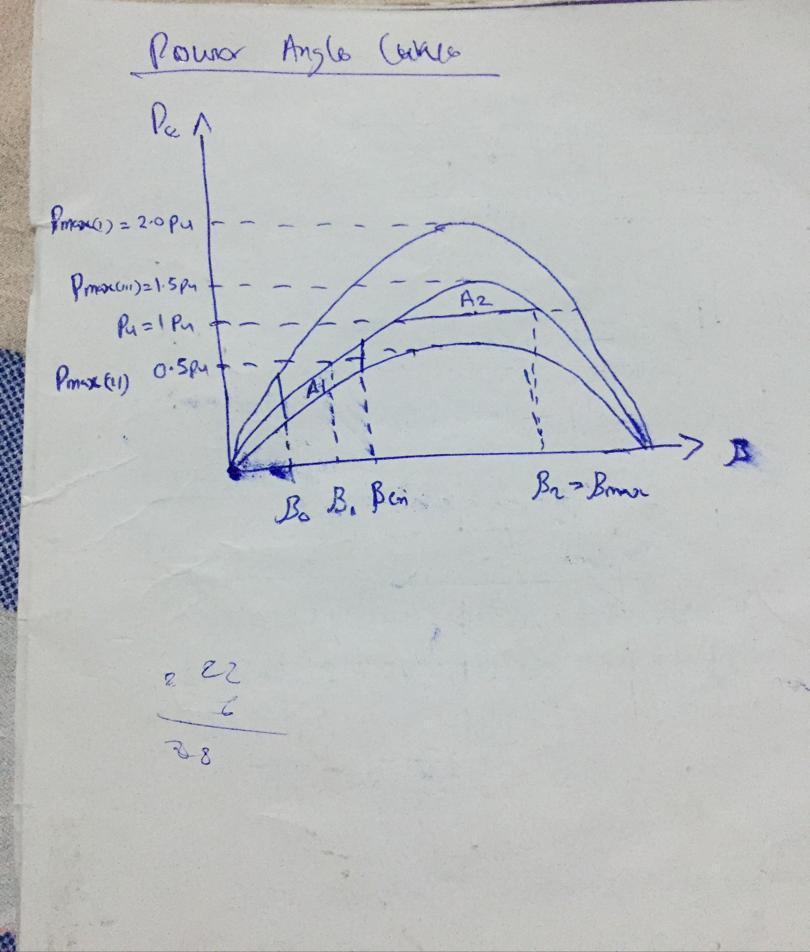
Attached is the power angle curve diagram and the remaining part of the solution.

The power angle curve is given as

= Pmax sinβ

therefore :  2sinβo = Pm

                   2sinβo = 1

                   sinβo = 0.5 pu

                   βo = sin^{-1} (0.5) = 30⁰

also ;   1.5sinβ1 = 1

               sinβ1 = 1/1.5

               β1 = sin^{-1} (\frac{1}{1.5} ) = 41.81⁰

∴ βmax = 180 - 41.81  = 138.19⁰

attached is the remaining solution

The critical clearing angle = cos^{-1} 0.3372  ≈ 70.3⁰

You might be interested in
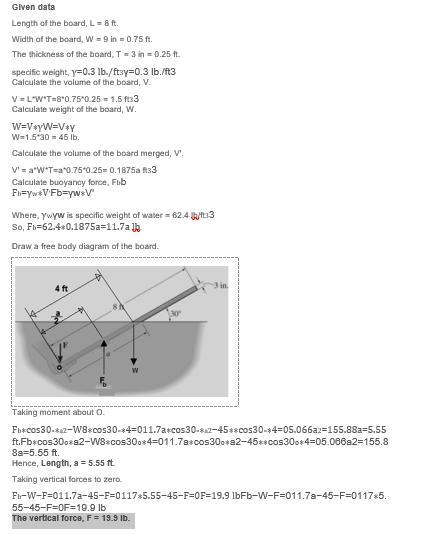
The uniform 8–ft board is pushed down into the water so it makes an angle of θ = 30o with the water surface. If the cross sectio
lana66690 [7]

Answer:

The vertical force, F = 19.9 lb.

Explanation:

3 0
2 years ago
) A shaft encoder is to be used with a 50 mm radius tracking wheel to monitor linear displacement. If the encoder produces 256 p
andrey2020 [161]

Answer:

number of pulses produced =  162 pulses

Explanation:

give data

radius = 50 mm

encoder produces = 256 pulses per revolution

linear displacement = 200 mm

solution

first we consider here roll shaft encoder on the flat surface without any slipping

we get here now circumference that is

circumference = 2 π r .........1

circumference = 2 × π × 50

circumference = 314.16 mm

so now we get number of pulses produced

number of pulses produced = \frac{linear\ displacement}{circumference} × No of pulses per revolution .................2

number of pulses produced = \frac{200}{314.16} × 256

number of pulses produced =  162 pulses

5 0
2 years ago
A spring-loaded toy gun is used to shoot a ball of mass m = 1.50 kg straight up in the air. The spring has spring constant k = 6
adell [148]

Answer:

1) a) Mechanical energy is conserved because no dissipative forces perform work on the ball.

2) The muzzle velocity of the ball is approximately 5.272 meters per second.

3) The maximum height of the ball is 1.417 meters.

Explanation:

1) Which of the following statements are true?

a) Mechanical energy is conserved because no dissipative forces perform work on the ball.

True, statement indicates that there is no air resistence and no friction between ball and the inside of the gun because the first never touches the latter one.

b) The forces of gravity and the spring have potential energies associated with them.

False, force of gravity do work on the ball and spring receives a potential energy at being deformated by the ball.

c) No conservative forces act in this problem after the ball is released from the spring gun.

False, the absence of no conservative forces is guaranteed for the entire system according to the statement of the problem.

2) According to the statement, we understand that spring is deformed and once released and just after reaching its equilibrium position, the muzzle velocity is reached. As spring deformation is too small in comparison with height, we can neglect changes in gravitational potential energy. By Principle of Energy Conservation, we describe the motion of the ball by the following expression:

U_{k, 1}+K_{1}=U_{k,2}+K_{2} (Eq. 1)

Where:

U_{k,1}, U_{k,2} - Initial and final elastic potential energies of spring, measured in joules.

K_{1}, K_{2} - Initial and final translational kinetic energies of the ball, measured in joules.

After using definitions of elastic potential and translational kinetic energies, we expand the equation above as:

\frac{1}{2}\cdot m\cdot (v_{2}^{2}-v_{1}^{2}) = \frac{1}{2}\cdot k\cdot (x_{1}^{2}-x_{2}^{2})

And the final velocity is cleared:

m\cdot (v_{2}^{2}-v_{1}^{2}) = k\cdot (x_{1}^{2}-x_{2}^{2})

v_{2}^{2}-v_{1}^{2} =\frac{k}{m}\cdot (x_{1}^{2}-x_{2}^{2})

v_{2}^{2} =v_{1}^{2}+\frac{k}{m}\cdot (x_{1}^{2}-x_{2}^{2})

v_{2} = \sqrt{v_{1}^{2}+\frac{k}{m}\cdot (x_{1}^{2}-x_{2}^{2}) } (Eq. 2)

Where:

v_{1}, v_{2} - Initial and final velocities of the ball, measured in meters per second.

k - Spring constant, measured in newtons per meter.

m - Mass of the ball, measured in kilograms.

x_{1}, x_{2} - Initial and final position of spring, measured in meters.

If we know that v_{1} = 0\,\frac{m}{s}, k = 667\,\frac{N}{m}, m = 1.50\,kg, x_{1} = -0.25\,m and x_{2} = 0\,cm, the muzzle velocity of the ball is:

v_{2} =\sqrt{\left(0\,\frac{m}{s} \right)^{2}+\left(\frac{667\,\frac{N}{m} }{1.50\,kg} \right)\cdot [(-0.25\,m)^{2}-(0\,m)^{2}]}

v_{2}\approx 5.272\,\frac{m}{s}

The muzzle velocity of the ball is approximately 5.272 meters per second.

3) After leaving the toy gun, the ball is solely decelerated by gravity. We construct this model by Principle of Energy Conservation:

U_{g,2}+K_{2} = U_{g,3}+K_{3} (Eq. 3)

Where:

U_{g,2}, U_{g,3} - Initial and gravitational potential energies of the ball, measured in joules.

K_{2}, K_{3} - Initial and final translational kinetic energies of the ball, measured in joules.

After applying definitions of gravitational potential and translational kinetic energies, we expand the equation above and solve the resulting for the final height:

m\cdot g \cdot (h_{3}-h_{2}) = \frac{1}{2}\cdot m \cdot (v_{2}^{2}-v_{3}^{2})

h_{3}-h_{2}=\frac{v_{2}^{2}-v_{3}^{2}}{2\cdot g}

h_{3} = h_{2} +\frac{v_{2}^{2}-v_{3}^{2}}{2\cdot g} (Eq. 4)

h_{2}, h_{3} - Initial and final heights of the ball, measured in meters.

v_{2}, v_{3} - Initial and final velocities of the ball, measured in meters per second.

g - Gravitational acceleration, measured in meters per square second.

If we get that v_{2} = 5.272\,\frac{m}{s}, v_{3} = 0\,\frac{m}{s}, h_{2} = 0\,m and g = 9.807\,\frac{m}{s^{2}}, the maximum height of the ball is:

h_{3} = 0\,m+\frac{\left(5.272\,\frac{m}{s} \right)^{2}-\left(0\,\frac{m}{s} \right)^{2}}{2\cdot \left(9.807\,\frac{m}{s^{2}} \right)}

h_{3} = 1.417\,m

The maximum height of the ball is 1.417 meters.
5 0
2 years ago
13–27. The conveyor belt is moving downward at 4 m>s. If the coefficient of static friction between the conveyor and the 15-k
Feliz [49]

Answer:

See explanation for step by step procedure to get answer.

Explanation:

Given that:

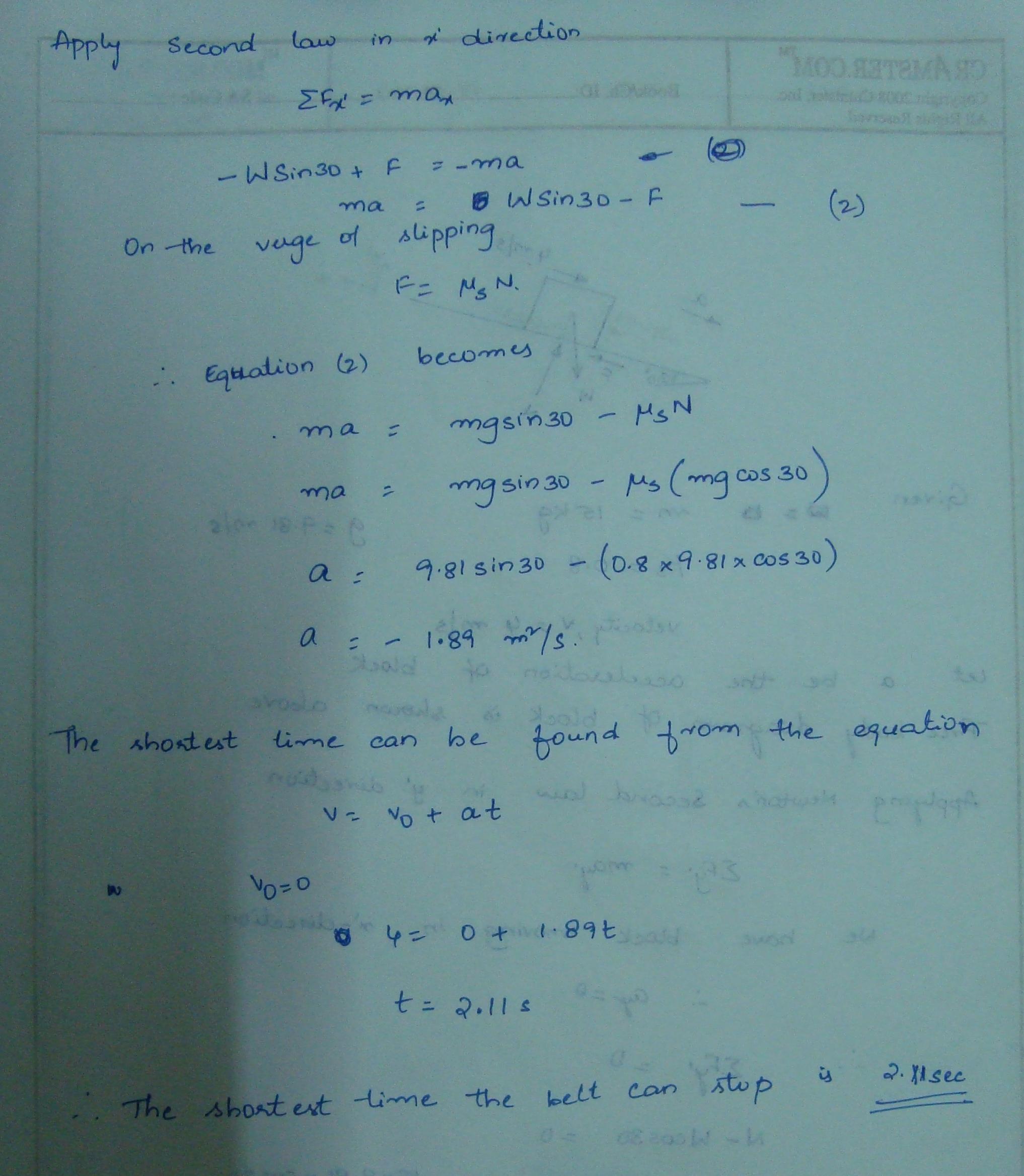
The conveyor belt is moving downward at 4 m>s. If the coefficient of static friction between the conveyor and the 15-kg package B is ms = 0.8, determine the shortest time the belt can stop so that the package does not slide on the belt.

See the attachments for complete steps to get answer.

4 0
2 years ago
Evan notices a small fire in his workplace. Since the fire is small and the atmosphere is not smoky he decides to fight the fire
Norma-Jean [14]

Answer:

not calling the firemean

Explanation:

7 0
2 years ago
Other questions:
  • How much extra water does a 21.5 ft, 175-lb concrete canoe displace compared to an ultra-lightweight 38-lb Kevlar canoe of the s
    8·1 answer
  • Consider a plane composite wall that is composed of two materials of thermal conductivities kA 0.1 W/mK and kB 0.04 W/mK and thi
    14·1 answer
  • Determine the amount of gamma and alpha phases in a 10-kg, 1060 steel casting as it is being cooled to the following temperature
    6·1 answer
  • 1. Create a class called Name that represents a person's name. The class should have fields named firstName representing the per
    8·2 answers
  • 5. A typical paper clip weighs 0.59 g and consists of BCC iron. Calculate (a) the number of
    5·1 answer
  • Which of the following is correct regarding the principal stresses and maximum in-plane shear stresses? a. Principal stresses ca
    14·1 answer
  • Flow and Pressure Drop of Gases in Packed Bed. Air at 394.3 K flows through a packed bed of cylinders having a diameter of 0.012
    8·1 answer
  • The atomic radii of a divalent cation and a monovalent anion are 0.77 nm and 0.136 nm, respectively.1- Calculate the force of at
    11·1 answer
  • Consider a steady developing laminar flow of water in a constant-diameter horizontal discharge pipe attached to a tank. The flui
    14·1 answer
  • Milton has been tracking the migrating patterns of whales in the northwest Atlantic Ocean for five years. He knows where and whe
    5·2 answers
Add answer
Login
Not registered? Fast signup
Signup
Login Signup
Ask question!