answer.
Ask question
Login Signup
Ask question
All categories
  • English
  • Mathematics
  • Social Studies
  • Business
  • History
  • Health
  • Geography
  • Biology
  • Physics
  • Chemistry
  • Computers and Technology
  • Arts
  • World Languages
  • Spanish
  • French
  • German
  • Advanced Placement (AP)
  • SAT
  • Medicine
  • Law
  • Engineering
Inessa05 [86]
2 years ago
14

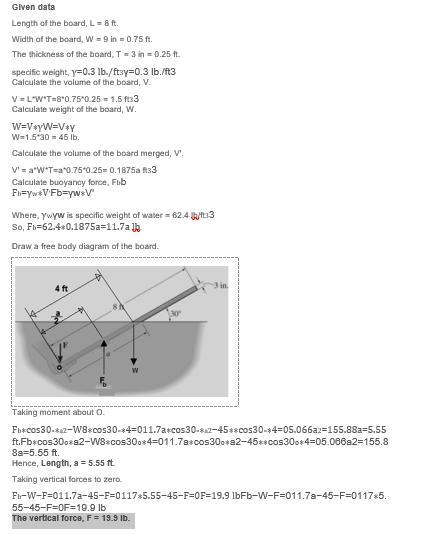
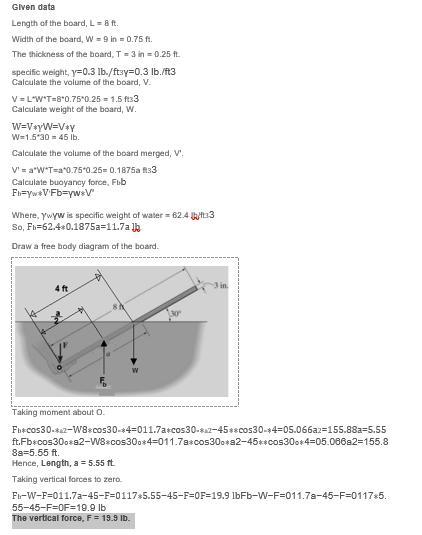
The uniform 8–ft board is pushed down into the water so it makes an angle of θ = 30o with the water surface. If the cross sectio

n of the board 3 in by 9 in, and its specific weight is γ = 30 lb/ft3 , determine the length a that will be submerged and the vertical force F needed to hold this end in this position.

Engineering
1 answer:
lana66690 [7]2 years ago
3 0

Answer:

The vertical force, F = 19.9 lb.

Explanation:

You might be interested in
On the reality television show "Survivor," two tribes compete for luxuries such as food and shelter. During such challenges, one
Ivan

Answer:

Realistic Group Conflict Theory

Explanation:

Realistic Group Conflict theory is a socio-psychological model of internal conflicts among groups.

These groups may compete for a scarce resources based on reality or perception.

These conflicts may be over political power, capital, or social status, etc.

According to this theory, in the competition, only one group wins over the scarce resources while the other has to lose.

Thus The reality show on the television showing two tribes competing for food and shelter where the success of one is the failure for the other is based on Realistic Group Conflict Theory.

5 0
2 years ago
Your roommate wants to learn about organizational chart. You can tell her that these charts can tell you all of these about an o
mars1129 [50]

Answer:

Control mechanisms

Explanation:

Organizational chart of any company will give details of different aspects of the company such as the major sub-units of the organization with the names of team leaders for different sub-units, it can also give you the span of control and the division of work within the company. However, the chart can't show you control mechanisms of different departments.

4 0
2 years ago
The ingredient weights for making 1 yd (cyd) of concrete by assuming aggregates in SSD state are given below. The volume of air
Pachacha [2.7K]

Answer:

Explanation:

Ans) Given batch weight of each component :

Cement = 700 lb

Water = 315 lb

Coarse aggregate = 1575 lb

Fine aggregate = 1100 lb

Part 1) Amount of water = 328.5 lb

Amount of water is needed to be increased if the aggregates has absorption capacity, To maintain constant water cement ratio, the mixing water is increased because some of the water is absorbed by aggregates.

Amount of water absorbed = 328.5 lb - 315 lb = 13.5 lb

Total amount of aggregates = 1575 + 1100 = 2675 lb

=> % Absorption capacity = 13.5 x 100 / 2675 = 0.5 %

Hence, new amount of Coarse aggregate = (1 - 0.005) x 1575 lb = 1567.125 lb

New amount of fine aggregate = (1 - 0.005) x 1100 = 1094.5 lb

Since, water cement ratio is maintained constant , amount of cement remains unchanged

=> Volume of water = 328.5 / 62.4 = 5.26 ft3

=> Volume of cement = 700 / (3.15 x 62.4) = 3.56 ft3

=> Volume of coarse aggregate = 1567.125 / (2.4 x 62.4) = 10.46 ft3

=> Volume of fine aggregate = 1100 / (2.4 x 62.4) = 7.34 ft3

Volume of air = 2% = 0.02 x 27 = 0.54 ft3

Total concrete volume = 5.26 + 3.56 + 10.46 + 7.34 + 0.54 \approx 27 ft3 = 1 yd3

Hence, calculated amount of each component is correct

Part 2) We know, minus sign indicated that the aggregate will absorb some moisture from concrete, hence mixing water amount needed to be corrected .

=> Amount of water absorbed by coarse aggregate = 0.01 x 1567.125 lb = 15.67 lb

=> Amount of water absorbed by fine aggregate = 0.02 x 1094.50 lb = 21.89 lb

Total amount of water absorbed = 15.67 + 21.89 = 37.56 lb

To maintain same water cement ratio, amount of mixing water is needed to be increased

=> Corrected amount of mixing water = 328.5 lb + 37.56 lb = 366 lb

=> Corrected amount of coarse aggregate = (1 - 0.01) x 1567.125 = 1551.45 lb

=> Corrected amount of fine aggregate = (1 - 0.02) x 1094.5 = 1072.6 lb

Part 3) We know,

Unit weight = Sum of weight of each material / Total volume

=> Sum of weight = 366 + 700 + 1551.45 + 1072.6 = 3690.05 lb

Total volume = 1 yd3 or 27 ft3

=> Expected Unit Weight = 3690.05 lb / 27 ft3 = 136.67 lb/ft3

Also, Concrete Yield = Weight of all components / Unit weight of concrete

=> Yield = 3690.05 / 136.67 = 27 ft3 or 1 yd3
4 0
2 years ago
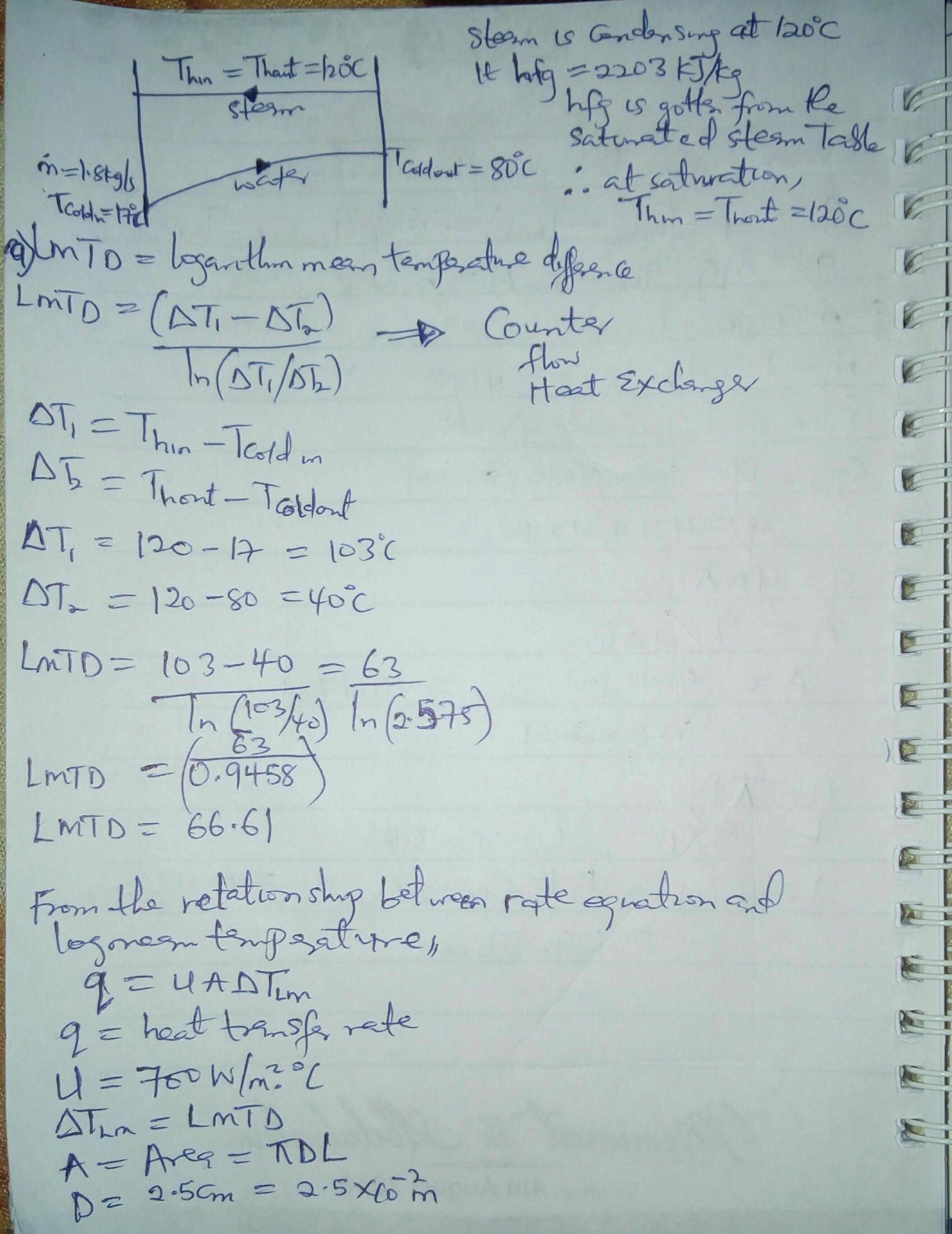
Water (cp = 4180 J/kg·°C) enters the 2.5 cm internal diameter tube of a double-pipe counter-flow heat exchanger at 17°C at a rat
aksik [14]

Answer:

Length = 129.55m, 129.55m

Explanation:

Given:

cp of water = 4180 J/kg·°C

Diameter, D = 2.5 cm

Temperature of water in =  17°C

Temperature of water out = 80°C

mass rate of water =1.8 kg/s.

Steam condensing at 120°C

Temperature at saturation = 120°C

hfg of steam at 120°C = 2203 kJ/kg

overall heat transfer coefficient of the heat exchanger = 700 W/m2 ·°C

U = 700 W/m2 ·°C

Since Temperature of steam is at saturation,

temperature of steam going in = temperature of steam out = 120°C

Energy balance:

Heat gained by water = Heat loss by steam

Let specific capacity of steam = 2010kJ/Kg .°C

Find attached the full solution to the question.

3 0
2 years ago
Poles are values of Laplace transform variable, s, that make denominator of transfer function zero. Zeros are values of Laplace
Ostrovityanka [42]

Answer:

Zero 1 = -1

Zero 2 = -3

Pole 1 = 0

Pole 2 = -2

Pole 3 = -4

Pole 4 = -6

Gain = 4

Explanation:

For any given transfer function, the general form is given as

T.F = k [N(s)] ÷ [D(s)]

where k = gain of the transfer function

N(s) is the numerator polynomial of the transfer function whose roots are the zeros of the transfer function.

D(s) is the denominator polynomial of the transfer function whose roots are the poles of the transfer function.

k [N(s)] = 4s² + 16s + 12 = 4[s² + 4s + 3]

it is evident that

Gain = k = 4

N(s) = (s² + 4s + 3) = (s² + s + 3s + 3)

= s(s + 1) + 3 (s + 1) = (s + 1)(s + 3)

The zeros are -1 and -3

D(s) = s⁴ + 12s³ + 44s² + 48s

= s(s³ + 12s² + 44s + 48)

= s(s + 2)(s + 4)(s + 6)

The roots are then, 0, -2, -4 and -6.

Hope this Helps!!!

3 0
2 years ago
Other questions:
  • A thin metal disk of mass m=2.00 x 10^-3 kg and radius R=2.20cm is attached at its center to a long fiber. When the disk is turn
    11·1 answer
  • Water is the working fluid in an ideal Rankine cycle. The condenser pressure is 8 kPa, and saturated vapor enters the turbine at
    10·1 answer
  • The 2-Mg concrete pipe has a center of mass at point G. If it is suspended from cables AB and AC, determine the diameter of cabl
    12·1 answer
  • Show that a chirped Gaussian pulse is compressed initially inside a single-mode fiber when ftC < 0. Derive expressions for th
    12·1 answer
  • 6.8.1: Function pass by pointer: Transforming coordinates. Define a function CoordTransform() that transforms its first two inpu
    9·1 answer
  • The Gill Art Gallery wishes to maintain data on their customers, artists and paintings. They may have several paintings by each
    7·1 answer
  • The mechanical properties of some metals may be improved by incorporating fine particles of their oxides. If the moduli of elast
    12·1 answer
  • "From the earth to the moon". In Jules Verne’s 1865 story with this title, three men went to the moon in a shell fired from a gi
    5·1 answer
  • Determine the design angle ϕ (0∘≤ϕ≤90 ∘) between struts AB and AC so that the 400 lb horizontal force has a component of 600 lb
    10·1 answer
  • What is the linear distance traveled in one revolution of a 36-inch wheel
    6·1 answer
Add answer
Login
Not registered? Fast signup
Signup
Login Signup
Ask question!