answer.
Ask question
Login Signup
Ask question
All categories
  • English
  • Mathematics
  • Social Studies
  • Business
  • History
  • Health
  • Geography
  • Biology
  • Physics
  • Chemistry
  • Computers and Technology
  • Arts
  • World Languages
  • Spanish
  • French
  • German
  • Advanced Placement (AP)
  • SAT
  • Medicine
  • Law
  • Engineering
satela [25.4K]
2 years ago
11

a square has an area of 36 and one side that lies along the line y=3. what could be the location of one of the vertices of this

shape? a) (9, 4) b) (-5, -3) c) (6, 5) d) (3, 6)

Mathematics
1 answer:
Pani-rosa [81]2 years ago
8 0

Answer:

Correct answer is:

b) (-5, -3)

Step-by-step explanation:

Given that area of square is <em>36 </em>and one sides lies along the line <em>y = 3</em>

<em>To find:</em>

Possible location of a vertex can be = ? Answer to be chosen from the options:

a) (9, 4)

b) (-5, -3)

c) (6, 5)

d) (3, 6)

<u>Solution:</u>

First of all, let us try to find the side of square.

Area = Side^2 \\\Rightarrow Side^2 = 36\\\Rightarrow Side = 6

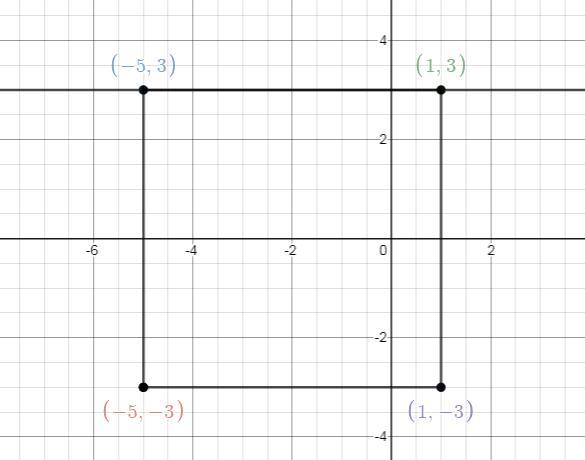
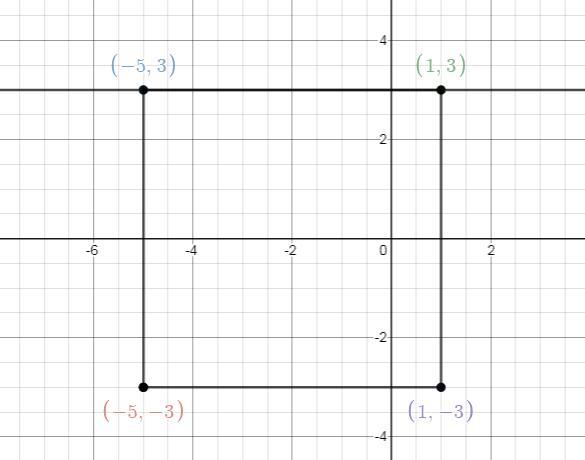
Now, given that one side lies on the line y = 3 that means 2 of its coordinates will have their y - coordinates as 3.

Now, we know that all the angles of a square are 90^\circ.

So, coordinates of adjacent vertices will have a change in only x value or either y value.

Therefore, we can say that The other two coordinates of the square will have the y coordinates the value either 3 + 6 = 9 or 3 -6 = -3

One such possible square is attached in the answer area.

\therefore possible location of the one of the vertex is:

<em>b) (-5, -3)</em>

You might be interested in
Which could be the dimensions of a rectangular prism whose surface area is greater than 140 square feet? Select three options,
ElenaW [278]

Answer:

These are the rectangular prisms that have a surface area greater than 140 square feet

6 feet by 5 feet by 4 feet

7 feet by 6 feet by 4 feet

8 feet by 3 feet by 7 feet

Step-by-step explanation:

The formula to find the surface area of a rectangular prism is SA=2(wl+hl+hw)

All you have to do is go through all the options given to you to figure out which retangular prisms have a surface area greater than 140 square feet.

6 feet by 2 feet by 3 feet

SA = 2((2)(6)+(3)(6)+(3)(2))

SA = 2(12 + 18 + 6)

SA = 2(36)

SA = 72

6 feet by 5 feet by 4 feet

SA = 2((6)(5) + (4)(5) + (4)(6))

SA = 2(30 + 20 + 24)

SA = 2(74)

SA = 148

7 feet by 6 feet by 4 feet

SA = 2((7)(6) + (4)(6) + (4)(7))

SA = 2(42 + 24 + 28)

SA = 2(94)

SA = 188

8 feet by 3 feet by 7 feet

SA = 2((8)(3)+(7)(3)+(7)(8))

SA = 2(24 + 21 + 56)

SA = 2(101)

SA = 202

8 feet by 4 feet by 3 feet

SA = 2((8)(4)+(3)(4)+(3)(8))

SA = 2(32 + 12 + 24)

SA = 2(68)

SA = 136

3 0
2 years ago
What’s the angle it’s looking for ?
Law Incorporation [45]

Given:

m(ar KN) = 2x + 151

m(ar LN) = 61°

m∠NMK = 2x + 45

To find:

m∠NMK

Solution:

By property of circle:

<em>If a tangent and a secant intersect outside a circle, then the measure of the angle formed is one-half the positive difference of the measures of the intercepted arcs.</em>

$\Rightarrow m\angle NMK=\frac{1}{2} (m \ ar(KN) - m\ arLN))

$\Rightarrow 2x+45=\frac{1}{2} (2x + 151-61)

$\Rightarrow 2x+45=\frac{1}{2} (2x + 90)

Multiply by 2 on both sides, we get

$\Rightarrow 2\times (2x+45)=2\times \frac{1}{2} (2x + 90)

$\Rightarrow 4x+90=2x + 90

Subtract 90 from both sides.

$\Rightarrow 4x+90-90=2x + 90-90

$\Rightarrow 4x=2x

Subtract 2x from both sides.

$\Rightarrow 4x-2x=2x-2x

$\Rightarrow 2x=0

$\Rightarrow x=0

Substitute x= 0 in m∠NMK.

m∠NMK = 2x + 45

              = 2(0) + 45

              = 45

Therefore m∠NMK = 45.

8 0
2 years ago
Tom sells baseball cards at 10 for 35 cents. Is that better deal than 12 for 40 cents? Prove your thinking
Aleks [24]

Answer:

12 for 40 cents is a better deal.

Step-by-step explanation: 35divided by 10 is 3.5 and 12 divided by 40 is 3.333... therefore for just one card it is cheaper but you are getting more cards anyways.

7 0
1 year ago
Given line has the equation 2X +12 Y equals negative one what is the equation in slope intercept form of the line that is perpen
Flauer [41]

Answer:

y = 12x + 9 is the answer.

Step-by-step explanation:

Since the given equation is 2x + 12 y = -1

12y = -2x -1

y=-\frac{1}{12}(2x+1)

y=-\frac{1}{12}x-\frac{1}{12}

Now this line is in the form of y = mx + c

Here m = slope = -1/12

We have to calculate the slope of another line perpendicular to this line and passing through (0, 9).

Let the equation is y = m' + c'

We know m×m' = -1 for two perpendicular lines

-(\frac{1}{12})(m')=-1

m' = 12

Therefore the equation will be

y = 12x + c'

Since this line passes through ( 0, 9)

9 = 12×0 + c'

c' = 9

Now the equation will be

y = 12x + 9

This is the answer.

3 0
2 years ago
Read 2 more answers
Steve likes to entertain friends at parties with "wire tricks." Suppose he takes a piece of wire 60 inches long and cuts it into
Alex_Xolod [135]

Answer:

a) the length of the wire for the circle = (\frac{60\pi }{\pi+4}) in

b)the length of the wire for the square = (\frac{240}{\pi+4}) in

c) the smallest possible area = 126.02 in² into two decimal places

Step-by-step explanation:

If one piece of wire for the square is y; and another piece of wire for circle is (60-y).

Then; we can say; let the side of the square be b

so 4(b)=y

         b=\frac{y}{4}

Area of the square which is L² can now be said to be;

A_S=(\frac{y}{4})^2 = \frac{y^2}{16}

On the otherhand; let the radius (r) of the  circle be;

2πr = 60-y

r = \frac{60-y}{2\pi }

Area of the circle which is πr² can now be;

A_C= \pi (\frac{60-y}{2\pi } )^2

     =( \frac{60-y}{4\pi } )^2

Total Area (A);

A = A_S+A_C

   = \frac{y^2}{16} +(\frac{60-y}{4\pi } )^2

For the smallest possible area; \frac{dA}{dy}=0

∴ \frac{2y}{16}+\frac{2(60-y)(-1)}{4\pi}=0

If we divide through with (2) and each entity move to the opposite side; we have:

\frac{y}{18}=\frac{(60-y)}{2\pi}

By cross multiplying; we have:

2πy = 480 - 8y

collect like terms

(2π + 8) y = 480

which can be reduced to (π + 4)y = 240 by dividing through with 2

y= \frac{240}{\pi+4}

∴ since y= \frac{240}{\pi+4}, we can determine for the length of the circle ;

60-y can now be;

= 60-\frac{240}{\pi+4}

= \frac{(\pi+4)*60-240}{\pi+40}

= \frac{60\pi+240-240}{\pi+4}

= (\frac{60\pi}{\pi+4})in

also, the length of wire for the square  (y) ; y= (\frac{240}{\pi+4})in

The smallest possible area (A) = \frac{1}{16} (\frac{240}{\pi+4})^2+(\frac{60\pi}{\pi+y})^2(\frac{1}{4\pi})

= 126.0223095 in²

≅ 126.02 in² ( to two decimal places)
4 0
2 years ago
Other questions:
  • Help plz. For what value of g does the function f(g) = g2 + 3g equal 18?
    11·1 answer
  • What is the total cost of two dozen erasers that are priced at 50 cent each if 8%sales tax is added.
    11·1 answer
  • The table shows how an elevator 500 feet above the ground is descending at a steady rate. Which equation represents the height,
    11·1 answer
  • Andrew deposits $300 into an account that earns 2% interest each year. After the first year, Andrew has $306 in the account. Aft
    6·1 answer
  • 12x+7&lt;−11 AND5x−8≥4012
    7·2 answers
  • Jason opened an account at MathsWatch Bank. MathsWatch Bank’s interest rate was 4%. After one year, the bank paid him interest.
    7·1 answer
  • How many square yards of cement are needed to create the walkway around the rectangular pool?
    10·2 answers
  • Which of following lies between 0 and -1 ?
    9·1 answer
  • Which point on the y-axis lies on the line that passes through point C and is perpendicular to line AB?
    13·1 answer
  • Carmen draws this area model to help her divide 1,800 by 9. She says the quotient is 20. Does Carmen's model make sense? Use the
    13·1 answer
Add answer
Login
Not registered? Fast signup
Signup
Login Signup
Ask question!