answer.
Ask question
Login Signup
Ask question
All categories
  • English
  • Mathematics
  • Social Studies
  • Business
  • History
  • Health
  • Geography
  • Biology
  • Physics
  • Chemistry
  • Computers and Technology
  • Arts
  • World Languages
  • Spanish
  • French
  • German
  • Advanced Placement (AP)
  • SAT
  • Medicine
  • Law
  • Engineering
rusak2 [61]
2 years ago
9

. Analyze the following scenarios and mention in which normal form it is with reason? a) Book- bookID bookTitle PublisherName Pu

blisherAddress b) Order- Order_No Product_ID Product Description c) Part- Part_ID PartDescription PartPrice d) Student S_ID CNIC Address S_Name e) Department Dep_No Location Dep_Name Manager_Name Manager_ID
Engineering
1 answer:
svet-max [94.6K]2 years ago
8 0

Answer:

You so good is ué KKKKKK a gente não não é possível que o seu ponto de vista da minha irmã me ligou

Explanation:

Irieiwy Wwowuwowywbrbbdnd

You might be interested in
Why is it so dangerous to use a ground lift on a metal cased power tool
MaRussiya [10]
Answer:

Removal of the safety ground connection on equipment can expose users to an increased danger of electric shock and may contradict wiring regulations. ... If a fault develops in any line-operated equipment, cable shields and equipment enclosures may become energized, creating an electric shock hazard.
7 0
1 year ago
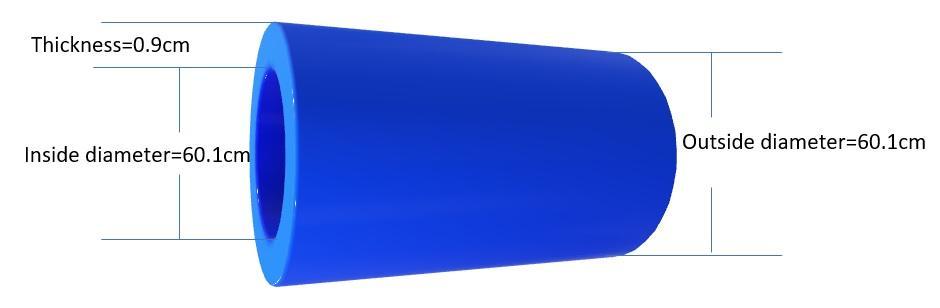
Water is flowing in a metal pipe. The pipe OD (outside diameter) is 61 cm. The pipe length is 120 m. The pipe wall thickness is
Yuki888 [10]

Answer:

1113kN

Explanation:

The ouside diameter OD of the pipe is 61cm and the thickness T is 0.9cm, so the inside diameter ID will be:

Inside Diameter = Outside Diameter - Thickness

Inside Diameter = 61cm - 0.9cm = 60.1cm

Converting this diameter to meters, we have:

60.1cm*\frac{1m}{100cm}=0.601m

This inside diameter is useful to calculate the volume V of water inside the pipe, that is the volume of a cylinder:

V_{water}=\pi  r^{2}h

V_{water}=\pi (\frac{0.601m}{2})^{2}*120m

V_{water}=113.28m^{3}

The problem gives you the water density d as 1.0kg/L, but we need to convert it to proper units, so:

d_{water}=1.0\frac{Kg}{L}*\frac{1L}{1000cm^{3}}*(\frac{100cm}{1m})^{3}

d_{water}=1000\frac{Kg}{m^{3}}

Now, water density is given by the equation d=\frac{m}{V}, where m is the water mass and V is the water volume. Solving the equation for water mass and replacing the values we have:

m_{water}=d_{water}.V_{water}

m_{water}=1000\frac{Kg}{mx^{3}}*113.28m^{3}

m_{water}=113280Kg

With the water mass we can find the weight of water:

w_{water}=m_{water} *g

w_{water}=113280kg*9.8\frac{m}{s^{2}}

w_{water}=1110144N

Finally we find the total weight add up the weight of the water and the weight of the pipe,so:

w_{total}=w_{water}+w_{pipe}

w_{total}=1110144N+2500N

w_{total}=1112644N

Converting this total weight to kN, we have:

1112644N*\frac{0.001kN}{1N}=1113kN

7 0
2 years ago
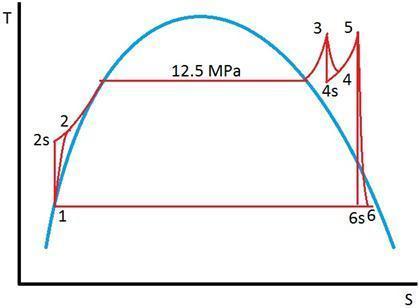
A steam power plant operates on the reheat Rankine cycle. Steam enters the highpressure turbine at 12.5 MPa and 550°C at a rate
gayaneshka [121]

Answer:

A) condenser pressure = 9.73 kPa,

B) 10242 kw

C) 36.9%

Explanation:

given data

entrance pressure of steam = 12.5 MPa

temperature of steam = 550⁰c

flow rate of steam = 7.7 kg/s

outer pressure = 2 MPa

reheated steam temperature = 450⁰c

isentropic efficiency of turbine( nt ) = 85% = 0.85

isentropic efficiency of pump = 90% = 0.90

From steam tables

at 12.5 MPa and 550⁰c ; h3 = 3476.5 kJ/kg,  S3 = 6.6317 kJ/kgK

also for an Isentropic expansion

S4s = S3 .

therefore when S4s = 6.6317 kJ/kg and P4 = 2 MPa

h4s = 2948.1 kJ/kg

nt = 0.85

nt (0.85) = \frac{h3-h4}{h3-h4s} = \frac{3476.5 - h4}{3476.5 - 2948.1}

making h4 subject of the equation

h4 = 3476.5 - 0.85 (3476.5 - 2948.1)

h4 = 3027.3 kj/kg

at P5 = 2 MPa and T5 = 450⁰c

h5 = 3358.2 kj/kg,  s5 = 7.2815 kj/kgk

at P6 , x6 = 0.95  and s5 = s6

using nt = 0.85 we can calculate for h6 and h6s

from the chart attached below we can see that

p6 = 9.73 kPa, h6 = 2463.3 kj/kg

B) the net power output

solution is attached below

c) thermal efficiency

thermal efficiency = 1 - \frac{qout}{qin} = 1 - ( 2273.7/ 3603.8) = 36.9% ≈ 37%

8 0
2 years ago
Fix the code so the program will run correctly for MAXCHEESE values of 0 to 20 (inclusive). Note that the value of MAXCHEESE is
GarryVolchara [31]

Answer:

Code fixed below using Java

Explanation:

<u>Error.java </u>

import java.util.Random;

public class Error {

   public static void main(String[] args) {

       final int MAXCHEESE = 10;

       String[] names = new String[MAXCHEESE];

       double[] prices = new double[MAXCHEESE];

       double[] amounts = new double[MAXCHEESE];

       // Three Special Cheeses

       names[0] = "Humboldt Fog";

       prices[0] = 25.00;

       names[1] = "Red Hawk";

       prices[1] = 40.50;

       names[2] = "Teleme";

       prices[2] = 17.25;

       System.out.println("We sell " + MAXCHEESE + " kind of Cheese:");

       System.out.println(names[0] + ": $" + prices[0] + " per pound");

       System.out.println(names[1] + ": $" + prices[1] + " per pound");

       System.out.println(names[2] + ": $" + prices[2] + " per pound");

       Random ranGen = new Random(100);

       // error at initialising i

       // i should be from 0 to MAXCHEESE value

       for (int i = 0; i < MAXCHEESE; i++) {

           names[i] = "Cheese Type " + (char) ('A' + i);

           prices[i] = ranGen.nextInt(1000) / 100.0;

           amounts[i] = 0;

           System.out.println(names[i] + ": $" + prices[i] + " per pound");

       }        

   }

}

7 0
2 years ago
Identify an object in your house that contains a physical system and list three questions you could use to define the system
jonny [76]

Answer:

ALL CAREFULLY ANSWERED CORRECTLY

Explanation:

1) A loaf of Bread PHYSICAL SYSTEM

✓ How can the environment affect the edibility of the bread

✓ What are the constituents that makes up the bread

✓ What process is involved in these constituents mixing to form the loaf.

2) The law of thermodynamics makes us to understand that when heat/energy passes through a system, the systems internal energy changes with respect to the conservation of energy law. That is energy lost = energy gained. Typically, ice would melt in a cup of hot tea because of the thermal energy in the molecules of the hot tea. When you heat a material, you are adding thermal kinetic energy to its molecules and usually raising its temperature. The temperature of the ice raises due to the kinetic energy added to it and it melts to water.

3) The theory of systems view the world as a complex system of interconnected parts. If we consider the society; (financial systems, political systems, etc) we will agree that they individually have their own components and it's the summation of this components that makes the system, this implies that system thinking could be applicable in this kinda of systems as long as they are made up of components.

4) Technology has boosted every sector of our lives and it has the capacity to do more. Restricting it's importance to entertainment alone would be an underusing of its potentials. Engineering students infact should not need any drive to be encouraged about maximizing all it can do in shaping our world.

5) ~ Nature shows its splendid soul

~Never ceases to leave us in amazement

~And we are in love

4 0
2 years ago
Other questions:
  • Oil with a density of 800 kg/m3 is pumped from a pressure of 0.6 bar to a pressure of 1.4 bar, and the outlet is 3 m above the i
    9·1 answer
  • If the electric field just outside a thin conducting sheet is equal to 1.5 N/C, determine the surface charge density on the cond
    9·1 answer
  • Two physical properties that have a major influence on the cracking of workpieces, tools, or dies during thermal cycling are the
    13·1 answer
  • The driving force for fluid flow is the pressure difference, and a pump operates by raising the pressure of a fluid (by converti
    13·1 answer
  • Check the answer that best describes the relationship between f(x) and x. (For example if f(x) is Θ(x) check that as your answer
    12·1 answer
  • A horizontal pipe has an abrupt expansion from D1 5 8 cm to D2 5 16 cm. The water velocity in the smaller section is 10 m/s and
    7·1 answer
  • Oil enters a counterflow heat exchanger at 600 K with a mass flow rate of 10 kg/s and exits at 200 K. A separate stream of liqui
    12·1 answer
  • A thin, flat plate that is 0.2 m × 0.2 m on a side is oriented parallel to an atmospheric airstream having a velocity of 40 m/s.
    5·2 answers
  • technician A says that in any circuit, electrical current takes the path of least resistance. technician B says that while this
    13·1 answer
  • What should always be done before beginning any diagnosis?
    9·1 answer
Add answer
Login
Not registered? Fast signup
Signup
Login Signup
Ask question!