answer.
Ask question
Login Signup
Ask question
All categories
  • English
  • Mathematics
  • Social Studies
  • Business
  • History
  • Health
  • Geography
  • Biology
  • Physics
  • Chemistry
  • Computers and Technology
  • Arts
  • World Languages
  • Spanish
  • French
  • German
  • Advanced Placement (AP)
  • SAT
  • Medicine
  • Law
  • Engineering
yaroslaw [1]
2 years ago
3

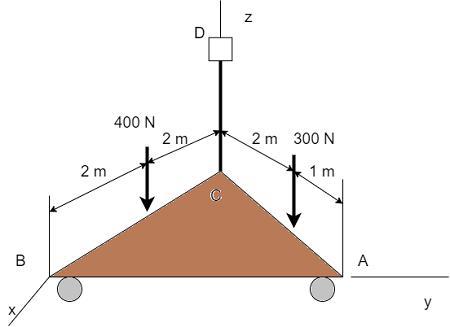
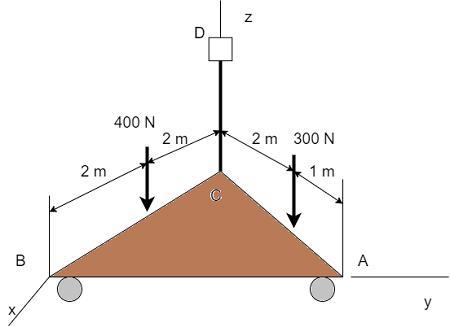
A plate is supported by a ball-and-socket joint at A, a roller joint at B, and a cable at C. How many unknown support reactions

are there in this problem?

Engineering
1 answer:
garik1379 [7]2 years ago
6 0

Answer:

<em>There are five (5) unknown support reactions in this problem.</em>

Explanation:

A roller joint rotates and translates along the surface on which the roller rests. The resulting reaction force is always a single force that is perpendicular to, and away from, the surface. This allows the roller to move in a single plane along the surface where it rests.

A cable support provides support in one direction, parallel, and in opposite direction to the load on it. There exists a single reaction from the cable pointed upwards.

A ball-and-socket joint have  reaction forces in all 3 cardinal  directions. This allows it to move in the x-y-z plane.

The total unknown reactions on the member are five in number.

You might be interested in
Technician A that shielding gas nozzles may have different shapes. Technician B says that gelding gas nozzles is attached to the
Lilit [14]
B is correct! in this senecio
5 0
2 years ago
Dust, dirt, or metal chips can pose a potential ____ injury risk in a shop.
pantera1 [17]

Answer:

Eye.

Explanation:

Dust, dirt, and metal chips are most unpleasant to get in your eyes. Just experience it and you'll know what I mean.

;)

3 0
2 years ago
To unload a bound stack of plywood from a truck, the driver first tilts the bed of the truck and then accelerates from rest. Kno
azamat

Answer:

a) The truck must have an acceleration of at least 3.92 * cos(θ)^2 for the stack to start sliding.

b) a = 2.94 * cos(θ)^2 + 0.32 * L * cos(θ)

Explanation:

The stack of plywood has a certain mass. The weight will depend on that mass.

w = m * g

There will be a normal reaction between the stack and the bed of the truck, this will be:

nr = -m * g * cos(θ)

Being θ the tilt angle of the bed.

The static friction force will be:

ffs = - m * g * cos(θ) * fJK

The dynamic friction force will be:

ffd = - m * g * cos(θ) * fik

These forces would produce accelerations

affs = -g * cos(θ) * fJK

affd = -g * cos(θ) * fik

affs = -9.81 * cos(θ) * 0.4 = -3.92 * cos(θ)

affd = -9.81 * cos(θ) * 0.3 = -2.94 * cos(θ)

These accelerations oppose to movement and must be overcome by another acceleration to move the stack.

The acceleration of the truck is horizontal, the horizontal component of these friction forces is:

affs = -3.92 * cos(θ)^2

affd = -2.94 * cos(θ)^2

The truck must have an acceleration of at least 3.92 * cos(θ)^2 for the stack to start sliding.

Assuming the bed has a lenght L.

The horizontal movement will be over a distance cos(θ) * L because L is tilted.

Movement under constant acceleration:

X(t) = X0 + V0 * t + 1/2 * a * t^2

In this case X0 = 0, V0 = 0, and a will be the sum of the friction force minus the acceleration of the truck.

If we set the frame of reference with the origin on the initial position of the stack and the positive X axis pointing backwards, the acceleration of the truck will now be negative and the dynamic friction acceleration positive.

L * cos(θ) = 1/2 * (2.94 * cos(θ)^2 - a) * 0.4^2

2.94 * cos(θ)^2 - a = 2 * 0.16 * L * cos(θ)

a = 2.94 * cos(θ)^2 + 0.32 * L * cos(θ)
6 0
2 years ago
A thermal energy storage unit consists of a large rectangular channel, which is well insulated on its outer surface and encloses
yaroslaw [1]

Answer:

the temperature of the aluminum at this time is 456.25° C

Explanation:

Given that:

width w of the aluminium slab = 0.05 m

the initial temperature T_1 = 25° C

T{\infty} =600^0C

h = 100 W/m²

The properties of Aluminium at temperature of 600° C by considering the conditions for which the storage unit is charged; we have ;

density ρ = 2702 kg/m³

thermal conductivity k = 231 W/m.K

Specific heat c = 1033 J/Kg.K

Let's first find the Biot Number Bi which can be expressed by the equation:

Bi = \dfrac{hL_c}{k} \\ \\ Bi = \dfrac{h \dfrac{w}{2}}{k}

Bi = \dfrac{hL_c}{k} \\ \\ Bi = \dfrac{100 \times \dfrac{0.05}{2}}{231}

Bi = \dfrac{2.5}{231}

Bi = 0.0108

The time constant value \tau_t is :

\tau_t = \dfrac{pL_cc}{h} \\ \\ \tau_t = \dfrac{p \dfrac{w}{2}c}{h}

\tau_t = \dfrac{2702* \dfrac{0.05}{2}*1033}{100}

\tau_t = \dfrac{2702* 0.025*1033}{100}

\tau_t = 697.79

Considering Lumped capacitance analysis since value for Bi is less than 1

Then;

Q= (pVc)\theta_1 [1-e^{\dfrac {-t}{ \tau_1}}]

where;

Q = -\Delta E _{st} which correlates with the change in the internal energy of the solid.

So;

Q= (pVc)\theta_1 [1-e^{\dfrac {-t}{ \tau_1}}]= -\Delta E _{st}

The maximum value for the change in the internal energy of the solid  is :

(pVc)\theta_1 = -\Delta E _{st}max

By equating the two previous equation together ; we have:

\dfrac{-\Delta E _{st}}{\Delta E _{st}{max}}= \dfrac{  (pVc)\theta_1 [1-e^{\dfrac {-t}{ \tau_1}}]} { (pVc)\theta_1}

Similarly; we need to understand that the ratio of the energy storage to the maximum possible energy storage = 0.75

Thus;

0.75=  [1-e^{\dfrac {-t}{ \tau_1}}]}

So;

0.75=  [1-e^{\dfrac {-t}{ 697.79}}]}

1-0.75=  [e^{\dfrac {-t}{ 697.79}}]}

0.25 =  e^{\dfrac {-t}{ 697.79}}

In(0.25) =  {\dfrac {-t}{ 697.79}}

-1.386294361= \dfrac{-t}{697.79}

t = 1.386294361 × 697.79

t = 967.34 s

Finally; the temperature of Aluminium is determined as follows;

\dfrac{T - T _{\infty}}{T_1-T_{\infty}}= e ^ {\dfrac{-t}{\tau_t}}

\dfrac{T - 600}{25-600}= e ^ {\dfrac{-967.34}{697.79}

\dfrac{T - 600}{25-600}= 0.25

\dfrac{T - 600}{-575}= 0.25

T - 600 = -575 × 0.25

T - 600 = -143.75

T = -143.75 + 600

T = 456.25° C

Hence; the temperature of the aluminum at this time is 456.25° C

3 0
2 years ago
What is the mass per unit area of an 7 inch by 10 inch lead sheet that weighs 192 gm. ____________g / cm2
liq [111]

Answer:

M/A = 0.425 g/cm²

Explanation:

<u>Given the following data;</u>

Mass = 192 grams

Dimensions = 7 * 10 inches.

To find the mass per unit area;

First of all, we would determine the area of the lead sheet;

Area = 7 * 10

Area = 70 in²

<u><em>Conversion:</em></u>

1 square inch = 6.452 square centimeters

70  inches = 70 * 6.452 = 451.64 square centimeters

Next, we find the mass per unit area;

M/A = 192/451.64

<em>M/A = 0.425 g/cm²</em>

8 0
1 year ago
Other questions:
  • A_____ transducer is a device that can convert an electronic controller output signal into a standard pneumatic output. A. pneum
    13·1 answer
  • Small droplets of carbon tetrachloride at 68 °F are formed with a spray nozzle. If the average diameter of the droplets is 200 u
    10·1 answer
  • Choose the correct sequence of the following events leading to the sensory processing of a stimulus. 1. transmission 2. transduc
    13·1 answer
  • A platinum resistance temperature sensor has a resistance of 120 Ω at 0℃ and forms one arm of a Wheatstone bridge. At this tempe
    12·1 answer
  • Hot combustion gases, modeled as air behaving as an ideal gas, enter a turbine at 10 bar, 1500 K and exit at 1.97 bar and 900 K.
    7·1 answer
  • Suppose we store a relation R (x,y) in a grid file. Both attributes have a range of values from 0 to 1000. The partitions of thi
    12·1 answer
  • An air standard cycle with constant specific heats is executed in a closed pistoncylinder system and is composed of the followin
    10·1 answer
  • Determine the design angle ϕ (0∘≤ϕ≤90 ∘) between struts AB and AC so that the 400 lb horizontal force has a component of 600 lb
    10·1 answer
  • An annealed copper strip of 228 mm wide and 25 mm thick being rolled to a thickness of 20 mm, in one pass. The roll radius is 30
    6·1 answer
  • Most fatal collisions in Florida happen during
    8·2 answers
Add answer
Login
Not registered? Fast signup
Signup
Login Signup
Ask question!