answer.
Ask question
Login Signup
Ask question
All categories
  • English
  • Mathematics
  • Social Studies
  • Business
  • History
  • Health
  • Geography
  • Biology
  • Physics
  • Chemistry
  • Computers and Technology
  • Arts
  • World Languages
  • Spanish
  • French
  • German
  • Advanced Placement (AP)
  • SAT
  • Medicine
  • Law
  • Engineering
Eduardwww [97]
2 years ago
10

Which of the following describes radioactive decay by beta particle emission?a. The daughter isotope has an atomic number two le

ss than the parent and a mass number four less.b. The mass number of the daughter isotope is one more than the parent, and both isotopes have the same atomic number.c. The atomic number of the daughter isotope is one more than the parent; the mass numbers are the same.d. The daughter isotope has an atomic number one less than the parent and a mass number two less.
Chemistry
1 answer:
asambeis [7]2 years ago
3 0

Answer:

c. The atomic number of the daughter isotope is one more than the parent; the mass numbers are the same

Explanation:

Radioactive decay by beta particle emission involves the emission of an electron.

An electron is a very light particle and its emission does not reflect a loss in mass of the parent molecule. However, the atomic number of the parent molecule increase by one due to the retention of a proton.

Therefore, the daughter isotope has the same mass number as the parent molecule but its atomic number increases by one unit.

An example of beta particle emission is given below;

Th₀(234) ---> Pa₉₁(234) + e₋₁(0)

Thorium₉₀(234) emits a beta particle, e₋₁(0) to give Protactinium₉₁(234)

You might be interested in
Based on the crystal-field strengths cl- < f- < h2o < nh3 < h2nc2h4nh2, which octahedral ti (iii) complex below has
kati45 [8]
<span>Based on the crystal field strength, Cl ligand would give the longest d-d transition when complexed with Ti(III). as this is the weak field ligand and would cause minimum splitting of d orbitals.</span>
8 0
2 years ago
An experiment was conducted to measure the effect of equal amounts of fertilizer on the growth of bean plants and corn plants. T
ss7ja [257]

Answer:

b

Explanation:

3 0
2 years ago
Read 2 more answers
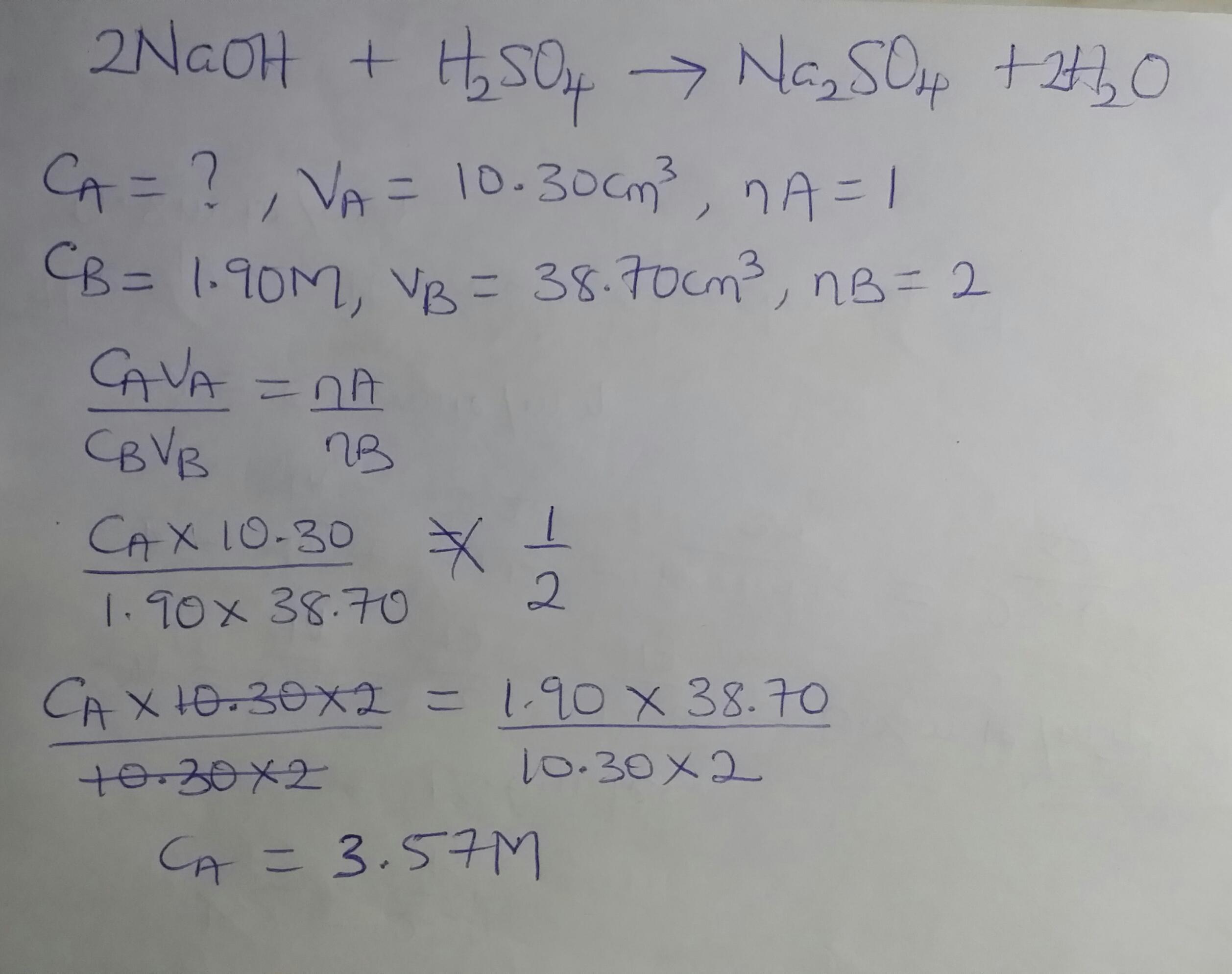
If it takes 38.70cm³ of 1.90 M NaOH to neutralize 10.30cm³ of H2SO4 in a battery, What's the Molarity of the H2SO4 ?​
arlik [135]

Answer: 3.57M

Explanation:Please see attachment for explanation

3 0
2 years ago
Read 2 more answers
Give four different chemical meanings for the word element and an example of each
Naddika [18.5K]

Answer ;

-An element is a substance containing only one type of atom, for example; H2 or 02  (consisting of atoms that all have the same number of protons).

-Microscopic, single atom of that element

-Macroscopic, sample of that element large enough to weigh on a balance

- A substance that cannot be broken down chemically; e.g; sodium metal,

Explanation;

-An element is a substance whose atoms all have the same number of protons: another way of saying this is that all of a particular element's atoms have the same atomic number. Elements are chemically the simplest substances and hence cannot be broken down using chemical reactions.

-An element is uniquely determined by the number of protons in the nuclei of its atoms.

3 0
2 years ago
When a 1.00 L sample of water from the surface of the Dead Sea (which is more than 400 meters below sea level and much saltier t
Harlamova29_29 [7]

Answer: Molarity of MgCl_2 in the original sample was 1.96M

Explanation:

Molarity is defined as the number of moles of solute dissolved per liter of the solution.

Molarity=\frac{\text{no of moles}}{\text{Volume in L}}

{\text {moles of solute}=\frac{\text {given mass}}{\text {molar mass}}=\frac{186g}{95g/mol}=1.96

Now put all the given values in the formula of molarity, we get

Molarity=\frac{1.96}{1.00L}

Molarity=1.96mol/L

Thus molarity of MgCl_2 in the original sample was 1.96M

4 0
2 years ago
Other questions:
  • To separate a mixture of hard candies and marbles, the most efficient method would be
    9·2 answers
  • a 9.84 ounces ingot of unknown metal is heated from 73.2 degrees fahrenheit - 191.2 degrees fahrenheit this requires 3.912 calor
    9·1 answer
  • What is this volume (2.49 × 10⁴ L) in cubic meters?
    6·1 answer
  • A mixture of 60 mol % n-propylcyclohexane and 40 mol % n-propylbenzene is distilled through a simple distillation apparatus; ass
    7·1 answer
  • Estimate the increase in the molar entropy of O2(g) when the temperature is increased at constant pressure from 298 K to 348 K,
    6·1 answer
  • Challenge question: This question is worth 6 points. As you saw in problem 9 we can have species bound to a central metal ion. T
    14·1 answer
  • The reaction A  B + C is second order in A. When [A]0 = 0.100 M, the reaction is 35.0% complete in 32.3 hours. Calculate the va
    15·1 answer
  • What type of ossification occurs to form an immovable joint
    15·1 answer
  • How much energy must be added to a bowl of 125popcorn kernels in order for them to reach a popping temperature of 175°C? Assume
    8·1 answer
  • onsider the reversible dissolution of lead(II) chloride. P b C l 2 ( s ) − ⇀ ↽ − P b 2 + ( a q ) + 2 C l − ( a q ) PbClX2(s)↽−−⇀
    9·1 answer
Add answer
Login
Not registered? Fast signup
Signup
Login Signup
Ask question!