answer.
Ask question
Login Signup
Ask question
All categories
  • English
  • Mathematics
  • Social Studies
  • Business
  • History
  • Health
  • Geography
  • Biology
  • Physics
  • Chemistry
  • Computers and Technology
  • Arts
  • World Languages
  • Spanish
  • French
  • German
  • Advanced Placement (AP)
  • SAT
  • Medicine
  • Law
  • Engineering
Sergeeva-Olga [200]
2 years ago
3

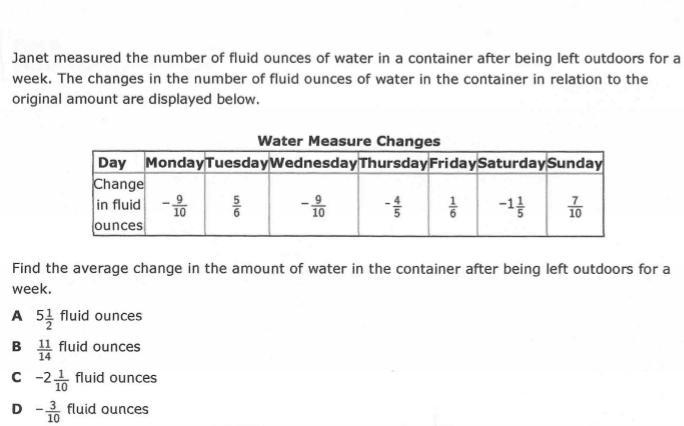
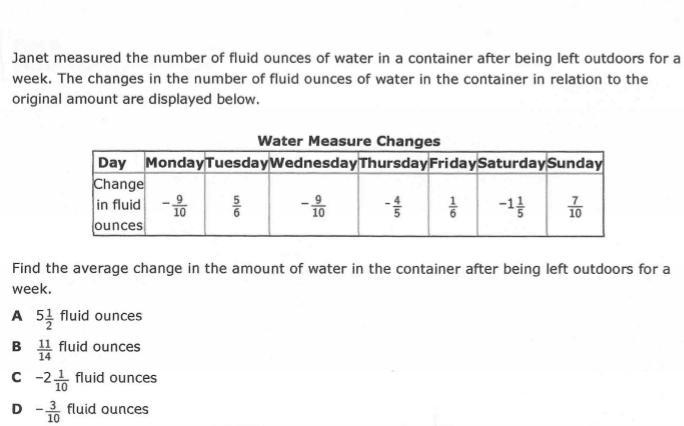
Janet measured the number of fluid Ounces of water in a container after being left outdoors for a week.

Mathematics
1 answer:
scoundrel [369]2 years ago
5 0

Question is not complete. I have attached the complete question.

Answer:

Option D: -3/10 fluid ounces

Step-by-step explanation:

The changes in the number of fluid Ounces of water in the container in relation to the original amount for each day of the week are;

Monday: -9/10

Tuesday: 5/6

Wednesday: -9/10

Thursday: -4/5

Friday: 1/6

Saturday: -(1 + (1/5)) = -6/5

Sunday: 7/10

Since there are 7 days in a week, the average change in the amount of water in the container after being left outdoors for a week would be;

Sum off all changes/7

Average = [(-9/10) + (5/6) + (-9/10) +(-4/5) + (1/6) + (-6/5) + (7/10)]/7

Average = (-21/10)/7

Average = -3/10 fluid Ounces

The correct answer is Option D

You might be interested in
During the summer, Gavin tutors and Eva washes cars.To show their earnings, Gavin makes a graph and Eva makes a table. Who earns
sladkih [1.3K]
To find Eva's slope divide 23 by 2.

23/2 = 11.5

SO, 

Gavin earns $8.50 more than Eva.

Hope this helps :)
6 0
2 years ago
Read 2 more answers
According to the Rational Root Theorem, which could be a factor of the polynomial f(x) = 60x4 + 86x3 – 46x2 – 43x + 8?
kaheart [24]
<span> If P(x) is a polynomial with integer coefficients and if is a zero of P(x) ( P( ) = 0 ), then p is a factor of the constant term of P(x) and q is a factor of the leading coefficient of P(x) .

</span><span>A. x – 6
</span><span>60(6)^4 + 86(6)^3 – 46(6)^2 – 43(6) + 8 = 94430
</span><span>
B. 5x – 8
</span>60(8/5)^4 + 86(8/5)^3 – 46(8/5)^2 – 43(8/5) + 8 = 566.912<span>

C. 6x – 1
</span>60(1/6)^4 + 86(1/6)^3 – 46(1/6)^2 – 43(1/6) + 8 = 0 -------> ANSWER
<span>
D. 8x + 5
</span>60(-5/8)^4 + 86(-5/8)^3 – 46(-5/8)^2 – 43(-5/8) + 8 = 5.07
3 0
2 years ago
Read 2 more answers
Jane likes to exercise daily. The table shows the number of calories y she burns by exercising steadily for x minutes. How many
Nataly_w [17]
Do you have a picture of the table?
8 0
2 years ago
Read 2 more answers
In a certain community, eight percent of all adults over age 50 have diabetes. If a health service in this community correctly d
____ [38]

Complete question is;

In a certain community, 8% of all people above 50 years of age have diabetes. A health service in this community correctly diagnoses 95% of all person with diabetes as having the disease, and incorrectly diagnoses 10% of all person without diabetes as having the disease. Find the probability that a person randomly selected from among all people of age above 50 and diagnosed by the health service as having diabetes actually has the disease.

Answer:

P(has diabetes | positive) = 0.442

Step-by-step explanation:

Probability of having diabetes and being positive is;

P(positive & has diabetes) = P(has diabetes) × P(positive | has diabetes)

We are told 8% or 0.08 have diabetes and there's a correct diagnosis of 95% of all the persons with diabetes having the disease.

Thus;

P(positive & has diabetes) = 0.08 × 0.95 = 0.076

P(negative & has diabetes) = P(has diabetes) × (1 –P(positive | has diabetes)) = 0.08 × (1 - 0.95)

P(negative & has diabetes) = 0.004

P(positive & no diabetes) = P(no diabetes) × P(positive | no diabetes)

We are told that there is an incorrect diagnoses of 10% of all persons without diabetes as having the disease

Thus;

P(positive & no diabetes) = 0.92 × 0.1 = 0.092

P(negative &no diabetes) =P(no diabetes) × (1 –P(positive | no diabetes)) = 0.92 × (1 - 0.1)

P(negative &no diabetes) = 0.828

Probability that a person selected having diabetes actually has the disease is;

P(has diabetes | positive) =P(positive & has diabetes) / P(positive)

P(positive) = 0.08 + P(positive & no diabetes)

P(positive) = 0.08 + 0.092 = 0.172

P(has diabetes | positive) = 0.076/0.172 = 0.442
8 0
2 years ago
Agustina made a scaled copy of the following quadrilateral. She used a scale factor less than 1. What could be the length of the
Leya [2.2K]

Answer:

A

Step-by-step explanation:

8 0
2 years ago
Read 2 more answers
Other questions:
  • What is the multiplicative rate of change of the exponential function represented in the table? 1.5 2.25 3.0 4.5
    10·2 answers
  • A carpenter is framing an opening in a wall to hang a rectangular door. Which properties must the door frame have to ensure that
    14·2 answers
  • Solve for z a(t+z)=45z+67
    13·2 answers
  • Which statement is true about a line and a point? (1 point)
    5·1 answer
  • The speed, s, of the current in a certain whirlpool is modeled by s=300/d, where d is the distance from the center of the whirlp
    13·2 answers
  • Silva a counted the total number of Fish she had caught at the end of each of the last three weeks. Her fish counts as shown bel
    15·1 answer
  • Round 66.3899872389 to the nearest thousandth
    10·2 answers
  • Joel, a tutor at the Math Help, decided that it would be a good
    6·1 answer
  • Find the times (to the nearest hundredth of a second) that the weight is halfway to its maximum negative position over the inter
    12·1 answer
  • 8. Which of the numbers in each pair is farther to the left on the number line?
    5·1 answer
Add answer
Login
Not registered? Fast signup
Signup
Login Signup
Ask question!