answer.
Ask question
Login Signup
Ask question
All categories
  • English
  • Mathematics
  • Social Studies
  • Business
  • History
  • Health
  • Geography
  • Biology
  • Physics
  • Chemistry
  • Computers and Technology
  • Arts
  • World Languages
  • Spanish
  • French
  • German
  • Advanced Placement (AP)
  • SAT
  • Medicine
  • Law
  • Engineering
Alex
2 years ago
12

When encountering low visibility from rain or fog, you should use your ____.

Engineering
1 answer:
kirza4 [7]2 years ago
4 0

Answer:

B

Explanation:

Low beams should only be used when fog and rain is present, as high beams can cause a dangerous glare to you and other drivers. You should also use your fog lights, but not every vehicle has them.

You might be interested in
A group of statisticians at a local college has asked you to create a set of functions that compute the median and mode of a set
iVinArrow [24]

Answer:

Functions to create a median and mode of a set of numbers

Explanation:

def median(list):

   if len(list) == 0:

       return 0

   list.sort()

   midIndex = len(list) / 2

   if len(list) % 2 == 1:

       return list[midIndex]

   else:

       return (list[midIndex] + list[midIndex - 1]) / 2

def mean(list):

   if len(list) == 0:

       return 0

   list.sort()

   total = 0

   for number in list:

       total += number

   return total / len(list)

def mode(list):

   numberDictionary = {}

   for digit in list:

       number = numberDictionary.get(digit, None)

       if number == None:

           numberDictionary[digit] = 1

       else:

           numberDictionary[digit] = number + 1

   maxValue = max(numberDictionary.values())

   modeList = []

   for key in numberDictionary:

       if numberDictionary[key] == maxValue:

           modeList.append(key)

   return modeList

def main():

   print "Mean of [1, 2, 3, 4, 5, 6, 7, 8, 9, 10]: ", mean(range(1, 11))

   print "Mode of [1, 1, 1, 1, 4, 4]:", mode([1, 1, 1, 1, 4, 4])

   print "Median of [1, 2, 3, 4]:", median([1, 2, 3, 4])

main()

3 0
2 years ago
Read 2 more answers
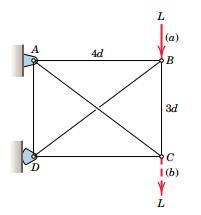
The rectangular frame is composed of four perimeter two-force members and two cables AC and BD which are incapable of supporting
Rama09 [41]

Answer:

Your question is lacking some information attached is the missing part and the solution

A) AB = AD = BD = 0, BC = LC

    AC = \frac{5L}{3}T, CD = \frac{4L}{3} C

B) AB = AD = BC = BD = 0

   AC = \frac{5L}{3} T, CD = \frac{4L}{3} C

Explanation:

A) Forces in all members due to the load L in position A

assuming that BD goes slack from an inspection of Joint B

AB = 0 and BC = LC from Joint D, AD = 0 and CD = 4L/3 C

B) steps to arrive to the answer is attached below

AB = AD = BC = BD = 0

AC = \frac{5L}{3} T,  CD = \frac{4L}{3}C

7 0
2 years ago
An excited electron in an Na atom emits radiation at a wavelength 589 nm and returns to the ground state. If the mean time for t
11Alexandr11 [23.1K]

Answer:   Inherent width in the emission line: 9.20 × 10⁻¹⁵ m or 9.20 fm

                length of the photon emitted: 6.0 m

Explanation:

The emitted wavelength is 589 nm and the transition time is ∆t = 20 ns.

Recall the Heisenberg's uncertainty principle:-

                                 ∆t∆E ≈ h ( Planck's Constant)

The transition time ∆t corresponds to the energy that is ∆E

E=h/t = \frac{(1/2\pi)*6.626*10x^{-34} J.s}{20*10x^{-9} } = 5.273*10x^{-27} J =  3.29* 10^{-8} eV.

The corresponding uncertainty in the emitted frequency ∆v is:

∆v= ∆E/h = (5.273*10^-27 J)/(6.626*10^ J.s)=  7.958 × 10^6 s^-1

To find the corresponding spread in wavelength and hence the line width ∆λ, we can differentiate

                                                    λ = c/v

                                                    dλ/dv = -c/v² = -λ²/c

Therefore,

      ∆λ = (λ²/c)*(∆v) = {(589*10⁻⁹ m)²/(3.0*10⁸ m/s)} * (7.958*10⁶ s⁻¹)

                                 =  9.20 × 10⁻¹⁵ m or 9.20 fm

     The length of the photon (<em>l)</em> is

l = (light velocity) × (emission duration)

  = (3.0 × 10⁸  m/s)(20 × 10⁻⁹ s) = 6.0 m          


6 0
2 years ago
Poles are values of Laplace transform variable, s, that make denominator of transfer function zero. Zeros are values of Laplace
Ostrovityanka [42]

Answer:

Zero 1 = -1

Zero 2 = -3

Pole 1 = 0

Pole 2 = -2

Pole 3 = -4

Pole 4 = -6

Gain = 4

Explanation:

For any given transfer function, the general form is given as

T.F = k [N(s)] ÷ [D(s)]

where k = gain of the transfer function

N(s) is the numerator polynomial of the transfer function whose roots are the zeros of the transfer function.

D(s) is the denominator polynomial of the transfer function whose roots are the poles of the transfer function.

k [N(s)] = 4s² + 16s + 12 = 4[s² + 4s + 3]

it is evident that

Gain = k = 4

N(s) = (s² + 4s + 3) = (s² + s + 3s + 3)

= s(s + 1) + 3 (s + 1) = (s + 1)(s + 3)

The zeros are -1 and -3

D(s) = s⁴ + 12s³ + 44s² + 48s

= s(s³ + 12s² + 44s + 48)

= s(s + 2)(s + 4)(s + 6)

The roots are then, 0, -2, -4 and -6.

Hope this Helps!!!

3 0
2 years ago
6.28 A six-lane freeway (three lanes in each direction) in rolling terrain has 10-ft lanes and obstructions 4 ft from the right
dimulka [17.4K]

Answer:

Assume Base free flow speed (BFFS) = 70 mph

Lane width = 10 ft

Reduction in speed corresponding to lane width, fLW = 6.6 mph

Lateral Clearance = 4 ft

Reduction in speed corresponding to lateral clearance, fLC = 0.8 mph

Interchanges/Ramps = 9/ 6 miles = 1.5 /mile

Reduction in speed corresponding to Interchanges/ramps, fID = 5 mph

No. of lanes = 3

Reduction in speed corresponding to number of lanes, fN = 3 mph

Free Flow Speed (FFS) = BFFS – fLW – fLC – fN – fID = 70 – 6.6 – 0.8 – 3 – 5 = 54.6 mph

Peak Flow, V = 2000 veh/hr

Peak 15-min flow = 600 veh

Peak-hour factor = 2000/ (4*600) = 0.83

Trucks and Buses = 12 %

RVs = 6 %

Rolling Terrain

fHV = 1/ (1 + 0.12 (2.5-1) + 0.06 (2.0-1)) = 1/1.24 = 0.806

fP = 1.0

Peak Flow Rate, Vp = V / (PHV*n*fHV*fP) = 2000/ (0.83*3*0.806*1.0) = 996.54 ~ 997 veh/hr/ln

Vp < (3400 – 30 FFS)

S = FFS

S = 54.6 mph

Density = Vp/S = (997) / (54.6) = 18.26 veh/mi/ln

7 0
2 years ago
Other questions:
  • A gas metal arc welder is also known as a _____ welder.
    5·1 answer
  • Consider a plane composite wall that is composed of two materials of thermal conductivities kA 0.1 W/mK and kB 0.04 W/mK and thi
    14·1 answer
  • Oil in an engine is being cooled by air in a cross-flow heat exchanger, where both fluids are unmixed. Oil (cp = 2000 J/kg. K) f
    12·1 answer
  • Which of the following is correct regarding the principal stresses and maximum in-plane shear stresses? a. Principal stresses ca
    14·1 answer
  • A signalized intersection approach has an upgrade of 4%. The total width of the cross street at this intersection is 60 feet. Th
    15·1 answer
  • Prompt the user to enter five numbers, being five people's weights. Store the numbers in an array of doubles. Output the array's
    11·2 answers
  • The 2-Mg concrete pipe has a center of mass at point G. If it is suspended from cables AB and AC, determine the diameter of cabl
    12·1 answer
  • John was a high school teacher earning $ 80,000 per year. He quit his job to start his own business in pizza catering. In order
    11·1 answer
  • Toeboards are usually ___ inches high and used on landings and balconies.
    8·1 answer
  • 11 Notează, în caiet, trăsăturile personajelor ce se pot
    13·1 answer
Add answer
Login
Not registered? Fast signup
Signup
Login Signup
Ask question!