answer.
Ask question
Login Signup
Ask question
All categories
  • English
  • Mathematics
  • Social Studies
  • Business
  • History
  • Health
  • Geography
  • Biology
  • Physics
  • Chemistry
  • Computers and Technology
  • Arts
  • World Languages
  • Spanish
  • French
  • German
  • Advanced Placement (AP)
  • SAT
  • Medicine
  • Law
  • Engineering
lubasha [3.4K]
2 years ago
3

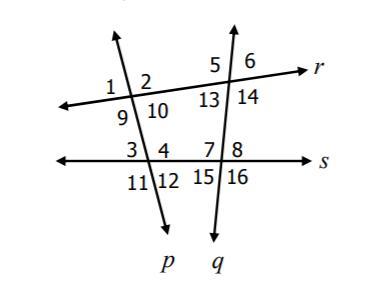
Using the diagram below classify the angle pairs as corresponding, alternate interior angles, alternate exterior angles, consecu

tive interior or none.

Mathematics
1 answer:
QveST [7]2 years ago
5 0

Answer:

The corresponding angles in pairs are;

∠1 and ∠5, ∠2 and ∠6, ∠9 and ∠13, ∠10 and ∠14,

∠3 and ∠7, ∠4 and ∠8, ∠11 and ∠15, ∠12 and ∠16

∠1 and ∠3, ∠2 and ∠4, ∠9 and ∠11, ∠10 and ∠12

∠7 and ∠5, ∠8 and ∠6, ∠15 and ∠13, ∠16 and ∠14

The alternate interior angles are;

∠9 and ∠4, ∠10 and ∠3, ∠8 and ∠13, ∠7 and ∠14

∠2 and ∠13, ∠10 and ∠5, ∠4 and ∠15, ∠7 and ∠12

The alternate exterior angles are;

∠1 and ∠12, ∠2 and ∠11, ∠5 and ∠16, ∠6 and ∠15

∠1 and ∠14, ∠9 and ∠6, ∠3 and ∠16, ∠11 and ∠8

Consecutive interior angles

∠9 and ∠3, ∠10 and ∠4, ∠13 and ∠7, ∠14 and ∠8

∠2 and ∠5, ∠10 and ∠13, ∠4 and ∠7, ∠12 and ∠15

None

Some of the angles without specific relations are;

∠1 and ∠4, ∠2 and ∠3, ∠5 and ∠8, ∠6 and ∠7, ∠9 and ∠12, ∠10 and ∠11, ∠13 and ∠16, ∠14 and ∠15, ∠6 and ∠12, ∠5 and ∠11, ∠1 and ∠16, ∠2 and ∠15, ∠1 and ∠8, ∠2 and ∠12, ∠9 and ∠7, ∠10 and ∠8

Step-by-step explanation:

Corresponding angles are angles on the same side of two lines that are crossed by a given transversal

Alternate interior angles are angles on the inner but opposite sides of two lines crossed by a transversal

Alternate exterior angles are angles on the outer but opposite sides of two lines crossed by a transversal

Consecutive interior angles are angles that are next to each other on the same side of the transversal and in between the two lines.
You might be interested in
Alex bought a new easy chair for $399. She bought it on the '12 months is the same as cash' plan. The contract stated that if no
jek_recluse [69]

Answer:

$ 454.86 : $33.25

Step-by-step explanation:

1.

Alex bought the new easy chair for $ 399 .

If she pays the amount in 13th month. So,  she has to pay the interest of 1 month too , which is, = $ \frac {399 \times 14}{100}

                                    =  $ 55.86

So, total amount she has to pay for the chair,

                       = (cost price of the chair + interest)

                       = $ (399 + 55.86)

                       = $ 454.86  (answer)

2.    

If she wants to pay the amount within the 12 months, so that she doesn't have to pay the interest,  her budget for that for each month will be ,

                               $ \frac {399}{12}

                               = $ 33. 25  (answer)

5 0
2 years ago
Teresa says that because the diagonals of a parallelogram bisect each other, if one diagonal is 4.2 cm, the other diagonal must
saw5 [17]

Answer:

See it in the pic.

Step-by-step explanation:

See it in the pic.

3 0
2 years ago
Find the real numbers x and y if -3+ix^2y and x^2+y+4i are conjugate of each other. Pls solve with the steps
Firdavs [7]
ANSWER
x = ±1 and y = -4.
Either x = +1 or x = -1 will work

EXPLANATION
If -3 + ix²y and x² + y + 4i are complex conjugates, then one of them can be written in the form a + bi and the other in the form a - bi. In other words, between conjugates, the imaginary parts are same in absolute value but different in sign (b and -b). The real parts are the same

For -3 + ix²y
⇒ real part: -3
⇒ imaginary part: x²y

For x² + y + 4i
⇒ real part: x² + y (since x, y are real numbers)
⇒ imaginary part: 4

Therefore, for the two expressions to be conjugates, we must satisfy the two conditions. 

Condition 1: Imaginary parts are same in absolute value but different in sign. We can set the imaginary part of -3 + ix²y to be the negative imaginary part of x² + y + 4i so that the 

   x²y = -4 ... (I)

Condition 2: Real parts are the same

   x² + y = -3 ... (II)

We have a system of equations since both conditions must be satisfied

   x²y = -4 ... (I)
   x² + y = -3 ... (II)

We can rearrange equation (II) so that we have

   y = -3 - x² ... (II)

Substituting into equation (I)

   x²y = -4 ... (I)
   x²(-3 - x²) = -4
   -3x² - x⁴ = -4
   x⁴ + 3x² - 4 = 0
   (x² + 4)(x² - 1) = 0
   (x² + 4)(x-1)(x+1) = 0

Therefore, x = ±1.
Leave alone (x² + 4) as it gives no real solutions.

Solve for y:

   y = -3 - x² ... (II)
   y = -3 - (±1)²
   y = -3 - 1
   y = -4

So x = ±1 and y = -4. We can confirm this results in conjugates by substituting into the expressions:

   -3 + ix²y 
   = -3 + i(±1)²(-4)
   = -3 - 4i

   x² + y + 4i
   = (±1)² - 4 + 4i
   = 1 - 4 + 4i
   = -3 + 4i

They result in conjugates
4 0
2 years ago
Read 2 more answers
Determine if the ordered pair (6, 4) is a solution to the inequality y is greater than negative one half times x plus 7. Yes, be
tia_tia [17]

Answer:

(6,4) is not a solution of y > -x/2 + 7 because (6,4) is on the line

The answer is D.

Hope this helps!

6 0
2 years ago
Read 2 more answers
Let g(x)= -2(3x+4)(x−1)(x−3)^2 be a polynomial function. Name all horizontal and vertical intercepts of the graph. State the end
lesantik [10]

Answer:

The vertical intercepts is

(4/3,0) (3,0) (1,0)

The horinzontial intercepts is

(0,72)

The end behavior is

<em>as x approaches positive infinity, f(x) approaches negative infinity. As x approaches negative infinity, f(x) approaches negative infinity.</em>

Step-by-step explanation:

The vertical or y intercepts will be zeroes of the following factors.

3x + 4 = 0

x - 1 = 0

(x - 3) {}^{2}  = 0

We solve for x each time.

x =  -  \frac{4}{3}

x = 1

x = 3

Part B). We need to find the intercepts by setting the equation equal to zero.

The constant expanded will equal 72.

If x=0,

{0}^{y}  = 0

where y is any real number.

So this means all the exponets will equal 0. The constant will just add to the term. so our horinzontal intercept is

0 + 72 = 72

Part C) End Behavior

The leading degree is even. Even Degree Polynomials like Quadratics tend to go approach positive infinity vertically as x approaches positive infinity, and as x approaches negative infinity, it approaches positive infinity vertically.

Our leading coefficient is negative so this means our quadratic will get reflected across the x axis.

Now this means, as x approaches positive infinity, f(x) approaches negative infinity. As x approaches negative infinity, f(x) approaches negative infinity.

7 0
2 years ago
Other questions:
  • 1. Assume the reserve requirement is 10%. First National Bank receives a deposit of $5,400. If there is no slippage, how much co
    8·1 answer
  • he data set gives the number of hours it took each of the 10 students in a cooking class to master a particular technique. {5, 3
    10·2 answers
  • For what value of x is the equation 2^2x+7 = 2^15 true?
    9·1 answer
  • norma cut a triangle out of construction paper for an art project. the area of the triangle os 84.5 square centimeters. select t
    10·1 answer
  • The​ Adeeva's gross monthly income is ​$5600. They have 18 remaining payments of $ 360 on a new car. They are applying for a 15​
    15·1 answer
  • Consider the graph of the line y = one-halfx – 4 and the point (−4, 2). The slope of a line parallel to the given line is . A po
    12·2 answers
  • Len made 1 1/3 liters of punch. He added 2/5 liters of water to make the punch. How much water was used for each liter of punch?
    8·1 answer
  • The solution generated by the calculator is 5.779E-8. Describe how to interpret the solution.
    11·1 answer
  • A researcher wants to know how professional athletes in her city feel about safety measures. She obtains a list of 952 professio
    12·1 answer
  • You supervise a team of seven workers. You record the number of team members who reach
    12·1 answer
Add answer
Login
Not registered? Fast signup
Signup
Login Signup
Ask question!
