answer.
Ask question
Login Signup
Ask question
All categories
  • English
  • Mathematics
  • Social Studies
  • Business
  • History
  • Health
  • Geography
  • Biology
  • Physics
  • Chemistry
  • Computers and Technology
  • Arts
  • World Languages
  • Spanish
  • French
  • German
  • Advanced Placement (AP)
  • SAT
  • Medicine
  • Law
  • Engineering
ra1l [238]
2 years ago
8

Kris and James are working at a construction site that has a significant amount of stagnant water. Which type of hazard are they

most likely to be exposed to?
Engineering
2 answers:
marusya05 [52]2 years ago
8 0

Answer:

A biological hazard

Explanation:

Biological because insects and other organisms thrive in stagnant water.

valkas [14]2 years ago
7 0

Answer:

Biological

Explanation:

A biological hazard refers to a biological substance such as viruses, insects, fungus, etc. that can affect humans or other animals' health negatively. In the case of Kris and James, they are exposed to a biological hazard because stagnant water is commonly used by mosquitos to place eggs, this leads to a lot of mosquitos around stagnant waters and therefore a higher risk of mosquito-transmitted diseases such as malaria. Besides this, stagnant water is highly polluted and includes bacteria and parasites that are harmful.

You might be interested in
Determine the angular acceleration of the uniform disk if (a) the rotational inertia of the disk is ignored and (b) the inertia
lukranit [14]

Answer:

α = 7.848 rad/s^2  ... Without disk inertia

α = 6.278 rad/s^2  .... With disk inertia

Explanation:

Given:-

- The mass of the disk, M = 5 kg

- The right hanging mass, mb = 4 kg

- The left hanging mass, ma = 6 kg

- The radius of the disk, r = 0.25 m

Find:-

Determine the angular acceleration of the uniform disk without and with considering the inertia of disk

Solution:-

- Assuming the inertia of the disk is negligible. The two masses ( A & B )  are hung over the disk in a pulley system. The disk is supported by a fixed support with hinge at the center of the disk.

- We will make a Free body diagram for each end of the rope/string ties to the masses A and B.

- The tension in the left and right string is considered to be ( T ).

- Apply newton's second law of motion for mass A and mass B.

                      ma*g - T = ma*a

                      T - mb*g = mb*a

Where,

* The tangential linear acceleration ( a ) with which the system of two masses assumed to be particles move with combined constant acceleration.

- g: The gravitational acceleration constant = 9.81 m/s^2

- Sum the two equations for both masses A and B:

                      g* ( ma - mb ) = ( ma + mb )*a

                      a =  g* ( ma - mb ) / ( ma + mb )

                      a = 9.81* ( 6 - 4 ) / ( 6 + 4 ) = 9.81 * ( 2 / 10 )

                      a = 1.962 m/s^2  

- The rope/string moves with linear acceleration of ( a ) which rotates the disk counter-clockwise in the direction of massive object A.

- The linear acceleration always acts tangent to the disk at a distance radius ( r ).

- For no slip conditions, the linear acceleration can be equated to tangential acceleration ( at ). The correlation between linear-rotational kinematics is given below :

                     a = at = 1.962 m/s^2

                     at = r*α      

Where,

           α: The angular acceleration of the object ( disk )

                    α = at / r

                    α = 1.962 / 0.25

                    α = 7.848 rad/s^2                                

- Take moments about the pivot O of the disk. Apply rotational dynamics conditions:


                Sum of moments ∑M = Iα

                 ( Ta - Tb )*r = Iα

- The moment about the pivots are due to masses A and B.


               Ta: The force in string due to mass A

               Tb: The force in string due to mass B

                I: The moment of inertia of disk = 0.5*M*r^2

                   ( ma*a - mb*a )*r = 0.5*M*r^2*α

                   α = ( ma*a - mb*a ) / ( 0.5*M*r )

                   α = ( 6*1.962 - 4*1.962 ) / ( 0.5*5*0.25 )

                   α = ( 3.924 ) / ( 0.625 )

                   α = 6.278 rad/s^2

6 0
2 years ago
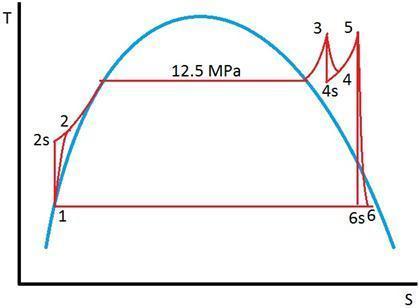
A steam power plant operates on the reheat Rankine cycle. Steam enters the highpressure turbine at 12.5 MPa and 550°C at a rate
gayaneshka [121]

Answer:

A) condenser pressure = 9.73 kPa,

B) 10242 kw

C) 36.9%

Explanation:

given data

entrance pressure of steam = 12.5 MPa

temperature of steam = 550⁰c

flow rate of steam = 7.7 kg/s

outer pressure = 2 MPa

reheated steam temperature = 450⁰c

isentropic efficiency of turbine( nt ) = 85% = 0.85

isentropic efficiency of pump = 90% = 0.90

From steam tables

at 12.5 MPa and 550⁰c ; h3 = 3476.5 kJ/kg,  S3 = 6.6317 kJ/kgK

also for an Isentropic expansion

S4s = S3 .

therefore when S4s = 6.6317 kJ/kg and P4 = 2 MPa

h4s = 2948.1 kJ/kg

nt = 0.85

nt (0.85) = \frac{h3-h4}{h3-h4s} = \frac{3476.5 - h4}{3476.5 - 2948.1}

making h4 subject of the equation

h4 = 3476.5 - 0.85 (3476.5 - 2948.1)

h4 = 3027.3 kj/kg

at P5 = 2 MPa and T5 = 450⁰c

h5 = 3358.2 kj/kg,  s5 = 7.2815 kj/kgk

at P6 , x6 = 0.95  and s5 = s6

using nt = 0.85 we can calculate for h6 and h6s

from the chart attached below we can see that

p6 = 9.73 kPa, h6 = 2463.3 kj/kg

B) the net power output

solution is attached below

c) thermal efficiency

thermal efficiency = 1 - \frac{qout}{qin} = 1 - ( 2273.7/ 3603.8) = 36.9% ≈ 37%

8 0
2 years ago
CHALLENGE ACTIVITY 1.4.1: Basic syntax errors. Type the statements. Then, correct the one syntax error in each statement. Hints:
Lunna [17]

Answer:

Lets check each statement for the errors.

Explanation:

System.out.println("Predictions are hard.");

This statement has no syntax errors. When this statement is executed the following line will be displayed:

Predictions are hard.

System.out.print("Especially ');

This statement is missing the closing quotation mark. A single quotation mark is placed instead of double quotation mark in the statement.

The following error message will be displayed when this program statement will be compiled:

Main.java:15: error: unclosed string literal

String literals use double quotes. So to correct this syntax error, the statement should be changed as follows:

System.out.print("Especially");

The output of this corrected line is as following:

Especially

System.out.println("about the future.").

In this line a period . is placed at the end of the statement instead of a semicolon ; but according to the syntax rules statements should end in semicolons.

The error message displayed when this line is compiled is as following:

Main.java:15: error: ; expected

Main.java:15: error: not a statement

So in order to correct this syntax error the statement should be changed as following:

System.out.println("about the future.");    

The output of this corrected line is as following:

about the future

System.out.println("Num is: " - userName);

There is a syntax error in this statement because of - symbol used instead of +

+ symbol is used to join together a variable and a value a variable and another variable in a single print statement.

The error message displayed when this line is compiled is as following:

Main.java:13: error: bad operand types for binary operator '-'

So in order to correct this syntax error the statement should be changed as following:

System.out.println("Num is: " + userName);

This line will print two things one is the string Num is and the other is the value stored in userName variable.

So let userName= 5 then the output of this corrected line is as following:

Num is: 5

8 0
2 years ago
Which of these is true about airbag charts?
Arlecino [84]
A should be it or b
4 0
2 years ago
The outer surface of an engine is situated in a place where oil leakage can occur. When leaked oil comes in contact with ahot su
VladimirAG [237]

Answer:

TBC thickness of 4 mm is insufficient to prevent fire hazard

Explanation:

Given:

- Temperature of hot-fluid inner surface T_i = 333°C

- The convection coefficient hot-fluid h_i = 7 W/m^2K

- The thermal conductivity of engine cover k_1 = 14 W/mK

- The thickness of engine cover L_1 = 0.01 m

- The thermal conductivity of TBC layer k_2 = 1.1 W/mK  ... (Typing error)

- The thickness of TBC layer L_2 = 0.004 m

- Temperature of ambient air outer surface T_o = 69°C

- The convection coefficient ambient air h_o = 7 W/m^2K

Find:

Would a TBC layer of 4 mm thickness be sufficient to keep the engine cover surface below autoignition temperature of 200°C to prevent fire hazard?

Solution:

- We will use thermal circuit analogy for the 1-D problem and steady state conduction with no heat generation in the cover or TBC layer.

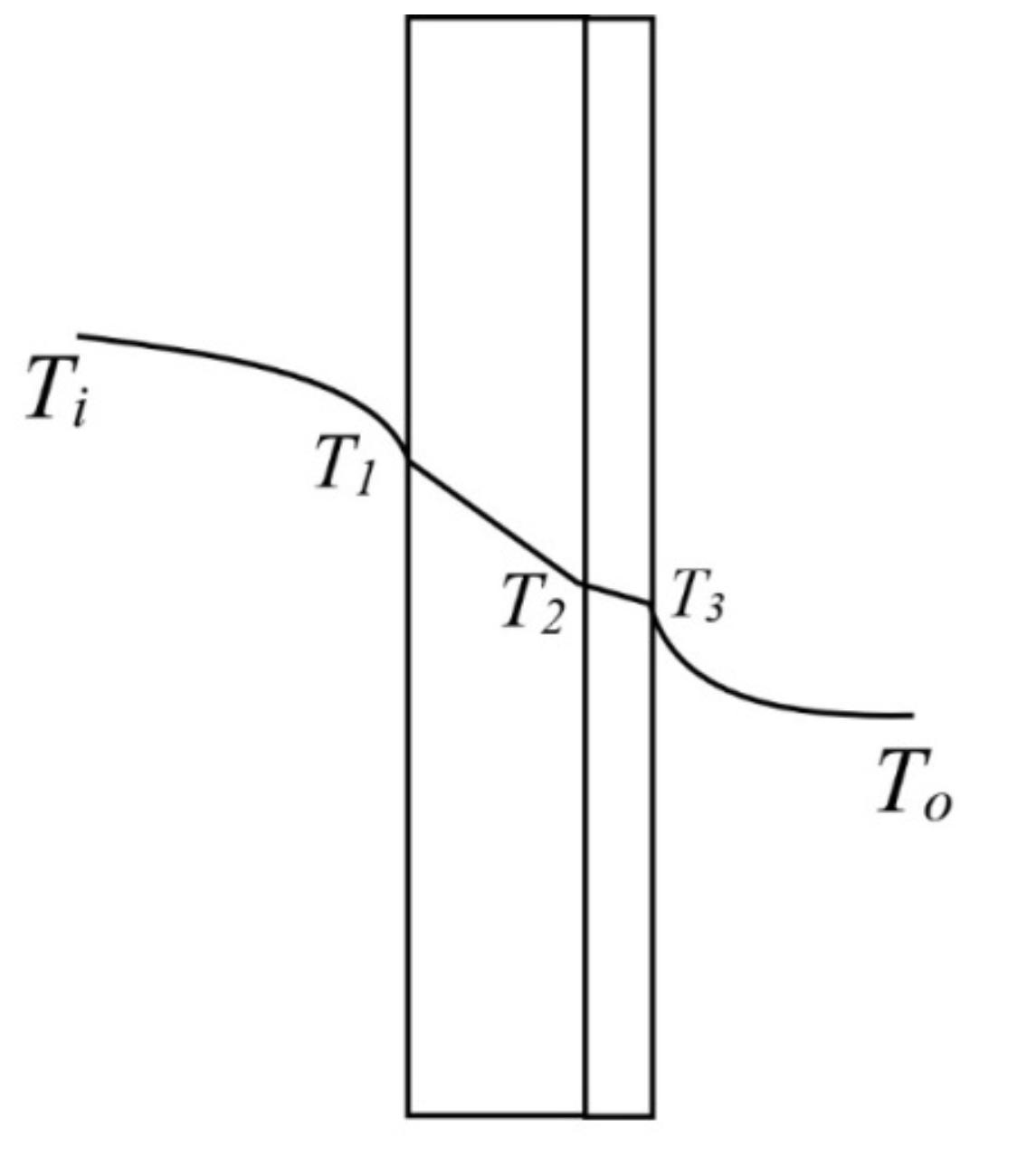
 The temperature at each medium interface and the Thermal resistance for each medium is given in the attachment schematic and circuit analogy.

 - We will calculate the total heat flux for the entire system q:

                       q = ( T_i - T_o ) / R_total

- R_total is the equivalent thermal resistance of the entire circuit. Since all resistances are in series we have:

                       R_total = 1 / h_i + L_1 / k_1 + L_2 / k_2 + 1 / h_o

- Plug in the values and compute:

                       R_total = 1 / 7 + 0.01 / 14 + 0.004 / 1.1 + 1 / 7

                       R_total = 0.2900649351 T-m^2 / W

- Calculate the Total heat flux q:

                       q = ( 333 - 69 ) / 0.2900649351

                       q = 910.141 W / m^2

- Just like the total current in a circuit remains same, the total heat flux remains same. We will use the total heat flux q to calculate the temperature of outer engine surface T_2 as follows:

                      q = ( T_i - T_2 ) / R_i2

Where,

                      R_i2 = 1 / h_i + L_1 / k_1

                      R_i2 = 1 / 7 + 0.01 / 14 = 0.14357 T-m^2 / W

Hence,

                      ( T_i - T_2 ) = q*R_i2

                        T_2 = T_i - q*R_i2

Plug the values in:

                        T_2 = 333 - 910.141*0.14357

                        T_2 = 202.33°C

- The outer surface of the engine cover has a temperature above T_ignition = 200°C. Hence, the TBC thickness of 4 mm is insufficient to prevent fire hazard

3 0
2 years ago
Other questions:
  • A petrol engine produces 20 hp using 35 kW of heat transfer from burning fuel. What is its thermal efficiency, and how much powe
    14·1 answer
  • A steam power plant operates on an ideal reheat- regenerative Rankine cycle and has a net power output of 80 MW. Steam enters th
    10·1 answer
  • You are an electrician on the job. The electrical blueprint shows that eight 500-W lamps are to be installed on the same circuit
    11·1 answer
  • Argon contained in a closed, rigid tank, initially at 33.7°C, 2.1 bar, and a volume of 4.2 m3, is heated to a final pressure of
    12·1 answer
  • or a metal pipe used to pump tomato paste, the overall heat- transfer coefficient based on internal area is 2 W/(m2 K). The insi
    14·1 answer
  • A thin, flat plate that is 0.2 m × 0.2 m on a side is oriented parallel to an atmospheric airstream having a velocity of 40 m/s.
    5·2 answers
  • What action below would tell your computer to "Send" an email?
    14·2 answers
  • The total floor area of a building, including below-grade space but excluding unenclosed areas, measured from the exterior of th
    8·1 answer
  • Use the drop -down menus to select the appropriate question type. Picking between two possible alternatives: Showing an understa
    7·1 answer
  • Is an isothermal process necessarily internally reversible? Explain your answer with an example
    7·1 answer
Add answer
Login
Not registered? Fast signup
Signup
Login Signup
Ask question!