answer.
Ask question
Login Signup
Ask question
All categories
  • English
  • Mathematics
  • Social Studies
  • Business
  • History
  • Health
  • Geography
  • Biology
  • Physics
  • Chemistry
  • Computers and Technology
  • Arts
  • World Languages
  • Spanish
  • French
  • German
  • Advanced Placement (AP)
  • SAT
  • Medicine
  • Law
  • Engineering
omeli [17]
2 years ago
9

The mechanism for the reaction described by 2N2O5(g) ---> 4NO2(g) + O2(g) is suggested to be (1) N2O5(g) (k1)--->(K-1) NO2

(g) + NO3(g) (2) NO2(g) + NO3(g) --->(K2) NO2(g) + O2(g) + NO(g)
(3) NO(g) + N2O5(g) --->(K3) 3NO2(g) Assuming that [NO3] is governed by steady-state conditions, derive the rate law for the production of O2(g) and enter it in the space below.
Rate of reaction= ∆[O2]/∆t = ???
Chemistry
1 answer:
aliina [53]2 years ago
5 0
Go add me on Snapchat christian3cruz
You might be interested in
A student dissolved a sample in hexane, spotted it on to a TLC plate and eluted using ethyl acetate. After visualizing the TLC p
Zepler [3.9K]

1) Consider the following silica gel TLC plate of compounds A, B, and C developed in hexanes:

<span><span>Determine the Rf values of compounds A, B, and C run on a silica gel TLC plate using hexanes as the solvent.</span>Which compound, A, B, or C, is the most polar?<span>What would you expect to happen to the Rf values if you used acetone instead of hexanes as the eluting solvent?</span><span>How would the Rf values change if eluted with hexanes using an alumina TLC plate?</span></span>

Show answer

2) You are trying to determine a TLC solvent system which will separate the compounds X, Y, and Z. You ran the compounds on a TLC plate using hexanes/ethyl acetate 95:5 as the eluting solvent and obtained the chromatogram below. How could you change the solvent system to give better separation of these three compounds?

Show answer

3) After a rather lengthy organic chemistry synthesis procedure, a student ran the product of the reaction on a TLC plate and obtained the result below. What might he/she have done wrong, if anything?

Show answer

4) A student spots an unknown sample on a TLC plate. After developing in hexanes/ethyl acetate 50:50, he/she saw a single spot with an Rf of 0.55. Does this indicate that the unknown material is a pure compound? What can be done to verify the purity of the sample?

Show answer

5) Consider a sample that is a mixture composed of biphenyl, benzoic acid, and benzyl alcohol. The sample is spotted on a TLC plate and developed in a hexanes/ethyl acetate solvent mixture. Predict the relative Rf values for the three compounds in the sample.

Show answer

6) Plate A, below, represents the TLC chromatogram of a compound run in hexanes. The same compound was then spotted on a large TLC plate and again run in hexanes. Which TLC plate, B, C, or D, correctly represents how far the compound would run on the longer plate?

Show answer

Back to TLC

Original content © University of Colorado at Boulder, Department of Chemistry and Biochemistry.
The information on these pages is available for academic use without restriction.
3 0
2 years ago
How many grams of sodium acetate ( molar mass = 83.06 g/mol ) must be added to 1.00 Liter of a 0.200 M acetic acid solution to m
Pie

<u>Answer:</u> The mass of sodium acetate that must be added is 30.23 grams

<u>Explanation:</u>

To calculate the number of moles for given molarity, we use the equation:

\text{Molarity of the solution}=\frac{\text{Moles of solute}}{\text{Volume of solution (in L)}}

Molarity of acetic acid solution = 0.200 M

Volume of solution = 1 L

Putting values in above equation, we get:

0.200M=\frac{\text{Moles of acetic acid}}{1L}\\\\\text{Moles of acetic acid}=(0.200mol/L\times 1L)=0.200mol

To calculate the pH of acidic buffer, we use the equation given by Henderson Hasselbalch:

pH=pK_a+\log(\frac{[\text{salt}]}{[\text{acid}]})  

pH=pK_a+\log(\frac{[CH_3COONa]}{[CH_3COOH]})

We are given:

pK_a = negative logarithm of acid dissociation constant of acetic acid = 4.74

[CH_3COONa]=?mol  

[CH_3COOH]=0.200mol

pH = 5.00

Putting values in above equation, we get:

5=4.74+\log(\frac{[CH_3COONa]}{0.200})

[CH_3COONa]=0.364mol

To calculate the mass of sodium acetate for given number of moles, we use the equation:

\text{Number of moles}=\frac{\text{Given mass}}{\text{Molar mass}}

Molar mass of sodium acetate = 83.06 g/mol

Moles of sodium acetate = 0.364 moles

Putting values in above equation, we get:

0.364mol=\frac{\text{Mass of sodium acetate}}{83.06g/mol}\\\\\text{Mass of sodium acetate}=(0.364mol\times 83.06g/mol)=30.23g

Hence, the mass of sodium acetate that must be added is 30.23 grams

7 0
2 years ago
How much volume (in cm3) is gained by a person who gains 11.1 lbs of pure fat?
kirill [66]

The density of human fat is 0.918 g/cm^{3}. The mass of the pure fat is 11.1 lbs.

First convert mass from lb to g as follows:

1 lb=453.592 g

Thus,

11.1 lb\rightarrow 11.1\times 453.592 g=5034.875 g

Density of a substance is defined as mass per unit volume, thus volume can be calculated as:

V=\frac{m}{d}

Putting the values,

V=\frac{5034.875 g}{0.918 g/cm^{3}}=5484.61 cm^{3}

Therefore, volume gained by person will be 5484.61 cm^{3}.

6 0
2 years ago
When the solutes are evenly distributed throughout a solution, we say the solution has reached _______. when the solutes are eve
german
If the solutes are dispersed evenly in their particular solvent we say that the solution has reached diffusion I believe.
5 0
2 years ago
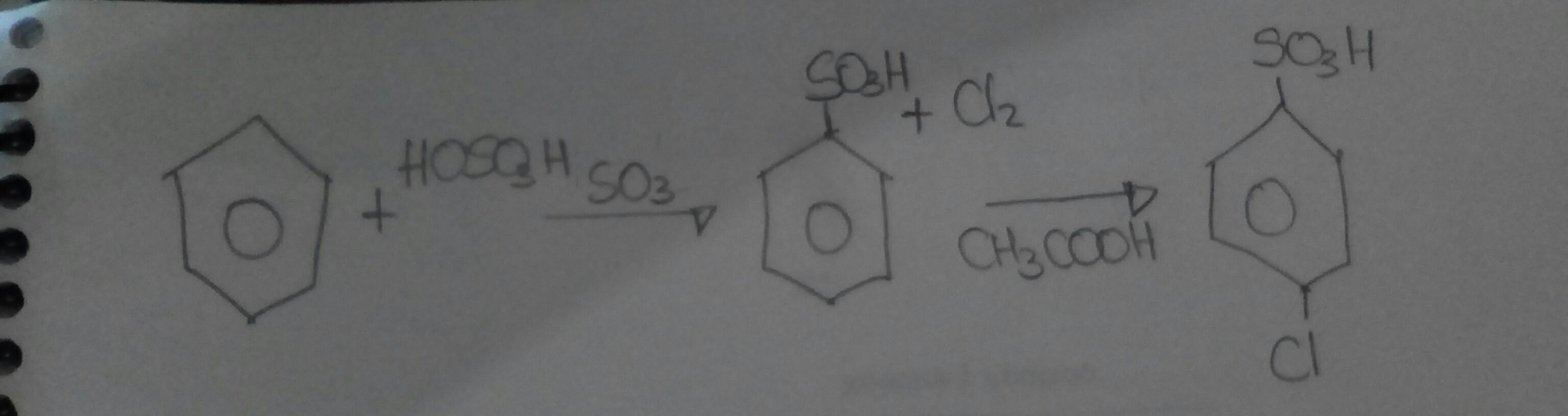
Synthesis of disubstituted benzenes involves two steps, each introducing one of the functional groups. For the synthesis of p-ch
Setler79 [48]

Answer:

The synthesis of p-chlorobenzenesulfonic acid with the reagents for each step and the structure of the monosubstituted intermediate compound is shown in the drawing below.

Explanation:

Benzenesulfonic acid is obtained from the sulfonation of benzene, using concentrated smoking sulfuric acid.

Chlorination of benzenesulfonic acid with chlorine without catalyst requires a polar solvent, such as acetic acid to obtain the selectivity in the position for and the ortho derivative in a low proportion.

7 0
2 years ago
Other questions:
  • A newly discovered element has two isotopes. one has an atomic weight of 120.9038 amu with 57.25% abundance. the other has an at
    14·2 answers
  • In the diagram below, particles of the substance are moving from the liquid phase to the gas phase at the same rate as they move
    11·2 answers
  • True or false when an object is placed in water, the water level falls
    8·2 answers
  • the electron affinity of nitrogen is lower (less negative) than that of both carbon and oxygen. This trend is best explained by
    6·1 answer
  • Which of the following statements concerning the process of spontaneous folding of proteins is false?
    10·2 answers
  • Mgcl2 has a concentration of 0.054 M in the ocean. How many grams are present in 25ml of sea water ​
    8·1 answer
  • Your lab partner named this compound 3-methyl-4-n-propylhexane, but that is not correct.
    9·1 answer
  • When 15.3 g of sodium nitrate, NaNO₃, was dissolved in water in a constant-pressure calorimeter, the temperature fell from 25.00
    8·2 answers
  • A higher temperature of fresh concrete results in a __________ hydration of cement.
    11·1 answer
  • The three aspects of the measuring process are units, systems, and instruments.
    15·2 answers
Add answer
Login
Not registered? Fast signup
Signup
Login Signup
Ask question!