answer.
Ask question
Login Signup
Ask question
All categories
  • English
  • Mathematics
  • Social Studies
  • Business
  • History
  • Health
  • Geography
  • Biology
  • Physics
  • Chemistry
  • Computers and Technology
  • Arts
  • World Languages
  • Spanish
  • French
  • German
  • Advanced Placement (AP)
  • SAT
  • Medicine
  • Law
  • Engineering
Maurinko [17]
2 years ago
9

One employee was climbing a metal ladder to hand an electric drill to the journeyman installer on a scaffold about five feet abo

ve him.
When the victim reached the third rung from the bottom of the ladder he received an electric shock that killed him. The investigation
revealed that the extension cord had a missing grounding prong and that a conductor on the green grounding wire was making
intermittent contact with the energizing black wire thereby energizing the entire length of the grounding wire and the drill's frame.
The drill was not double insulated. What could have been done to prevent this accident?
Stathatay
U
d
f orce
to
ed equipment Grounding conductor program to protect employees on construction sites
Engineering
1 answer:
lbvjy [14]2 years ago
5 0

Answer:

ACCIDENT PREVENTION RECOMMENDATIONS  

Fatal Fact made us to understand some of the prevention techniques as stated below.

1. Use approved ground fault circuit interrupters or an assured equipment grounding conductor program to protect employees on construction sites.  

2. Use equipment that provides a permanent and continuous path from circuits, equipment, structures, conduit or enclosures to ground.

3. Inspect electrical tools and equipment daily and remove damaged or defective equipment from use until it is repaired.

Explanation:

In order to gain a better understanding of the answer above let explain some terms

Ground Fault Circuit Interrupters :

    A ground fault circuit interrupter (GFCI), or Residual Current Device (RCD) is a type of circuit breaker which shuts off electric power when it senses an imbalance between the outgoing and incoming current. The main purpose is to protect people from an electric shock caused when some of the current travels through a person's body due to an electrical fault such as a short circuit, insulation failure, or equipment malfunction.

So the first statement is implying that in order to prevent this accident that  this device (GFCI) should have  been used in that  construction site, or as  an alternative before the  construction commenced  the company should have drafted a lay down conductor program(i.e. a step by step conductor program) that assured equipment grounding  in order to protect employees on construction sites

You might be interested in
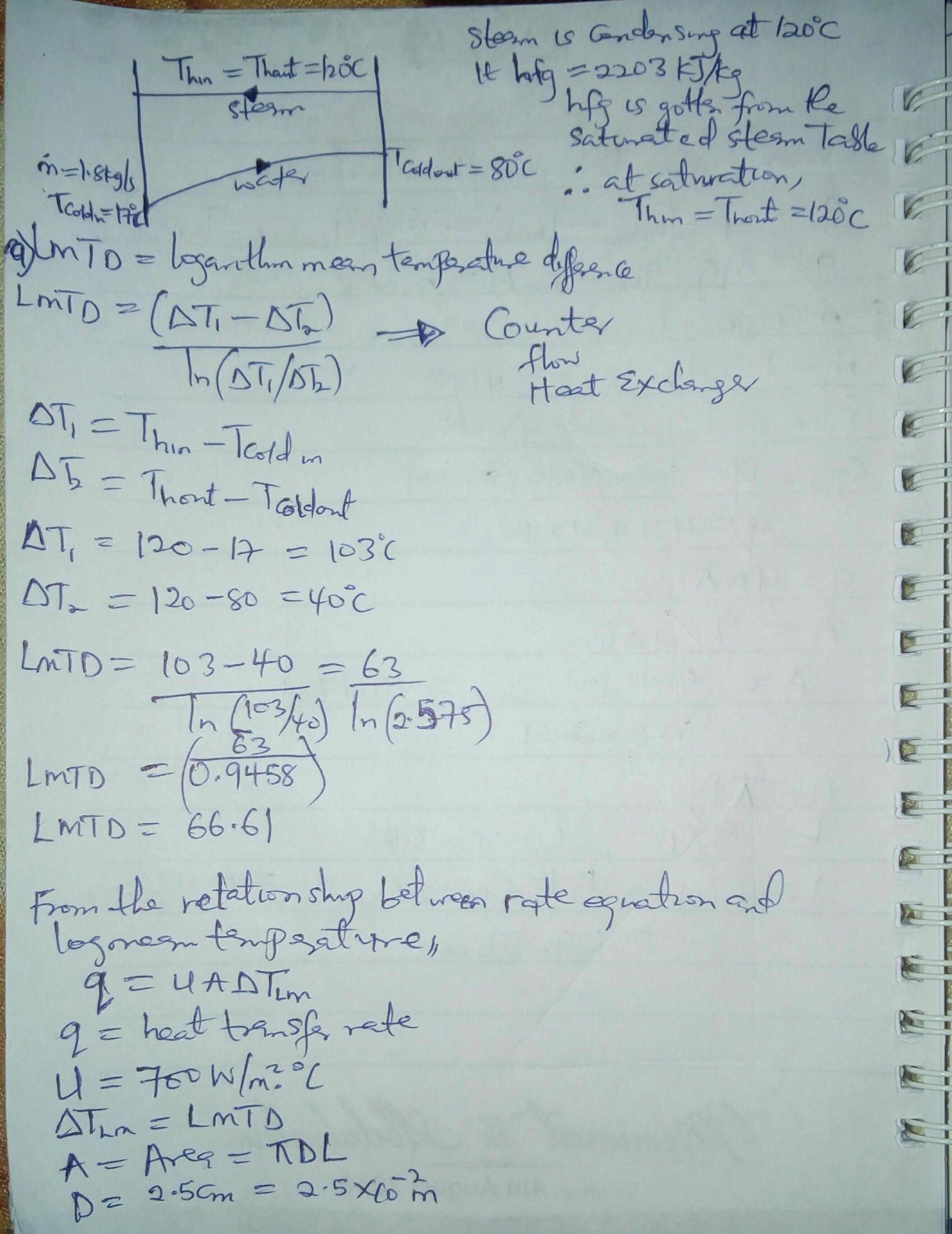
Water (cp = 4180 J/kg·°C) enters the 2.5 cm internal diameter tube of a double-pipe counter-flow heat exchanger at 17°C at a rat
aksik [14]

Answer:

Length = 129.55m, 129.55m

Explanation:

Given:

cp of water = 4180 J/kg·°C

Diameter, D = 2.5 cm

Temperature of water in =  17°C

Temperature of water out = 80°C

mass rate of water =1.8 kg/s.

Steam condensing at 120°C

Temperature at saturation = 120°C

hfg of steam at 120°C = 2203 kJ/kg

overall heat transfer coefficient of the heat exchanger = 700 W/m2 ·°C

U = 700 W/m2 ·°C

Since Temperature of steam is at saturation,

temperature of steam going in = temperature of steam out = 120°C

Energy balance:

Heat gained by water = Heat loss by steam

Let specific capacity of steam = 2010kJ/Kg .°C

Find attached the full solution to the question.

3 0
2 years ago
A double-acting duplex pump with 6.5-in. liners, 2.5-in. rods, and 18-in. strokes was operated at 3,000 psig and 20 cycles/min.
Stella [2.4K]

Answer:

Pump factor = Fp =  7.854 gal/cycle

Ev = 82.00 %

P_H = 183.29 hp

Explanation:

Given data:

Dimension of duplex pump

6.5 inch liner  

2.5 inch rod

18 inch strokes

Pressure 3000 psig

Pit dimension

7 ft wide

20 ft long

Ls = 18 inch

Velocity = (18)/10

volumetric efficiency is given as E_v = (Actual flow rate)/(Theortical flow rate) * 100

we know that flow rate is given as = Area * velocity

Theoritical flow rate = \frac{\pi}{2}\times Ls(2d_l^2 - d_r^2)\times N

Ev = \frac{7\times 12 \times 20\times 12\times 12 \times \frac{18}{10} inch^3/min}{\frac{\pi}{2} \times 18 (2\times 6.5^2 -2.5^2) \times 20}

Ev = 82.00 %

Pump factor Fp = = \frac{\pi}{2}\times Ls(2d_l^2 - d_r^2)\times Ev

Fp =\frac{\pi}{2} \times 18 (2\times 6.5^2 -2.5^2) \times 0.82

Fp = 1814.22 in^3/cyl

Fp =  7.854 gal/cycle

Flow rate q = NFp = 20 \times 7.854 = 157.08 gal/min

Power Ph = \frac{\DeltaP q}{1714} = \frac{3000 \times 157.08}{1714} = 274.93 hp

6 0
2 years ago
The roof of a building frame is subjected to the wind loading shown. Determine (a) the equivalent force-couple system at D, (b)
bulgar [2K]

Answer:

quivalent force-couple system at D, (b) the resultant of the loading and its line of action.Explanation:

5 0
2 years ago
Which situation is an enabler for the rise of Artificial Intelligence (AI) in recent years?
Vladimir [108]

Explanation:

Which situation is an enabler for the rise of Artificial Intelligence (A in recent years? availability of cloud-based, hosted machine learning platforms.

8 0
2 years ago
Read 2 more answers
A hand crank generator is used to power a light bulb. The person turning the crank uses 22 Newtons of input force to turn the cr
ikadub [295]

Answer:

1. The input power is 17.6 Watts

2. The output power is 0.7232 Watts

3.The efficiency of the hand crank generator is approximately 4.109%

Explanation:

The given parameters are;

The force with which the crank generator is turned = 22 Newtons

The rate at which the crank is turned = 8 revolutions per 3 seconds

The distance the hand moves during each revolution = 0.3 meters

The current recorded by the multimeter = 0.08 amps

The voltage recorded by the multimeter = 9.04 volts

1. Power = The rate of doing work = Work done/(Time taken to do the work) = Force × Distance/Time

∴ The power input of the hand crank generator = 22 × 0.3 × 8/3 = 17.6 Watts

2. The power output to the bulb, P, is given by the formula for electrical power as follows;

Power = Current, I × Voltage V

∴ P = 0.08 ×  9.04 = 0.7232 Watts

3. Efficiency in percentage = Output/Input × 100

Therefore, the efficiency of the hand crank generator = )Output power/(Input power)) × 100 = (0.7232/17.6) × 100 ≈ 4.109%


8 0
2 years ago
Other questions:
  • Six years ago, an 80-kW diesel electric set cost $160,000. The cost index for this class of equipment six years ago was 187 and
    8·1 answer
  • The pump of a water distribution system is powered by a 6-kW electric motor whose efficiency is 95 percent. The water flow rate
    5·1 answer
  • A system consisting of 3 lb of water vapor in a piston–cylinder assembly, initially at 350°F and a volume of 71.7 ft3, is expand
    11·1 answer
  • PDAs with two stacks are strictly more powerful than PDAs with one stack. Prove that 2-stack PDAs are not a valid model for CFLs
    12·1 answer
  • A charge of 2.0 × 10⁻¹⁰ C is to be stored on each plate of a parallel-plate capacitor having an area of 650 mm2 (1.0 in.2 ) and
    14·1 answer
  • The uniform 8–ft board is pushed down into the water so it makes an angle of θ = 30o with the water surface. If the cross sectio
    14·1 answer
  • The in situ moist unit weight of a soil is 17.3 kN/m^3 and the moisture content is 16%. The specific gravity of soil solids is 2
    11·1 answer
  • Refrigerant-134a enters the coils of the evaporator of a refrigeration system as a saturated liquid–vapor mixture at a pressure
    5·1 answer
  • Air ows steadily in a thermally insulated pipe with a constant diameter of 6.35 cm, and an average friction factor of 0.005. At
    5·1 answer
  • 1. A _____ is applied to a wall or roof rafters to add strength and keep the building straight and plumb.
    9·1 answer
Add answer
Login
Not registered? Fast signup
Signup
Login Signup
Ask question!