answer.
Ask question
Login Signup
Ask question
All categories
  • English
  • Mathematics
  • Social Studies
  • Business
  • History
  • Health
  • Geography
  • Biology
  • Physics
  • Chemistry
  • Computers and Technology
  • Arts
  • World Languages
  • Spanish
  • French
  • German
  • Advanced Placement (AP)
  • SAT
  • Medicine
  • Law
  • Engineering
SOVA2 [1]
1 year ago
8

Suppose that the Celsius temperature at the point (x, y) in the xy-plane is T(x, y) = x sin 2y and that distance in the xy-plane

is measured in meters. A particle is moving clockwise around the circle of radius 1 m centered at the origin at the constant rate of 2 m/sec.How fast is the temperature experienced by the particle changing in degrees Celsius per meter at the point?
Mathematics
1 answer:
liraira [26]1 year ago
3 0

Missing information:

How fast is the temperature experienced by the particle changing in degrees Celsius per meter at the point

P = (\frac{1}{2}, \frac{\sqrt 3}{2})

Answer:

Rate = 0.935042^\circ /cm

Step-by-step explanation:

Given

P = (\frac{1}{2}, \frac{\sqrt 3}{2})

T(x,y) =x\sin2y

r = 1m

v = 2m/s

Express the given point P as a unit tangent vector:

P = (\frac{1}{2}, \frac{\sqrt 3}{2})

u = \frac{\sqrt 3}{2}i - \frac{1}{2}j

Next, find the gradient of P and T using: \triangle T = \nabla T * u

Where

\nabla T|_{(\frac{1}{2}, \frac{\sqrt 3}{2})}  = (sin \sqrt 3)i + (cos \sqrt 3)j

So: the gradient becomes:

\triangle T = \nabla T * u

\triangle T = [(sin \sqrt 3)i + (cos \sqrt 3)j] *  [\frac{\sqrt 3}{2}i - \frac{1}{2}j]

By vector multiplication, we have:

\triangle T = (sin \sqrt 3)*  \frac{\sqrt 3}{2} - (cos \sqrt 3)  \frac{1}{2}

\triangle T = 0.9870 * 0.8660 - (-0.1606 * 0.5)

\triangle T = 0.9870 * 0.8660 +0.1606 * 0.5

\triangle T = 0.935042

Hence, the rate is:

Rate = \triangle T = 0.935042^\circ /cm

You might be interested in
Marcos gana S/18,50 por hora y se le descuenta
Talja [164]

Answer:

$76,9

Step-by-step explanation:

Para calcular cuánto ganó Marcos ese día, tienes que multiplicar el salario por hora por el número de horas que trabajó y restarle el valor por los minutos que llegó tarde que es el resultado de multiplicar los minutos que llegó tarde por el valor a descontar por minuto:

salario: $18,50 por hora

número de horas trabajadas: 5

descuento por tardanza: $1,20 por minuto

número de minutos de tardanza: 13 minutos

salario del día=($18,50*5)-($1,20*13)

salario del día=$92,5-$15,6

salario del día=$76,9

De acuerdo con esto, el salario que Marcos ganó ese día es $76,9.

4 0
2 years ago
A person is watching a boat from the top of a lighthouse. The boat is approaching the lighthouse directly. When first noticed, t
maksim [4K]

Answer:

Boat traveled 553.24 feet towards the lighthouse.

Step-by-step explanation:

In the figure attached AB is the light house of height 200 feet.

Angle of depression of the boat from the top of a lighthouse = angle of elevation of the lighthouse from the boat = 14°52'

so 1' = \frac{1}{60} degree

so angle of elevation at point C = 14 + \frac{52}{60}

So angle of elevation from C = (14 + 0.87) = 14.87°

Similarly, when boat arrives at point D angle of elevation = 45°10' = 45 + \frac{10}{60} = 45.17°

Now we have to calculate the distance CD, traveled by the boat.

In ΔABC

tan14.87 = \frac{200}{BC}

0.2655 =  \frac{200}{BC}

BC = \frac{200}{0.26552}

BC = 753.239 feet

Similarly in ΔABD

tan45.17 = \frac{200}{BD}

1 = \frac{200}{BD}

BD = 200 feet

So distance CD = BC - BD

CD = 753.239 - 200

     = 553.24 feet

Therefore, Boat traveled 553.24 feet towards the lighthouse.

7 0
2 years ago
Read 2 more answers
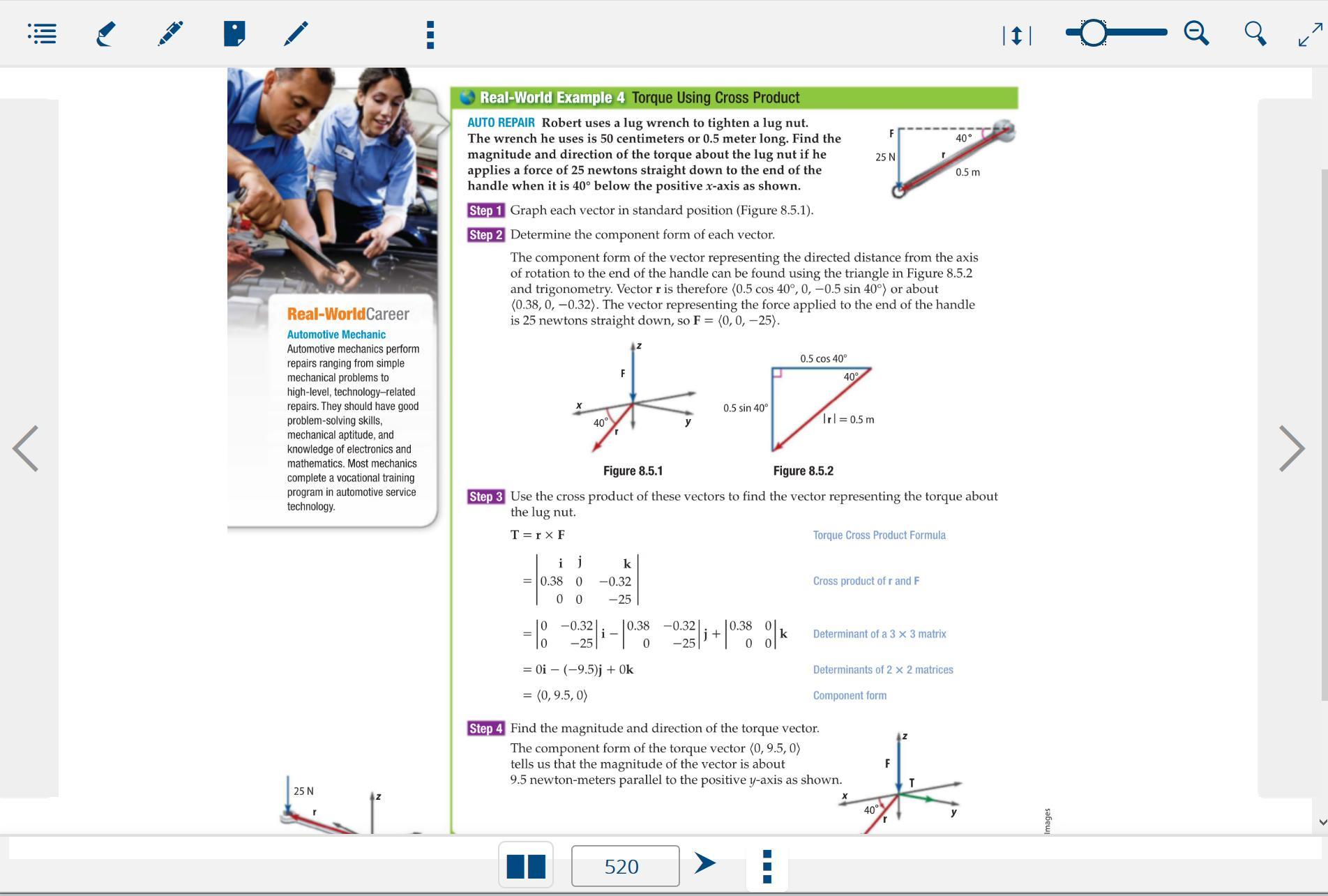
While doing bicep curls, Tamara applies 155 Newtons of force to lift the dumbbell. Her forearm is 0.366 meters long and she begi
Simora [160]

Answer:

4.025 meters

Step-by-step explanation:

Follow steps in precalculus textbook p. 520

5 0
2 years ago
Write the numbers in ascending order
nadezda [96]

-√2, 0, √5, 13/4

-1.5, 3/4, 3, √10

-3/2, -3/7, 0.75, 2

8 0
2 years ago
A scientist measured the energy of a system and found that it was increasing. The data shown represent the energy taken every bi
DiKsa [7]

At start ( t = 0 nanoseconds ) :

E ( t = 0 ) = 2.645 J

E ( t = 1 ) = 6.290 J

E ( t = 1 ) : E ( t = 0 ) = 6.290 : 2.645 = 2.37

Also:

E ( t = 2 ) : E ( t = 1 ) = 14.909 : 6.290 = 2.37

E ( t = 3 ) ; E ( t = 2 ) = 35.335 : 14.909 = 2.37

Therefore, the formula for calculating the energy of the system is:

E ( t ) = 2.645 * 2.37 ^ t

The answer is 4) exponential growth.


3 0
2 years ago
Read 2 more answers
Other questions:
  • What are these fractions in simplest form?
    10·1 answer
  • What are the dimensions of the rectangle shown below? Remember to use the axes on the coordinate grid to help you.
    15·1 answer
  • The sum of two consecutive odd numbers is 284
    11·1 answer
  • What is the balance on an amortized loan of $110,000 after the first payment if the interest rate is 5.5% with a monthly P&I
    7·1 answer
  • You and a friend play a game where you each toss a balanced coin. If the upper faces on the coins are both tails, you win $1; if
    13·1 answer
  • g In a survey of 500 residents, 300 were opposed to the use of the photo-cop for issuing traffic tickets.The standard error of t
    5·1 answer
  • PLZ helPZ me Wendell plans to paint the doghouse after it’s built. He wants to know what the surface area of the outside of the
    12·2 answers
  • Tammy got a new credit card with an APR of 21% a month ago, and she just
    12·1 answer
  • A salesperson earns $8 per hour plus 6% commission on her sales. In a week when she worked 40 hours, her total earnings were $69
    5·1 answer
  • Jada’s babysitter is four times Jada’s current age. In 5 years, Jada will be half her babysitter’s current age.
    10·1 answer
Add answer
Login
Not registered? Fast signup
Signup
Login Signup
Ask question!