answer.
Ask question
Login Signup
Ask question
All categories
  • English
  • Mathematics
  • Social Studies
  • Business
  • History
  • Health
  • Geography
  • Biology
  • Physics
  • Chemistry
  • Computers and Technology
  • Arts
  • World Languages
  • Spanish
  • French
  • German
  • Advanced Placement (AP)
  • SAT
  • Medicine
  • Law
  • Engineering
tresset_1 [31]
2 years ago
15

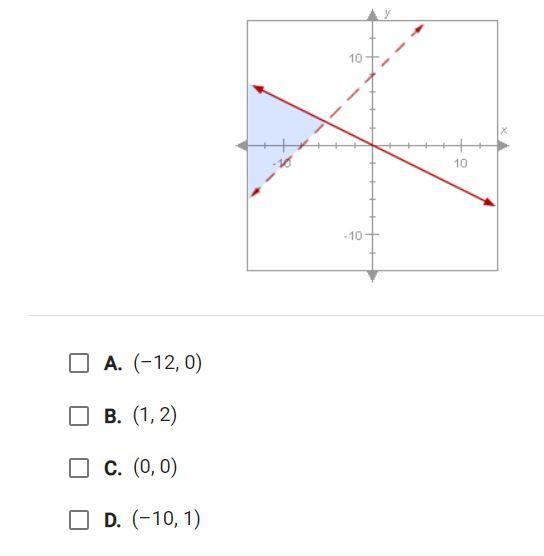
Select the points that are solutions to the system of inequalities. Select all that apply A. (-12, 0) B. (1, 2) C. (0, 0) D. (-1

0, 1)

Mathematics
1 answer:
Eddi Din [679]2 years ago
4 0

Answer:

B. (1, 2)

D. (-10, 1)

Step-by-step explanation:

Both points land in the highlighted area.

Hope this helps! :)

You might be interested in
a rectangular field has side lengths that measure 9/10 mile and 1/2 mile. What is the area of the field
GrogVix [38]

Answer:

9/20, or 0.45 mile.

Step-by-step explanation:\\

To find the area of a rectangle, multiply length times width. In this problem we are given both the length and width.

\frac{9}{10} × \frac{1\\}{2} is just 9/20, which is 0.45.

7 0
2 years ago
If Ana devotes all her time to making fudge, she can make 3 pounds of fudge an hour, and if he devotes all her time to making to
lara [203]

Answer: If Ana produce more furge and Leo produce more toffee.

Step-by-step explanation:

Comparative advantage: A country or a person has a comparative advantage in producing a commodity if the opportunity cost of producing that commodity is lower in that country as compared to the other country.

Here Ana or Leo will gain comparative advantage only when they are selling the good they are specializing in and they would specialize in that good which would have lower opportunity cost for them.

(a) For Ana who devoted all of her time to making either 3 pounds of fudge or 2 pounds of toffee,

the opportunity cost for making 1 pound of furge is = 2/3 = 0.66

the opportunity cost for making 1 pound of toffee is = 3/2 = 1.5

(b) For Leo who devoted all of her time to making either 4 pounds of fudge or 5 pounds of toffee,

the opportunity cost for making 1 pound of furge is = 5/4 = 1.25

the opportunity cost for making 1 pound of toffee is = 4/5 = 0.8

Above calculations clearly shows that Ana has a comparative advantage in producing furge because opportunity cost of making furge is lower than the Leo, so he devotes most of his time to produce furge.

Whereas Leo has a comparative advantage in producing Toffee because opportunity cost of making toffee is lower than the Ana, so he devotes most of his time to produce toffee.
7 0
2 years ago
Chandresh is helping his father paint the fence in their back yard. The fence is represented by the shaded part of the diagram b
Lyrx [107]

B. The total area painted is 864; they must buy two cans of paint.

Step-by-step explanation:

Step 1:

A rectangle's area can be calculated by multiplying its length and its width. The wall is made up of 5 different types of rectangular walls. All walls are 8 feet tall but the length varies.

Step 2:

The area of the 20 feet long wall = (length)(width)= (20)(8) =160,

The area of the 10 feet long wall = (length)(width)= (10)(8) =80,

The area of the 5 feet long wall = (length)(width)= (5)(8) =40,

The area of the 4 feet long wall = (length)(width)= (4)(8) =32,

The area of the 15 feet long wall = (length)(width)= (15)(8) =120.

The area of all the walls = 432 square feet.

Since there are two sides for every wall, total area = 432(2)=864 square feet.

Step 3:

If one paint can covers 500 square feet,

the number of cans required to paint 864 square feet = \frac{864}{500} = 1.728 cans.

so 2 paint cans are needed to paint 864 square feet which is option B.

7 0
2 years ago
An oblique prism has trapezoidal bases and a vertical height of 10 units. An oblique trapezoidal prism is shown. The trapezoid h
hichkok12 [17]

Answer:

30x² cubic units

Step-by-step explanation:

The volume of an Oblique prism = Base Area × Height

This oblique prism has trapezoidal bases.

Area of a Trapezoid = 1/2 × h × ( b1+b2)

where h = height

b1 and b2 = bases of the Trapezoid.

From the question,

h = 20

b1 = x

b2 = 2x

Area of the Trapezoid =

1/2 × x ×( x + 2x)

1/2 × x × (3x)

3x²/2 square units.

Remember, the volume of an Oblique prism = Base Area × Height

Height of the prism = The distance between the 2 trapezoid bases = 20 units.

Base Area = 3x²/2 square units × 20 units

= 30x² cubic units

3 0
2 years ago
What digit is in the ten thousands place 9,435,678
Maru [420]
Easy the 3 is in the ten thousands place
5 0
2 years ago
Other questions:
  • What did the athlete order when he needed a huge helping of mashed potatoes? Unscramble the following letters: p, p, r, o, m, n,
    7·2 answers
  • What is the product? (5r − 4)(r2 − 6r + 4)
    13·2 answers
  • A bank received an initial deposit of $12,000, kept a percentage of this money in reserve based on a reserve rate of 6%, and loa
    12·1 answer
  • Which is the endpoint of a ray?<br><br> point R<br> point S<br> point T<br> point U
    17·3 answers
  • Arrange the steps in the correct order to solve the equation 3 (2^2t-5 )- 4=10
    5·2 answers
  • A 15-foot flagpole leans slightly, such that it makes an 80° angle with the ground. The shadow of the flagpole is 10 feet long w
    5·2 answers
  • Kelly, Laura, and Tia so boxes of cookies for a fundraiser. Kelly sold 15 boxes less than Laura. Tia so twice as many boxes as K
    15·2 answers
  • Four people at pia’s pottery shop each make 29 mugs and 18 pottery bowls three people at Jason’s craft shop each make the same n
    8·1 answer
  • The information below is the number of daily emergency service calls made by the volunteer ambulance service of Walterboro, Sout
    12·1 answer
  • Dylan invested $93,000 in an account paying an interest rate of 3% compounded quarterly. Assuming no deposits or withdrawals are
    5·1 answer
Add answer
Login
Not registered? Fast signup
Signup
Login Signup
Ask question!
