answer.
Ask question
Login Signup
Ask question
All categories
  • English
  • Mathematics
  • Social Studies
  • Business
  • History
  • Health
  • Geography
  • Biology
  • Physics
  • Chemistry
  • Computers and Technology
  • Arts
  • World Languages
  • Spanish
  • French
  • German
  • Advanced Placement (AP)
  • SAT
  • Medicine
  • Law
  • Engineering
beks73 [17]
2 years ago
13

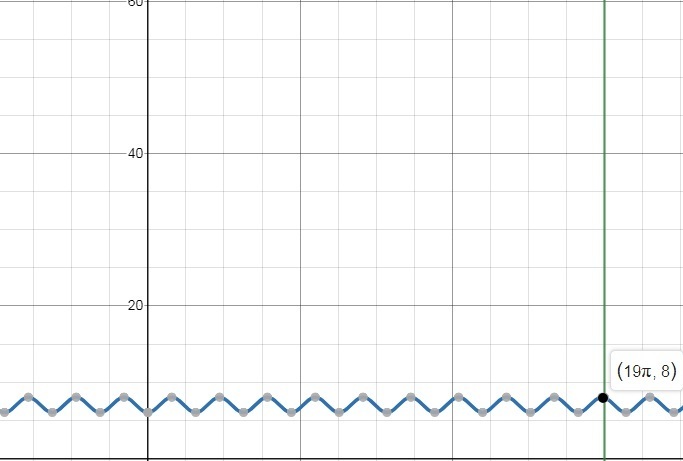
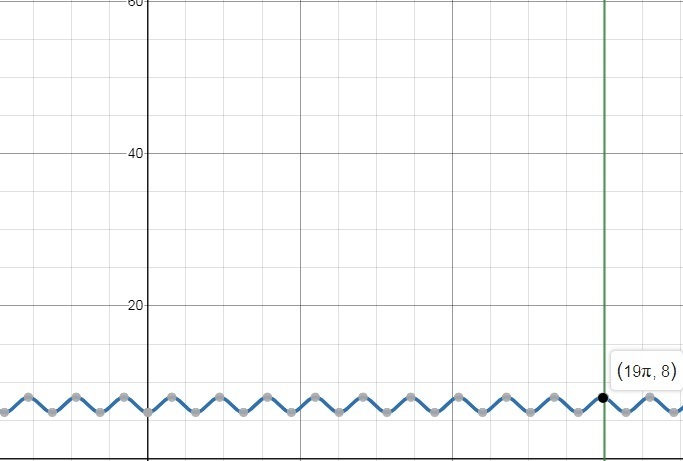
Graph the function y = –cos(x) + 7 and explain how to find the number of times the gum returns to the wall as it travels a dista

nce of 60 feet.

Mathematics
2 answers:
Veseljchak [2.6K]2 years ago
5 0

Answer:

The number of times the graph touches the bottom line is 9.

Step-by-step explanation:

We have been given the function:

y=-cos(x)+7

We will first graph the given function And since, we have to find number of gums returns to the wall as it travels a distance of 60 feet.

So we will count the number of times the graph touches the bottom line till the point x=60

You can look at the graph attached in the attachment.

The number of times the graph touches the bottom line is 9.

love history [14]2 years ago
3 0
The gum returns to the wall each time the graph shows a minimum value of 6 (the height of the wall).<span>Count the number of minimums that occur between x = 0 ft and x = 60 (but omit the first time when x = 0).</span><span>The gum returns to the wall 9 times while traveling a distance of 60 feet.</span>
You might be interested in
Which image (A'B'C'D') of ABCD cannot be produced using only reflections? A. B. C. D.
liberstina [14]

Answer:

the answer is D

Step-by-step explanation:

3 0
2 years ago
Counting from 1 to 46, how many 4s will you encounter? 8 10 11 12 14
Ray Of Light [21]

Answer:

11

Step-by-step explanation:

4=1

14=2

24=3

34=4

40=5

41=6

42=7

43=8

44=9

45=10

46=11

You will encounter 11 4s.

5 0
2 years ago
PROBLEM SOLVING You are participating in an orienteering competition. The diagram shows the position of a river that cuts throug
Wewaii [24]

Answer:

The shortest distance is 2.2 miles      

Step-by-step explanation:

we know that

The shortest distance you must travel to reach the river is the perpendicular distance to the river

step 1

Find the slope of the line perpendicular to the river

we have

y=3x+2

The slope of the river  is m=3

Remember that if two lines are perpendicular, then their slopes are opposite reciprocal (the product of their slopes is -1)

therefore

The slope of the line perpendicular to the river is

m=-1/3

step 2

Find the equation of the line into point slope form

y-y1=m(x-x1)

we have

m=-1/3

point(2,1)

substitute

y-1=-(1/3)(x-2)

step 3

Find the intersection point of the river and the line perpendicular to the river

we have

y=3x+2 ------> equation A

y-1=-(1/3)(x-2) -----> equation B

Solve the system by graphing

The intersection point is (-0.1,1,7)

see the attached figure

step 3

Find the distance between the points (2,1) and (-0,1,1.7)

the formula to calculate the distance between two points is equal to

d=\sqrt{(y2-y1)^{2}+(x2-x1)^{2}}

substitute

d=\sqrt{(1.7-1)^{2}+(-0.1-2)^{2}}

d=\sqrt{(0.7)^{2}+(-2.1)^{2}}

d=2.2\ miles

6 0
2 years ago
"An ordinance requiring that a smoke detector be installed in all previously constructed houses has been in effect in a particul
Galina-37 [17]

Answer:

a) Probability that the claim is rejected when the actual value of p is 0.8 = P(X ≤ 15) = 0.0173

b) Probability of not rejecting the claim when p = 0.7, P(X > 15) = 0.8106

when p = 0.6, P(X > 15) = 0.4246

c) Check Explanation

The error probabilities are evidently lower when 15 is replaced with 14 in the calculations.

Step-by-step explanation:

p is the true proportion of houses with smoke detectors and p = 0.80

The claim that 80% of houses have smoke detectors is rejected if in a sample of 25 houses, not more than 15 houses have smoke detectors.

If X is the number of homes with detectors among the 25 sampled

a) Probability that the claim is rejected when the actual value of p is 0.8 = P(X ≤ 15)

This is a binomial distribution problem

A binomial experiment is one in which the probability of success doesn't change with every run or number of trials (probability that each house has a detector is 0.80)

It usually consists of a number of runs/trials with only two possible outcomes, a success or a failure (we are sampling 25 houses with each of them either having or not having a detector)

The outcome of each trial/run of a binomial experiment is independent of one another.

Binomial distribution function is represented by

P(X = x) = ⁿCₓ pˣ qⁿ⁻ˣ

n = total number of sample spaces = 25 houses sampled

x = Number of successes required = less than or equal to 15

p = probability of success = probability that a house has smoke detectors = 0.80

q = probability of failure = probability that a house does NOT have smoke detectors = 1 - p = 1 - 0.80 = 0.20

P(X ≤ 15) = Sum of probabilities from P(X = 0) to P(X = 15) = 0.01733186954 = 0.01733

b) Probability of not rejecting the claim when p= 0.7 when p= 0.6

For us not to reject the claim, we need more than 15 houses with detectors, hence, th is probability = P(X > 15), but p = 0.7 and 0.6 respectively for this question.

n = total number of sample spaces = 25 houses sampled

x = Number of successes required = more than 15

p = probability that a house has smoke detectors = 0.70, then 0.60

q = probability of failure = probability that a house does NOT have smoke detectors = 1 - p = 1 - 0.70 = 0.30

And 1 - 0.60 = 0.40

P(X > 15) = sum of probabilities from P(X = 15) to P(X = 25)

When p = 0.70, P(X > 15) = 0.8105639765 = 0.8106

When p = 0.60, P(X > 15) = 0.42461701767 = 0.4246

c) How do the "error probabilities" of parts (a) and (b) change if the value 15 in the decision rule is replaced by 14.

The error probabilities include the probability of the claim being false.

When X = 15

(Error probability when p = 0.80) = 0.0173

when p = 0.70, error probability = P(X ≤ 15) = 1 - P(X > 15) = 1 - 0.8106 = 0.1894

when p = 0.60, error probability = 1 - 0.4246 = 0.5754

When X = 14

(Error probability when p = 0.80) = P(X ≤ 14) = 0.00555

when p = 0.70, error probability = P(X ≤ 14) = 0.0978

when p = 0.60, error probability = P(X ≤ 14) = 0.4142

The error probabilities are evidently lower when 15 is replaced with 14 in the calculations.

Hope this Helps!!!
6 0
2 years ago
Which statement best explains the relationship between lines FG and HJ?
Taya2010 [7]

Answer:they are not perpendicular because their slopes are not negative reciprocals.

Step-by-step explanation:

FG’s slope is 3/4 while HJ’s slope is 2/3. i just had this question on my test lol

5 0
2 years ago
Read 2 more answers
Other questions:
  • Which of the following statements is true? a. sin 30° = cos 30° b. sin 35° = cos 55° c. sin 60° = cos 60° d. sin 55° = cos 25°
    13·2 answers
  • Evaluate 3/2y-3+ 5/3z when y= 6 and z=3
    7·2 answers
  • Kyle got in the elevator on the 7th floor. He rode up 2 floors and then down 5 floors. Which expression represents the floor Kyl
    7·2 answers
  • Five out of eight birds that visited the feeder ate the birdseed. If 60 ate the birdseed today, how many birds visited the feede
    7·2 answers
  • A furniture store is having a sale on sofas and you're going to buy one. The advertisers know that buyers get to the store and t
    6·1 answer
  • Ramon wants to plant cucumbers and tomatoes in his garden. He has room for
    12·2 answers
  • 5) Linda picked a basket of apples. She gave half of the apples to a neighbor, then 10 apples to her mother, then half of the re
    15·1 answer
  • A company produces a women's bowling ball that is supposed to weigh exactly 14 pounds. Unfortunately, the company has a problem
    15·2 answers
  • A study of long-distance phone calls made from General Electric Corporate Headquarters in Fairfield, Connecticut, revealed the l
    14·1 answer
  • The base of an aquarium with given volume V is made of slate and the sides are made of glass. If the slate costs seven times as
    8·1 answer
Add answer
Login
Not registered? Fast signup
Signup
Login Signup
Ask question!