answer.
Ask question
Login Signup
Ask question
All categories
  • English
  • Mathematics
  • Social Studies
  • Business
  • History
  • Health
  • Geography
  • Biology
  • Physics
  • Chemistry
  • Computers and Technology
  • Arts
  • World Languages
  • Spanish
  • French
  • German
  • Advanced Placement (AP)
  • SAT
  • Medicine
  • Law
  • Engineering
Irina18 [472]
2 years ago
3

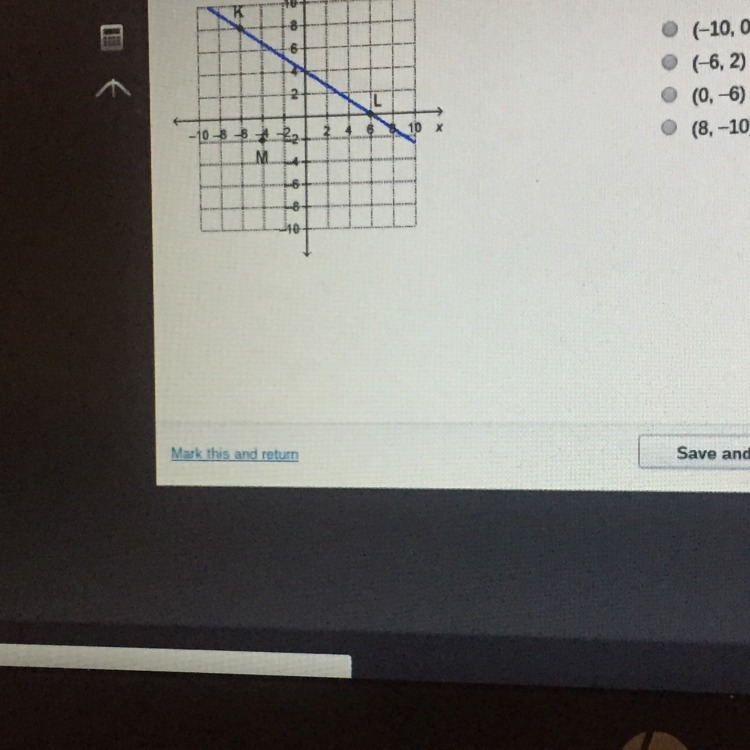
Which point could be on line that is parallel to line kl and passes through point m?

Mathematics
2 answers:
pshichka [43]2 years ago
7 0

Step 1

<u>Find the slope of the line KL</u>

we know that

The formula to calculate the slope between two points is equal to

m=\frac{y2-y1}{x2-x1}

we have

K(-6,8)\ L(6,0)

substitute the values

m=\frac{0-8}{6+6}

m=\frac{-8}{12}                                              

m=-\frac{2}{3}

Remember that

If two lines are parallel . then their slope are equal

we are going to calculate the slope of the line between point M and the different points. If the slope is equal to the slope of the line KL,  then the point could be on line that is parallel to the line KL and passes through the point M.

Step 2

<u>Find the slope of the points </u>

M(-4,-2)\ A(-10,0)  

substitute the values in the formula

m=\frac{0+2}{-10+4}

m=\frac{2}{-6}

m=-\frac{1}{3}

The slope of the line MA is not equal to the slope of the line KL

-\frac{1}{3}\neq -\frac{2}{3}

therefore

The point A could not be on line that is parallel to the line KL and passes through the point M

Step 3

<u>Find the slope of the points </u>

M(-4,-2)\ B(-6,2)  

substitute the values in the formula

m=\frac{2+2}{-6+4}

m=\frac{4}{-2}

m=-2

The slope of the line MB is not equal to the slope of the line KL

-2\neq -\frac{2}{3}

therefore

The point B could not be on line that is parallel to the line KL and passes through the point M

Step 4

<u>Find the slope of the points </u>

M(-4,-2)\ C(0,-6)  

substitute the values in the formula

m=\frac{-6+2}{0+4}

m=\frac{-4}{4}

m=-1

The slope of the line MC is not equal to the slope of the line KL

-1\neq -\frac{2}{3}

therefore

The point C could not be on line that is parallel to the line KL and passes through the point M

Step 5

<u>Find the slope of the points </u>

M(-4,-2)\ D(8,-10)  

substitute the values in the formula

m=\frac{-10+2}{8+4}

m=\frac{-8}{12}

m=-\frac{2}{3}

The slope of the line MD is equal to the slope of the line KL

-\frac{2}{3}=-\frac{2}{3}

therefore

The point D could be on line that is parallel to the line KL and passes through the point M

the answer is

(8,-10)  

IRINA_888 [86]2 years ago
5 0

The line which is parallel to the line KL passes through the point (8,-10) i.e, \fbox{\begin\\\ \bf option 4\\\end{minisapce}}.

Further explanation:  

From the given figure in the question it is observed that the line KL has a x-intercept and a y- intercept.

From the given figure it is observed that the line intersect the x-axis at the point (6,0) and intersects the y-axis at the point (0,4).

This implies that the x-intercept is (6,0) and the y-intercept is (0,4).

Consider the point (6,0) as (x_{1},y_{1}) and (0,4) as (x_{2},y_{2}).

The slope of a line which passes through the points (x_{1},y_{1}) and (x_{2},y_{2}) is calculated as follows:

\fbox{\begin\\\ \math m=\dfrac{y_{2}-y_{1}}{x_{2}-x_{1}}\\\end{minispace}}

Substitute the value of x_{1},x_{2},y_{1} and y_{2} in the above equation.

\begin{aligned}m&=\dfrac{4-0}{0-6}\\&=\dfrac{-2}{3}\end{aligned}

Therefore, the slope of the line KL is\dfrac{-2}{3}.

Since, the slope of line KL is \dfrac{-2}{3} so, the slope of the line which is parallel to KL is also \dfrac{-2}{3} because two parallel lines always have equal slope.

It is given that the line which is parallel to the line KL passes through the point M.

From the given figure it is observed that the coordinate for point M is (-4,-2).

The point slope form of a line is as follows:

\fbox{\begin\\\ \math (y-y_{1})=m(x-x_{1})\\\end{minispace}}

To obtain the equation of the line which is parallel to the line KL substitute -4 for x_{1}, -2 for y_{1} and \dfrac{-2}{3} for m in the above equation,.

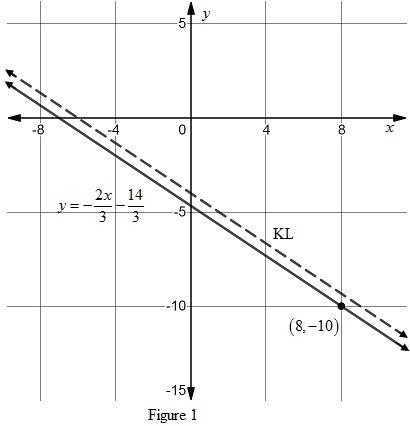
\begin{aligned}(y+2)&=\dfrac{-2}{3}(x+4)\\y+2&=\dfrac{-2x}{3}-\dfrac{8}{3}\\y&=\dfrac{-2x}{3}-\dfrac{14}{3}\end{aligned}

Therefore, the equation of the line which is parallel to the line KL is as follows:

\fbox{\begin\\\ \math y=\dfrac{-2x}{3}-\dfrac{14}{3}\\\end{minispace}}

Label the above equation as equation (1).

y=\dfrac{-2x}{3}-\dfrac{14}{3}                       (1)

Option1:

As per the option 1 the line y=\dfrac{-2x}{3}-\dfrac{14}{3} passes through the point (-10,0).

Substitute -10 for x in equation (1).

\begin{aligned}y&=\dfrac{-2\times (-10)}{3}-\dfrac{14}{3}\\&=\dfrac{20}{3}-\dfrac{14}{3}\\&=\dfrac{6}{3}\\&=2\end{aligned}

As per the above calculation it is concluded that the line y=\dfrac{-2x}{3}-\dfrac{14}{3} passes through the point (-10,2).

Therefore, the option 1 is incorrect.

Option 2:

As per the option 2 the line y=\dfrac{-2x}{3}-\dfrac{14}{3} passes through the point (-6,2).

Substitute -6 for x in equation (1).

\begin{aligned}y&=\dfrac{-2\times (-6)}{3}-\dfrac{14}{3}\\&=\dfrac{12}{3}-\dfrac{14}{3}\\&=\dfrac{-2}{3}\\&=\dfrac{-2}{3}\end{aligned}

As per the above calculation it is concluded that the line y=\dfrac{-2x}{3}-\dfrac{14}{3} passes through the point (-6,\frac{-2}{3}).

Therefore, option 2 is incorrect.

Option 3:

As per the option 3 the line y=\dfrac{-2x}{3}-\dfrac{14}{3} passes through the point (0,-6).

Substitute 0 for x in equation (1).

\begin{aligned}y&=\dfrac{-2\times 0}{3}-\dfrac{14}{3}\\&=-\dfrac{14}{3}\end{aligned}

As per the above calculation it is concluded that the line y=\dfrac{-2x}{3}-\dfrac{14}{3} passes through the point (0,\frac{-14}{3}).

Therefore, option 3 is incorrect.

Option 4:

As per the option 4 the line y=\dfrac{-2x}{3}-\dfrac{14}{3} passes through the point (8,-10).

Substitute 8 for x in equation (1).

\begin{aligned}y&=\dfrac{-2\times 8}{3}-\dfrac{14}{3}\\&=-\dfrac{16}{3}-\dfrac{14}{3}\\&=-\dfrac{30}{3}\\&=-10\end{aligned}

As per the above calculation it is concluded that the line y=\dfrac{-2x}{3}-\dfrac{14}{3} passes through the point (8,-10).

Therefore, option 4 is correct.

Figure 1 (attached in the end) shows that the line KL and the line y=-\dfrac{2x}{3}-\dfrac{14}{3} are parallel.

Thus, the line which is parallel to the line KL passes through the point (8,-10) i.e, \fbox{\begin\\\ \bf option 4\\\end{minispace}}.

Learn more:

1. A problem on greatest integer function brainly.com/question/8243712

2. A problem to find radius and center of circle brainly.com/question/9510228  

Answer details:

Grade: High school

Subject: Mathematics

Chapter: Lines

Keywords: Line, slope, intercept, x-intercept, y-intercept, slope intercept form, point slope form, curve, graph, intersects, equation, linear equation, (8,-10), y=-2x/3-14/3, KL, passes through M.
You might be interested in
The "normal" high temperature for a June day in Albemarle is $82^\circ$ (degrees Fahrenheit). Last year, the first ten days of J
crimeas [40]

Answer:

6° F

Step-by-step explanation:

To get average of 10 days highs, we need to add all and divide by 10.

Average = \frac{84+88+91+92+96+94+89+78+87+81}{10}\\=\frac{880}{10}\\=88

And, the normal high temp is given as 82.

<em>How much higher is 88 than 82??</em>

<em />

It is 88 - 82 = 6°F above

8 0
2 years ago
Matthew has three brothers: Alex, Mark, and Luke. The sum of their three ages is 12. List all the different combinations of ages
arsen [322]

Answer:

Step-by-step explanation:

Let Alex's age = x

Mark's age = y

Luke's age = a

x + y + z = 12

The possible combinations for their age are

1. 6, 3, 3

2. 3, 3, 6

3. 4,4, 4

4, 2, 2, 8

5. 8, 2, 2

6. 2, 8, 2

7. 9, 2, 1

Etc the age can keep going as long as you can find any three numbers and add them to give you 12

3 0
2 years ago
A professor is examining a new strain of bacteria. The amount of bacteria can be modeled by function s(n) = 20 · bn, where n is
user100 [1]
For this case we have a function of the form:
 y = A * (b) ^ n&#10;
 Where,
 A: initial amount
 b: growth rate (if b> 1)
 n: time in hours
 Substituting values we have:
 s (n) = 20 * b ^ n&#10;
 We have then that the initial amount is:
 A = 20&#10;
 If b = 1.85 then the growth percentage is:
 (1.85-1) * (100) = 85%&#10;
 Answer:
 
here were initially 20 bacteria.
 
The hourly percent growth rate of the bacteria would be 85%
8 0
2 years ago
True or false? If LM=MP, then M must be the midpoint of LP
Natalija [7]
I think that it's TRUE because it is in the middle when you draw the segment out
7 0
2 years ago
Read 2 more answers
If an exponential model was used to fit the data set below, which of the following would be the best prediction for the output o
satela [25.4K]

Answer:

The equation is found to be: y = 50.6e^{0.16x}

y(20) = 1241.34

Step-by-step explanation:

The given data is:

x:   3          7         11        14          17

y: 83      142      301     450      722

Now, we find sum summation values, relevant to the formula of exponential regression model, using calculator:

∑ ln y = 27.77305, ∑x ln y = 308.1494, ∑x = 52, ∑ x² = 664

and, n = no. of data points = 5

Now, we use formulae of exponential regression model to find out values of constant:

b = (n∑x lny - ∑x ∑ln y)/[n∑x² - (∑x)²]

b = [(5)(308.1494) - (52)(27.77305)]/[(5)(664) - (52)²]

b = 0.16

Now, for a;

a = (∑ln y - b∑x)/n

Therefore,

a = [(27.77305) - (0.16)(52)]/5

a = 3.9

For, α:

α = e^a = e^3.9

α = 50.6

So, the final equation of exponential regression model is given as:

y = \alpha e^{bx}\\ y = 50.6e^{0.16x}

Now, we find value of y for x = 20:

y(20) = (50.6) e^(0.16*20)

<u>y(20) = 1241.34</u>

8 0
2 years ago
Other questions:
  • A conditional relative frequency table is generated by row from a set of data. The conditional relative frequencies of the two c
    15·2 answers
  • A ramp is being used to unload the back of a truck. The bottom of the ramp is 12 feet from the truck and the top of the ramp is
    11·2 answers
  • I will give brainliest to the best answer to this question: Each year, the Department of Water Works measures the chloride conce
    13·2 answers
  • Which solid has a volume that is 1 /3 the volume of a cylinder?
    7·1 answer
  • What’s the largest fraction in each group? a. 5⁄6 and 29⁄36 b. 5⁄12 and 3⁄8 c. 2⁄5 and 19⁄45 d. 5⁄7, 13⁄14, and 19⁄21 e. 7⁄11 an
    6·2 answers
  • A number, y, is equal to the difference of a larger number and 3. The same number is one-third of the sum of the large number an
    9·2 answers
  • Which of the following are the most likely factors of the function graphed above?
    15·1 answer
  • The average life of a certain type of small motor is 10 years with a standard deviation of 2 years. The manufacturer replaces fr
    13·1 answer
  • Jenna constructs the model to represent 3x2 + 11x – 4. An algebra tile configuration. 0 tiles are in the Factor 1 spot. 0 tiles
    6·2 answers
  • I NEED HELP . I'm having trouble trying to figure out how to answer this can anyone help please?
    13·1 answer
Add answer
Login
Not registered? Fast signup
Signup
Login Signup
Ask question!
