answer.
Ask question
Login Signup
Ask question
All categories
  • English
  • Mathematics
  • Social Studies
  • Business
  • History
  • Health
  • Geography
  • Biology
  • Physics
  • Chemistry
  • Computers and Technology
  • Arts
  • World Languages
  • Spanish
  • French
  • German
  • Advanced Placement (AP)
  • SAT
  • Medicine
  • Law
  • Engineering
earnstyle [38]
2 years ago
7

Urn A has balls numbered 1 through 6. Urn B has balls numbered 1 through 4. What is the probability that a 4 is drawn from A fol

lowed by a 2 from B?

Mathematics
2 answers:
Crazy boy [7]2 years ago
8 0

The probability that a 4 is drawn from A followed by a 2 from B is 1/24

<h3>Further explanation</h3>

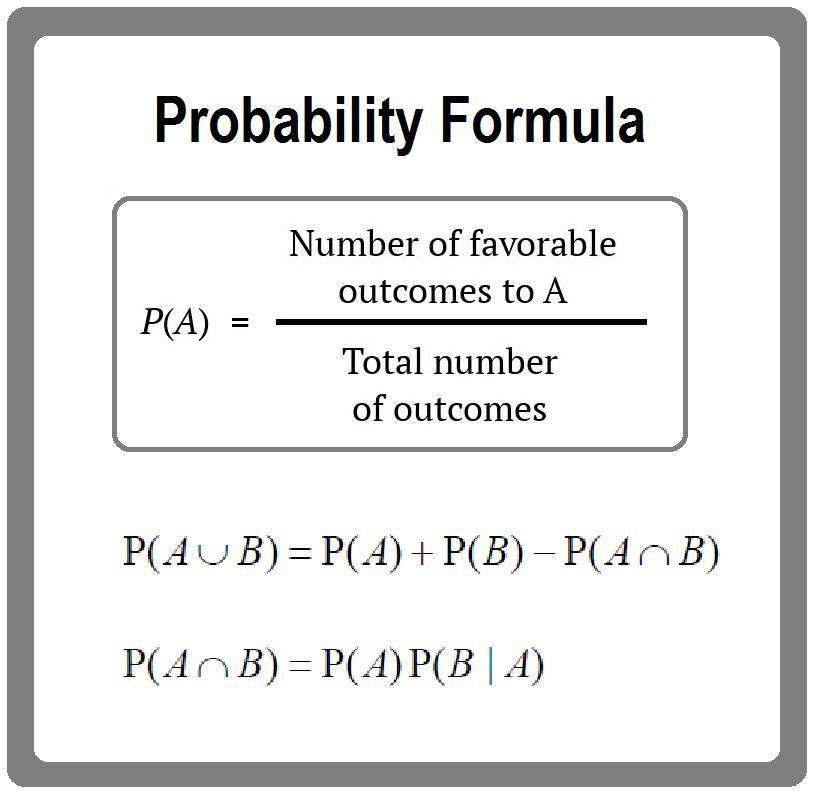
The probability of an event is defined as the possibility of an event occurring against sample space.

\large { \boxed {P(A) = \frac{\text{Number of Favorable Outcomes to A}}{\text {Total Number of Outcomes}} } }

<h2>Permutation ( Arrangement )</h2>

Permutation is the number of ways to arrange objects.

\large {\boxed {^nP_r = \frac{n!}{(n - r)!} } }

<h2>Combination ( Selection )</h2>

Combination is the number of ways to select objects.

\large {\boxed {^nC_r = \frac{n!}{r! (n - r)!} } }

Let us tackle the problem.

<h3>Urn A has balls numbered 1 through 6 → Total = 6 balls</h3>

<em>The probability of choosing a 4 ( 1 ball ) from Urn A is:</em>

P(A) = \boxed{\frac{1}{6}}

<h3>Urn B has balls numbered 1 through 4 → Total = 4 balls</h3>

<em>The probability of choosing a 2 ( 1 ball ) from Urn B is:</em>

P(B) = \boxed {\frac{1}{4}}

<em>The probability that a 4 is drawn from A followed by a 2 from B is</em>

P(A \cap B) = P(A) \times P(B)

P(A \cap B) = \frac{1}{6} \times \frac{1}{4}

P(A \cap B) = \boxed {\frac{1}{24}}

<h3>Learn more</h3>
  • Different Birthdays : brainly.com/question/7567074
  • Dependent or Independent Events : brainly.com/question/12029535
  • Mutually exclusive : brainly.com/question/3464581

<h3>Answer details</h3>

Grade: High School

Subject: Mathematics

Chapter: Probability

Keywords: Probability , Sample , Space , Six , Dice , Die , Binomial , Distribution , Mean , Variance , Standard Deviation
oksian1 [2.3K]2 years ago
7 0
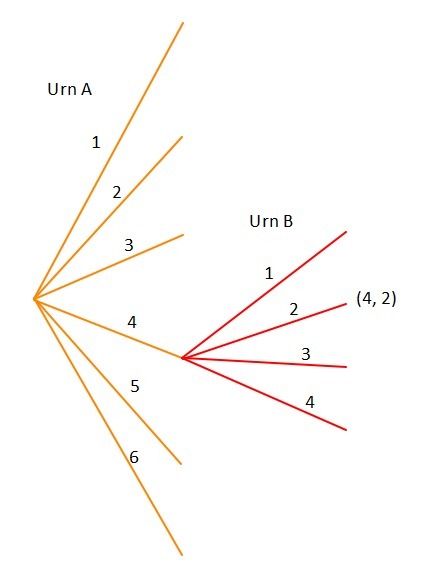
Drawing the tree diagram of the problem, we see that there are 6 branches for drawing from Urn A, and then 4 branches for each of the 6 branches, for drawing from Urn B.

This means that there are 6*4=24 possible outcomes, which could be listed as
{(1, 1), (1, 2), (1, 3), (1, 4), (2, 1)... (6, 3), (6, 4)},

where the first coordinates represent drawing from urn A, and the second coordinates, drawing from urn B.

(4, 2) is one of these 24, so the probability is 1/24


remark, this problem could also have been solved by the multiplication principle of the probabilities of separate events, that is 1/6 (probability of drawing 4 from Urn A) times 1/4 (probability of drawing 2 from B) = 1/24


Answer: 1/24

You might be interested in
The area of the rectangle is 64.8 square centimeters. What is the perimeter of the rectangle? One group of ten tenths and one gr
9966 [12]

Answer:

(a) Perimeter = 32.2\ cm

(b) 100

Step-by-step explanation:

Solving (a):

Given

Shape: Rectangle

Area = 64.8

Required

Calculate the perimeter.

Area is calculated as:

Area = L * W

Where

L = Length and W = Width

Substitute 64.8 for Area

64.8 = L * W

Make L the subject:

L = \frac{64.8}{W}

Perimeter is calculated as:

P = 2 * (L + W)

Substitute 64.8/W for L

P = 2 * (\frac{64.8}{W} + W)

P = \frac{129.6}{W} + 2W

To solve further, we take the derivative of P and set it to 0, afterwards.

dP = -\frac{129.6}{W^2} + 2

Set to 0

0 = -\frac{129.6}{W^2} + 2

Collect Like Terms

\frac{129.6}{W^2} = 2

Cross Multiply:

2W^2= 129.6

Divide through by 2

W^2 = 64.8

Take square roots

W = \sqrt{64.8

W = 8.05

Recall that:

L = \frac{64.8}{W}

So:

L= \frac{64.8}{8.05}\\

L= 8.05

The perimeter is:

Perimeter = 2 * (8.05 + 8.05)

Perimeter = 2 * (16.10)

Perimeter = 32.2\ cm

Solving (b):

Given

((1 Group of 10 tenths) and (1 group of 8 tenths))/(6 groups of 3 tenths)

Required

Solve

Tenths = \frac{1}{10}

So, the expression becomes:

((1 Group of 10 * \frac{1}{10}) and (1 group of 8 * \frac{1}{10}))/(6 groups of 3 * \frac{1}{10})

This gives:

((1 Group of \frac{10}{10}) and (1 group of \frac{8}{10}))/(6 groups of \frac{3}{10})

Group means product, so the expression becomes:

\frac{(1 * \frac{10}{10} \ and\ 1 * \frac{8}{10})}{6 * \frac{3}{10}}

And, as used here means addition

\frac{(1 * \frac{10}{10} +  1 * \frac{8}{10})}{6 * \frac{3}{10}}

Simplify:

\frac{(1 * 1 +  1 * 0.80)}{6 *0.30}

\frac{(1 +  0.80)}{1.80}

\frac{1.80}{1.80}

= 1.00

7 0
2 years ago
Farmers mowed 60 acres of grass a day instead of 50 and managed to finish the task one day earlier than planned. What is the are
schepotkina [342]
 300 acres. because <span>multiply 60 by 5.</span>
6 0
2 years ago
kevin draws a figure that has four sides all sides have the same length . his figure has no right angles . what figure does kevi
Oksanka [162]
A diamond because there are no right angles, and there are all the same length
6 0
3 years ago
Read 2 more answers
vegetable ghee is stored in the cylindrical vessel of internal radius 1.4m height 1.5m. if it is transferred into the rectangula
irina1246 [14]

Answer:

<em>5,598 cans are required to empty the vessel</em>

Step-by-step explanation:

The volume of a cylinder of radius r and height h is:

V = \pi r^2h

The volume of a box of dimensions X, Y, and Z is:

V=X.Y.Z

A cylinder of r=1.4 m and height h=1.5 is used to store vegetable ghee. It contains a volume of:

V_1 = \pi 1.4^2*1.5

V_1=9.236\ m^3

Converting to cubic cm:

V_1=9.236*1,000,000\ cm^3

V_1=9,236,282\ cm^3

The volume of each rectangular tin can is:

V_2=33*10*5=1,650\ cm^3

V_2=1,650\ cm^3

The number of cans required to empty the vessel is:

V_1/V_2=9,236,282/1,650 = 5,598

5,598 cans are required to empty the vessel

5 0
2 years ago
Researchers recorded that a group of bacteria grew from 100 to 7,000 in 14 hours. At this rate of growth, how many bacteria will
Alik [6]

The number of bacteria grown in 32 hours is 15771

<u>Step-by-step explanation:</u>

It is given that,

Researchers recorded that a group of bacteria grew from 100 to 7,000 in 14 hours.

Therefore, the bacteria has grown from 100 to 7000 in 14 hours.

<u> To calculate number of bacteria grown in 14 hours :</u>

⇒ 7000 - 100 = 6900

6900 bacteria grows in 14 hours. We need to find out the growth of bacteria in 1 hour in order to calculate its growth in 32 hours.

<u>To calculate number of bacteria grown in 1 hour :</u>

⇒ Total bacteria growth in 14 hours / 14

⇒ 6900 / 14

⇒ 492.85

<u>To calculate number of bacteria grown in 32 hours :</u>

⇒ 492.85 × 32

⇒ 15771.2

⇒ 15771  (rounded to nearest whole number)

∴ The number of bacteria grown in 32 hours is 15771

6 0
2 years ago
Read 2 more answers
Other questions:
  • The following system of equations is _____.
    14·1 answer
  • Which pairs of angles in the figure below are vertical angles?
    11·2 answers
  • A building across the street casts a shadow that is 24 feet long. Your friend is 6 feet tall and casts a shadow that is 4 feet l
    8·2 answers
  • Giselle brought a dress for $35 and three t-shirts she used a coupon for $2.50 off each t-shirt The total cost can be modeled by
    9·1 answer
  • Sarah received \$55$55dollar sign, 55 for her birthday. She used some of that money to buy 333 shirts priced at mmm dollars each
    11·1 answer
  • A meteorologist is studying the monthly rainfall in a section of the Brazilian rainforest. She recorded the monthly rainfall, in
    11·2 answers
  • Liam works at a zoo. He was looking at some data showing the masses of their 555 African elephants. The mean mass of the elephan
    6·3 answers
  • Nadia built a robot to filter air and water efficiently. She expects the robot to filter more than 343 liters of
    6·1 answer
  • 1. Pilar and her sister Marisol live near the beach. Pilar has 80 seashells in her collection when Marisol started collecting se
    7·2 answers
  • Erica can paint her room 5 hours .If she had her friend Rachel help her , they can paint the room together in 3 hours .How long
    9·1 answer
Add answer
Login
Not registered? Fast signup
Signup
Login Signup
Ask question!