answer.
Ask question
Login Signup
Ask question
All categories
  • English
  • Mathematics
  • Social Studies
  • Business
  • History
  • Health
  • Geography
  • Biology
  • Physics
  • Chemistry
  • Computers and Technology
  • Arts
  • World Languages
  • Spanish
  • French
  • German
  • Advanced Placement (AP)
  • SAT
  • Medicine
  • Law
  • Engineering
Dvinal [7]
2 years ago
6

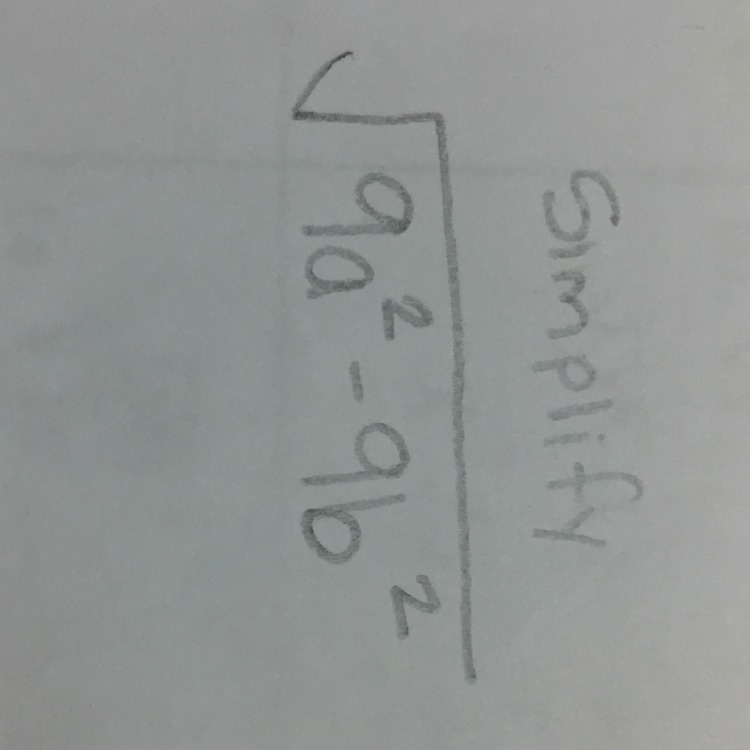
How do you simplify this?

Mathematics
1 answer:
7nadin3 [17]2 years ago
3 0
Your answer would b AB^2
You might be interested in
Suppose that the exam scores for students in a large university course are normally distributed with an unknown mean and standar
HACTEHA [7]

Answer:

Critical value t-score=2.701.

Step-by-step explanation:

When we calculate a confidence interval with an unknown population standard deviation, we estimate it from the sample standard deviation and use the t-score instead of the z-score.

The critical value for t depends on the level of confidence and the degrees of freedom.

If the sample size is 42, the degrees of freedom are:

df=n-1=42-1=41

For a confidence level of 99% and 41 degrees of freedom, the critical value of t is t=2.701.

6 0
2 years ago
Suppose that – in any given time period – a certain stock is equally likely to go up 1 unit or down 1 unit, and that the outcome
Scorpion4ik [409]

Answer:

Step-by-step explanation:

From the given information:

Let X represent the amount of the stock that goes up in the first period; &

Let Y denote the cumulative amount that goes up in the first three periods.

Then,

X= X_1 + X_2 \\ \\ \\EX=  EX_1 +EX_2\\ \\\\Now ; EX = 0 \\ \\ EX = \dfrac{1}{2}\times 1 + \dfrac{1}{2}\times -1 \\ \\ EX = \dfrac{1}{2}-\dfrac{1}{2} \\ \\ EX = 0

Cov(x,y) = Var(X_1) +Var(X_2) \\ \\ =\dfrac{1}{2}(1+1) + \dfrac{1}{2}(1+1) \\ \\ = \dfrac{1}{2}(2)+ \dfrac{1}{2}(2)  \\ \\ = 1+1  \\ \\ =2

Var (X) = Var (X_1+X_2)\\ \\ = 2 \ Var(X_1)  \\ \\ = 2 \times (1) \\ \\  = 2

Var (Y) = Var (X_1 +X_2+X_3) \\ \\ = 3 \times Var(X_1) = \\ \\ = 3 \times 1\\   \\ = 3

∴

Corr(x,y) = \dfrac{2}{\sqrt{6}} \\ \\ = \dfrac{2}{\sqrt{2\times 3}} \\ \\= \sqrt{\dfrac{2}{3}}

3 0
1 year ago
What is the volume of grain that could completely fill this silo, rounded to the nearest whole number? Use 22 over 7 for pi. (4
saveliy_v [14]

Answer: 19,461\ ft^3

Step-by-step explanation:

The missing figure is attached.

The volume of grain that could completely fill this silo is the sum of the volume of the cylinder and the volume of the hemisphere.

By definition, the volume of a cylinder can be calculated with this formula:

V_c=\pi r^2h

Where "r" is the radius and "h" is the height.

In this case you know that:

r=6\ ft\\\\h=168\ ft

And the volume of a hemisphere can be found using the following formula:

V_h=\frac{2}{3} \pi r^3

Where "r" is the radius.

In this case:

r=6\ ft

Therefore, the volume of grain that could completely fill this silo, rounded to the nearest whole number, is:

V_{grain}=(\frac{22}{7})(6\ ft)^2 (168\ ft)+\frac{2}{3} (\frac{22}{7})(6\ ft)^3\\\\V_{grain}\approx19,461\ ft^3

3 0
2 years ago
Ruth has 12 feet of ribbon.
Shkiper50 [21]

Answer:

See I don't know the answer but I did another one like this if it doesn't help you can report it no problem

Step-by-step explanation:

There are 2 different ways you can solve this problem and you'll get the same answer.

To help you visualize what you have to do, it might be easiest to translate your problem to a unit that easier to use.

Since you only have a ribbon 5 feet long, but you must cut it into 6 pieces, you know it won't even be 1 foot long.

One way to solve the problem would be to translate your 5-foot ribbon into a ribbon divided into inches.

1 foot = 12 inches

To find out how many inches long your ribbon is, you'll need to multiply the number of feet by 12.

Once you know that, then you can more easily divide it by 6. This will tell you how many inches each ribbon is.

Careful! the answer is to be put into feet so once you know how many inches long the ribbon is, you must then divide by 12 to get the correct answer in feet. Don't forget to round to the nearest tenth.

Another way to solve the problem is to simply divide the 5 feet by the number 6 and then round your number to the nearest tenth. It may be harder to visualize the answer this way, but you will get the same answer as if you translated your ribbon into inches and then divided by 12.

Good luck! I hope this helps!

6 0
2 years ago
The product of two whole numbers is 196 and their sum is 35. what are the two numbers
bonufazy [111]
A) x * y = 196A) x = 196 / y

B) x + y = 35Substituting A) into B)
B) 196 / y + y = 35Multiplying both sides by y
B) 196 + y^2 = 35yB) y^2 -35y + 196 = 0
X1 = 28X2 = 7
8 0
2 years ago
Other questions:
  • Is 70 thousand written in standard form or word form ? Explain
    9·1 answer
  • Each month Liz pays $35 to her phone company just to use the phone. Each text she sends costs her an additional $0.05. In March
    8·1 answer
  • When 0.3(4x – 8) – 0.5(–2.4x + 4) is simplified, what is the resulting expression?
    12·2 answers
  • The equation x2 – 1x – 90 = 0 has solutions {a, b}. What is a + b
    8·2 answers
  • Which expression shows the distance on the number line between 2 and −7?
    10·2 answers
  • If the m∠SRW = 85°, what are the measures of ∠VRU and ∠URW?<br><br> m∠VRU = °<br><br> m∠URW = °
    11·2 answers
  • LORAN is a long range hyperbolic navigation system. Suppose two LORAN transmitters are located at the coordinates (-100,0) and (
    7·1 answer
  • What fraction is equivalent to 8/15<br><br> i have a whole page of this to do please help
    11·2 answers
  • ANSWER QUICKLYYY PLEASEE
    5·1 answer
  • If h:k = 2:5, x:y=3:4 and 2h+x:k+2y = 1:2, find the ratio h-x: k-y.​
    14·1 answer
Add answer
Login
Not registered? Fast signup
Signup
Login Signup
Ask question!
