answer.
Ask question
Login Signup
Ask question
All categories
  • English
  • Mathematics
  • Social Studies
  • Business
  • History
  • Health
  • Geography
  • Biology
  • Physics
  • Chemistry
  • Computers and Technology
  • Arts
  • World Languages
  • Spanish
  • French
  • German
  • Advanced Placement (AP)
  • SAT
  • Medicine
  • Law
  • Engineering
Roman55 [17]
2 years ago
8

In this experiment, you will determine which of four variables affect the breakdown of rock samples. To do that, you will change

one variable at a time and then measure the change in mass of the rock sample. In the space below, write a scientific question you will answer by doing this experiment.
Biology
2 answers:
vivado [14]2 years ago
3 0
Which of the variables affects the mass of the rock (samples)?
OR
which of the variables causes the breakdown of the rocks (samples)?
Lelechka [254]2 years ago
3 0

the sample answer they give you is  What factors influence the rate of weathering? hope this helps.

You might be interested in
Classify the events as autogenic or allogenic succession.
nydimaria [60]

In ecology, allogenic succession is mediated by the abiotic components of the ecosystem, while the autogenic succession refers to the succession, which is mediated by the biotic components of an ecosystem.  

A volcanic eruption wiping out an entire island is an example of allogenic succession.  

A soybean crop helping in nitrogen fixation, leading to the development of other species is an illustration of autogenic succession.  

A tsunami devastating all the living organism in a habitat is an example of allogenic succession.  

Oak trees preventing the growth of smaller sun-seeking shrubs is an example of autogenic succession.  


5 0
2 years ago
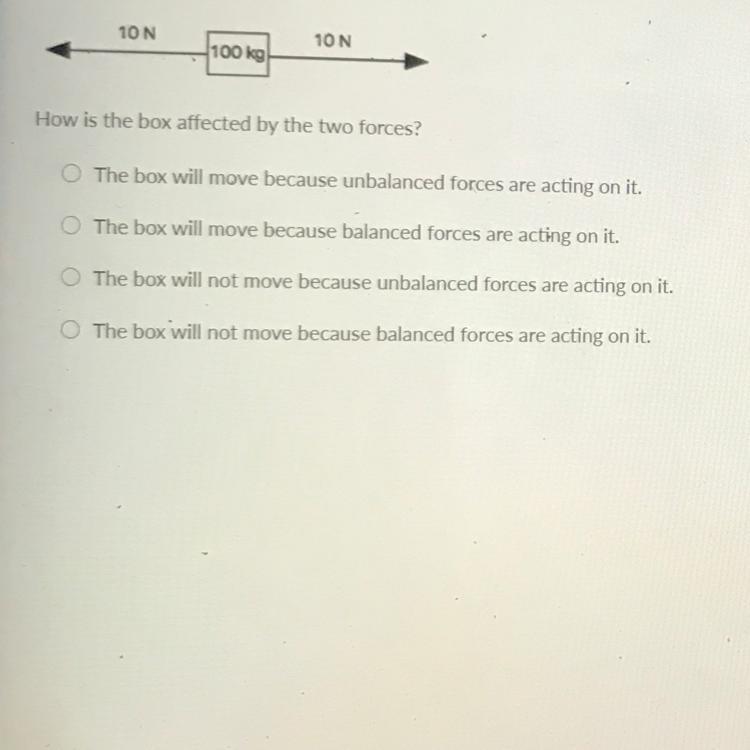
A 100 kg box is initially at rest on a level surface. One 10 N force acts on the box , directed toward the right. A second 10 N
Paladinen [302]

Answer:

The box will not move because balanced forces are acting on it.

Explanation:

According to Newton's first law of motion, an object will remain in its state of rest or motion along a straight line unless acted upon by an unbalanced force.

An unbalanced force is an individual force acting on any side of an object which is not balanced by a force of equal magnitude acting in the opposite direction.

From the image, two forces of equal magnitude of 10 N are pulling the 100 kg box in opposite directions. Since the two forces, 10 N each are pulling the object in opposite directions, they are balanced forces. Therefore, the box will not move because balanced forces are acting on it.

5 0
2 years ago
All of the cacti is removed from a desert ecosystem, what would happen to the population of cactus dwelling birds and in turn th
pishuonlain [190]

The population of cactus dwelling birds will decrease and that of the animal they eat will increase.

Explanation:

When cacti is removed from the desert ecosystem, the birds that have their nest on the cacti will no longer have a home so they will migrate to other areas with favorable ecosystem.This will reduce the number of birds in this ecosystem.In turn, the animals that were feed by the birds will have the chance to multiply in numbers because a predator has been removed in the ecosystem.

Learn More

  • Ecosystem : brainly.com/question/2865934

Keywords : Ecosystem, population

#LearnwithBrainly

6 0
2 years ago
Regardless of race all human beings have about the same number of melanocytes.
fomenos
The answer is true... bruh 
3 0
2 years ago
Which of the following statements correctly determines the process when following the scientific method?
crimeas [40]

Answer:

A) Formulate question,conduct research,propose hypothesis,test hypothesis

Explanation:

The scientific method is pertinent to the success of a scientific experiment. The scientific method is a sequential steps of processes involved in an experimentation. The correct order of steps that determines the process when following the scientific method are:

1) Formulate question: Asking a question about what has been previously observed is the key to starting a scientific method.

2) Conduct research: Research is done based on a previous observation that has been made by in order to gather necessary information.

3) Propose hypothesis: A hypothesis is a predictive statement or explanation to an asked question about the experiment that can be tested. It usually goes in an IF, THEN format.

4) Test hypothesis: As stated in the previous step, a hypothesis must be testable, which is done by conducting an experiment. The outcome of the experiment proves or disproves the hypothesis.

6 0
2 years ago
Other questions:
  • For a species with a haploid number of 23 chromosomes, how many different combinations of maternal and paternal chromosomes are
    11·2 answers
  • Briefly explain why a proeutectoid phase (ferrite or cementite) forms along austenite grain boundaries. hint: consult section 4.
    12·1 answer
  • The most productive marine habitats are in the open ocean. Please select the best answer from the choices provided T F
    13·2 answers
  • What equipment should a food worker use to reheat a baked potato?
    14·2 answers
  • A biologist marked 200 mice, by putting leg bands on them, out of a forest containing an unknown number of mice. The marked mice
    13·1 answer
  • Since llamas have sexual reproduction, the offspring have the potential to be genetically diverse. How can genetic diversity be
    6·1 answer
  • Interestingly, even though hemophilia in the royal families began in England, they were actually the only one of these four fami
    12·1 answer
  • Write a hypothesis about the effect of the red light on the population. Use the "if . . . Then . . . Because . . ." format, and
    12·2 answers
  • In two experiments, radioactively-labeled oxygen (shown in blue) was used to follow oxygen through the photosynthetic process. T
    9·1 answer
  • 4. Do you think recombinant organisms could also pose a threat to a population or ecosystem? Explain.
    14·1 answer
Add answer
Login
Not registered? Fast signup
Signup
Login Signup
Ask question!