answer.
Ask question
Login Signup
Ask question
All categories
  • English
  • Mathematics
  • Social Studies
  • Business
  • History
  • Health
  • Geography
  • Biology
  • Physics
  • Chemistry
  • Computers and Technology
  • Arts
  • World Languages
  • Spanish
  • French
  • German
  • Advanced Placement (AP)
  • SAT
  • Medicine
  • Law
  • Engineering
Bezzdna [24]
2 years ago
3

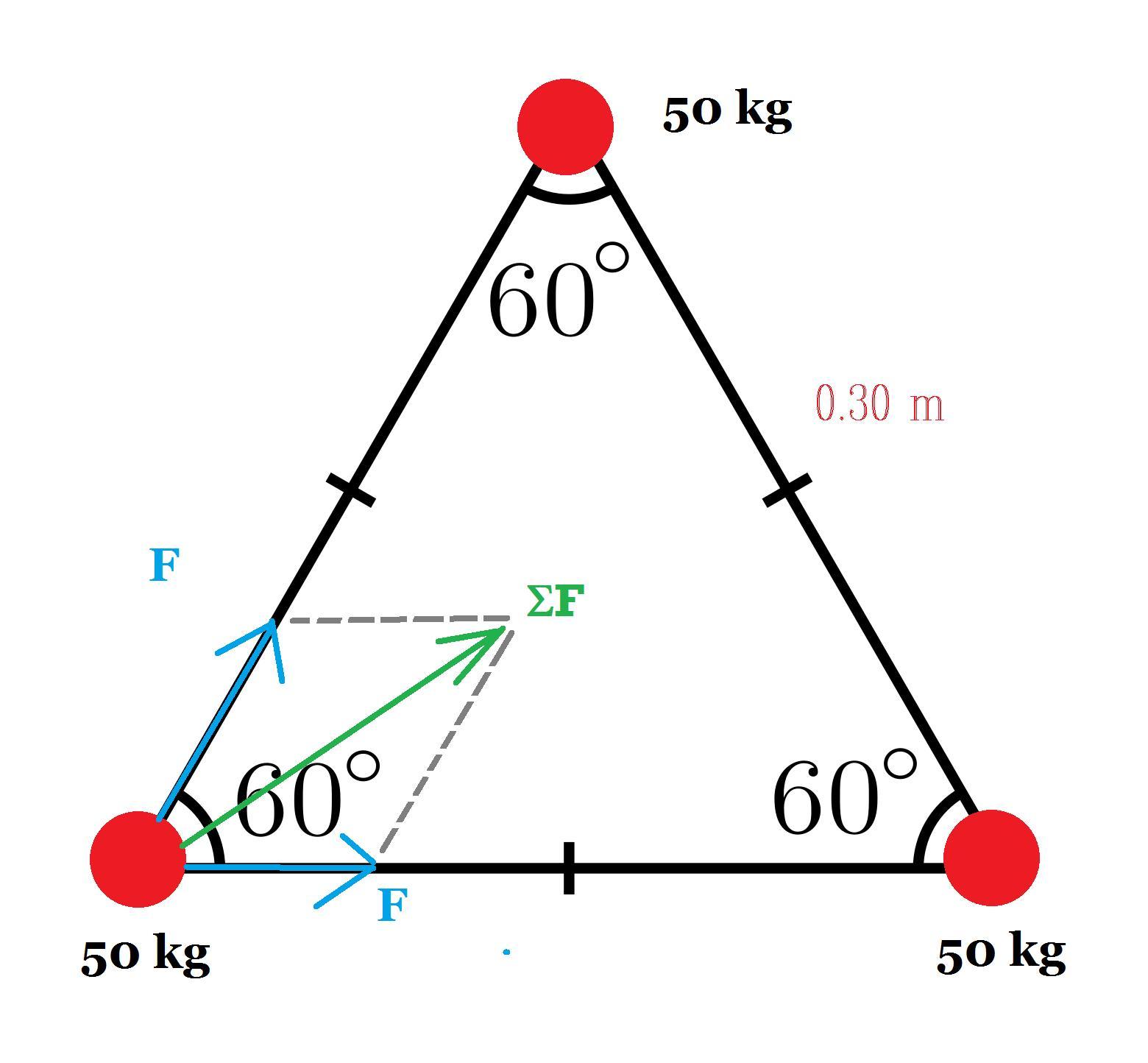
Three identical very small 50-kg masses are held at the corners of an equilateral triangle, 0.30 m on each side. if one of the m

asses is released, what is its initial acceleration if the only forces acting on it are the gravitational forces due to the other two masses

Physics
2 answers:
cluponka [151]2 years ago
4 0

Gravitational force between any two masses is given by

F = \frac{Gm_1m_2}{r^2}

F = \frac{6.67*10^-11 * 50 * 50}{0.30^2}

F = 1.853 * 10^{-6} N

Now net force on it due to two masses is given by

F_{net} = 2Fcos(\frac{\theta}{2})

here \theta = 60 degree

F_{net} = 2*1.853 * 10^{-6}cos(30)

F_{net} = 3.21 * 10^{-6} N

Now acceleration is given by

F= ma

a = \frac{3.21*10^{-6}}{50}

a = 6.42*10^{-8} m/s^2

lina2011 [118]2 years ago
4 0

If one of the masses is released, its initial acceleration is about 6.4 × 10⁻⁸ Newton

\texttt{ }

<h3>Further explanation</h3>

Newton's gravitational law states that the force of attraction between two objects can be formulated as follows:

\large {\boxed {F = G \frac{m_1 ~ m_2}{R^2}} }

<em>F = Gravitational Force ( Newton )</em>

<em>G = Gravitational Constant ( 6.67 × 10⁻¹¹ Nm² / kg² )</em>

<em>m = Object's Mass ( kg )</em>

<em>R = Distance Between Objects ( m )</em>

Let us now tackle the problem !

\texttt{ }

<u>Given:</u>

mass of the object = m = 50 kg

distance between the object = R = 0.30 m

<u>Asked:</u>

initial acceleration = a = ?

<u>Solution:</u>

<em>Firstly , let's find the gravitational force between 2 objects as follows:</em>

F = G \frac{m_1m_2}{R^2}

F = 6.67 \times 10^{-11} \times \frac{ 50 (50)}{0.30^2}

F \approx 1.85 \times 10^{-6} \texttt{ Newton}

\texttt{ }

<em>Next, we will calculate the resultant vector of these gravitational forces acting on a object:</em>

(\Sigma F)^2 = (F_1)^2 + (F_2)^2 + 2F_1F_2\cos \theta

(\Sigma F)^2 = F^2 + F^2 + 2F(F) \cos 60^o

(\Sigma F)^2 = 2F^2 + 2F^2(\frac{1}{2})

(\Sigma F)^2 = 3F^2

\Sigma F = \sqrt{3F^2}

\Sigma F = F\sqrt{3}

\Sigma F \approx 1.85 \times 10^{-6} (\sqrt{3})

\Sigma F \approx 3.2 \times 10^{-6} \texttt{ Newton}

\texttt{ }

<em>Finally, we could calculate the initial acceleration of the object by using 2nd-Newton's Law of Motion as follows:</em>

a = \frac{\Sigma F}{m}

a \approx \frac{3.2 \times 10^{-6}}{50}

a \approx 6.4 \times 10^{-8} \texttt{ m/s}^2

\texttt{ }

<h3>Learn more</h3>
  • Impacts of Gravity : brainly.com/question/5330244
  • Effect of Earth’s Gravity on Objects : brainly.com/question/8844454
  • The Acceleration Due To Gravity : brainly.com/question/4189441

\texttt{ }

<h3>Answer details</h3>

Grade: High School

Subject: Physics

Chapter: Gravitational Fields
You might be interested in
g A projectile is launched with speed v0 from point A. Determine the launch angle ! which results in the maximum range R up the
Svetlanka [38]

Answer:

The range is maximum when the angle of projection is 45 degree.

Explanation:

The formula for the horizontal range of the projectile is given by

R = \frac{u^{2}Sin2\theta }{g}

The range should be maximum if the value of Sin2θ is maximum.

The maximum value of Sin2θ is 1.

It means 2θ = 90

θ = 45

Thus, the range is maximum when the angle of projection is 45 degree.

If the angle of projection is 0 degree

R = 0

It means the horizontal distance covered by the projectile is zero, it can move in vertical direction.

If the angle of projection is 30 degree.

R = \frac{u^{2}Sin60 }{9.8}

R = 0.088u^2

If the angle of projection is 45 degree.

R = \frac{u^{2}Sin90 }{g}

R = u^2 / g

5 0
2 years ago
Changes that occur in the urinary system with aging include all of the following, EXCEPT
Sladkaya [172]

Answer: c. increased sensitivity to ADH

Explanation:

a. a decline in the number of functional nephrons: With aging the loss of nephron occurs that can be detected by the age related decrease in the glomerular filteration rate.

b. a reduction in the GFR (glomerular filtration rate): The GFR tend to decline in older age even though there is no disease. These people are required to check with the GFR in future.

d. problems with the micturition reflex: With aging people experience problem of bladder control. This leads to leakage or incontinence of urine or urinary retention that is inability to empty the bladder.

e. loss of sphincter muscle tone: With age the sphincter tone may diminish. This results in loss of control and storage capacity. The rectal muscles or sphincter muscles get loose which lead to passage of stool before reaching the washroom.

6 0
2 years ago
If the rocket has an initial mass of 6300 kg and ejects gas at a relative velocity of magnitude 2000 m/s , how much gas must it
Rzqust [24]

Answer:

The amount of gas that is to be released in the first second in other to attain an acceleration of  27.0 m/s2  is

      \frac{\Delta m}{\Delta t}   = 83.92 \ Kg/s

Explanation:

From the question we are told that

   The mass of the rocket is m = 6300 kg

   The velocity at gas is being ejected is  u =  2000 m/s

    The initial acceleration desired is a =  27.0 \  m/s

   The time taken for  the gas to be ejected is  t = 1 s

Generally this desired acceleration is mathematically represented as

        a = \frac{u *  \frac{\Delta m}{\Delta t} }{M -\frac{\Delta m}{\Delta t}* t}

Here \frac{\Delta m}{\Delta  t }  is the rate at which gas is being ejected with respect to time

Substituting values

      27 = \frac{2000 *  \frac{\Delta m}{\Delta t} }{6300 -\frac{\Delta m}{\Delta t}* 1}

=>   170100 -27* \frac{\Delta m}{\Delta t} = 2000 *  \frac{\Delta m}{\Delta t}

=>   170100  = 2027 *  \frac{\Delta m}{\Delta t}

=>   \frac{\Delta m}{\Delta t}   = \frac{170100}{2027}

=>   \frac{\Delta m}{\Delta t}   = 83.92 \ Kg/s


3 0
2 years ago
Two identical objects A and B fall from rest from different heights to the ground. If object B takes twice as long as A to reach
aivan3 [116]
I believe this ratio is 4:1 due to the inverse square law
4 0
2 years ago
Read 2 more answers
The potential (relative to infinity) at the midpoint of a square is 3.0 V when a point charge of +Q is located at one of the cor
Sveta_85 [38]

Answer:

d) 12 V

Explanation:

Due to the symmetry of the problem, the potential (relative to infinity) at the midpoint of the square, is the same for all charges, provided they be of the same magnitude and sign, and be located at one of the corners of the square.

We can apply the superposition principle (as the potential is linear with the charge) and calculating the total potential due to the 4 charges, just adding the potential due to any of  them:

V = V(Q₁) + V(Q₂) +V(Q₃) + V(Q₄) = 4* 3.0 V = 12. 0 V

4 0
2 years ago
Other questions:
  • A Labrador retriever breeder needs to determine if three male pups who were born to Sadie, his black Labrador retriever, are the
    11·1 answer
  • A hot–air balloon is moving at a speed of 10 meters/second in the +x–direction. The balloonist throws a brass ball in the +x–dir
    14·1 answer
  • 1. The sedimentary rock known as conglomerate typically forms in _______ environments in which particles can become rounded, suc
    12·2 answers
  • What is the direction of the current in the loop as the loop rotates clockwise through the magnetic field from as viewed from th
    14·2 answers
  • A solid uniform disk of diameter 3.20 m and mass 42 kg rolls without slipping to the ) bottom of a hill, starting from rest. If
    15·1 answer
  • A man stands on his balcony, 130 feet above the ground. He looks at the ground, with his sight line forming an angle of 70° with
    7·1 answer
  • Steam at 700 bar and 600 oC is withdrawn from a steam line and adiabatically expanded to 10 bar at a rate of 2 kg/min. What is t
    14·1 answer
  • Emmy kicks a soccer ball up at an angle of 45° over a level field. She watches the ball's trajectory and notices that it lands,
    6·1 answer
  • A 615 watt refrigerator runs 24 hours/day. How much energy is used per month (30 days)?
    12·1 answer
  • An object of mass m moves horizontally, increasing in speed from 0 to v in a time t. The power necessary to accelerate the objec
    9·1 answer
Add answer
Login
Not registered? Fast signup
Signup
Login Signup
Ask question!