answer.
Ask question
Login Signup
Ask question
All categories
  • English
  • Mathematics
  • Social Studies
  • Business
  • History
  • Health
  • Geography
  • Biology
  • Physics
  • Chemistry
  • Computers and Technology
  • Arts
  • World Languages
  • Spanish
  • French
  • German
  • Advanced Placement (AP)
  • SAT
  • Medicine
  • Law
  • Engineering
Elden [556K]
2 years ago
4

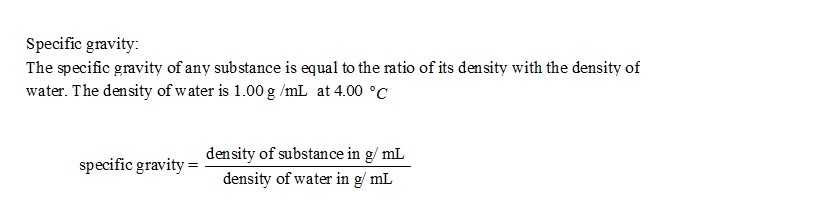
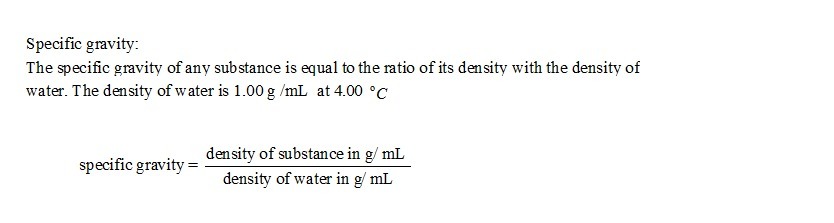
If 500 ml of mineral oil are used to prepare a liter of mineral oil emulsion, how many grams of the oil, having a specific gravi

ty of 0.87, would be used in the preparation of 1 gallon of the emulsion?

Chemistry
1 answer:
Xelga [282]2 years ago
4 0

We know that  

1 gallon = 3.78541 L  

1000 ml = 1.0 L

Density = mass / volume  

Mass = volume *density

Therefore  

(3.78541 L emulsion) x (500 mL oil / 1 L emulsion) x (0.87 g/mL oil) = 1647 g oil

Density = 0.87 g/ ml  

Because the density of water = 1.0 g/ ml  


You might be interested in
What is the density (in g/L) of a gas with a molar mass of 146.06 g/mol at 1.03 atm and 297k
marshall27 [118]
Lets assume the gas is acting Ideally, then According to Ideal Gas Equation the density is given as,

                                            d  =  P M / R T         -------  (1)
Where;
P  = Pressure =  1.03 atm

M  = Molar Mass =  146.06 g/mol

R  = Gas Constant =  0.08206 atm.L.mol⁻¹.K⁻¹

T  = Temperature =   297 K

Putting Values in eq. 1,

           d  =  (1.03 atm × 146.06 g/mol) ÷ (0.08206 atm.L.mol⁻¹.K⁻¹ × 297 K)

                                          density  =  6.17 g/L
6 0
2 years ago
If 500.0 mL of 0.10 M Ca2+ is mixed with 500.0 mL of 0.10 M SO42−, what mass of calcium sulfate will precipitate? Ksp for CaSO4
statuscvo [17]

Answer:

The mass of calcium sulfate that will precipitate is 6.14 grams

Explanation:

<u>Step 1:</u> Data given

500.0 mL of 0.10 M Ca^2+ is mixed with 500.0 mL of 0.10 M SO4^2−

Ksp for CaSO4 is 2.40*10^−5

<u>Step 2:</u> Calculate moles of Ca^2+

Moles of Ca^2+ = Molarity Ca^2+ * volume

Moles of Ca^2+ = 0.10 * 0.500 L

Moles Ca^2+ = 0.05 moles

<u>Step 3: </u>Calculate moles of SO4^2-

Moles of SO4^2- = 0.10 * 0.500 L

Moles SO4^2- = 0.05 moles

<u>Step 4: </u>Calculate total volume

500.0 mL + 500.0 mL = 1000 mL = 1L

<u>Step 5: </u> Calculate Q

Q = [Ca2+] [SO42-]  

[Ca2+]= 0.050 M   [O42-]

Qsp = (0.050)(0.050 )=0.0025 >> Ksp

This means precipitation will occur

<u> Step 6:</u> Calculate molar solubility

Ksp = 2.40 * 10^-5 = [Ca2+][SO42-] =(x)(x)

2.40 * 10^-5 = x²

x = √(2.40 * 10^-5)

x = 0.0049 M = Molar solubility

<u> Step 7:</u> Calculate total CaSO4 dissolved

total CaSO4 dissolved = 0.0049 M * 1 L * 136.14 mol/L = 0.667 g

<u>Step 8:</u> Calculate initial mass of CaSO4

Since initial moles CaSo4 = 0.050

Initial mass of CaSO4 = 0.050 * 136.14 g/mol

Initial mass of CaSO4 = 6.807 grams

<u>Step 9:</u> Calculate mass precipitate

6.807 - 0.667 = 6.14 grams

The mass of calcium sulfate that will precipitate is 6.14 grams
5 0
2 years ago
The mass of a container is determined to be 1.2 g. A sample of a compound is transferred to this container, and the mass of the
Nikitich [7]

Answer:

Sorry I don't know what you

3 0
1 year ago
Determine Z and V for steam at 250°C and 1800 kPa by the following: (a) The truncated virial equation [Eq. (3.38)] with the foll
makvit [3.9K]

Answer:

Explanation:

Given that:

the temperature T_1 = 250 °C= ( 250+ 273.15 ) K = 523.15 K

Pressure = 1800 kPa

a)

The truncated viral equation is expressed as:

\frac{PV}{RT} = 1 + \frac{B}{V} + \frac{C}{V^2}

where; B = - 152.5 \ cm^3 /mol   C = -5800 cm^6/mol^2

R = 8.314 × 10³ cm³ kPa. K⁻¹.mol⁻¹

Plugging all our values; we have

\frac{1800*V}{8.314*10^3*523.15} = 1+ \frac{-152.5}{V} + \frac{-5800}{V^2}

4.138*10^{-4}  \ V= 1+ \frac{-152.5}{V} + \frac{-5800}{V^2}

Multiplying through with V² ; we have

4.138*10^4  \ V ^3 = V^2 - 152.5 V - 5800 = 0

4.138*10^4  \ V ^3 - V^2 + 152.5 V + 5800 = 0

V = 2250.06  cm³ mol⁻¹

Z = \frac{PV}{RT}

Z = \frac{1800*2250.06}{8.314*10^3*523.15}

Z = 0.931

b) The truncated virial equation [Eq. (3.36)], with a value of B from the generalized Pitzer correlation [Eqs. (3.58)–(3.62)].

The generalized Pitzer correlation is :

T_c = 647.1 \ K \\ \\ P_c = 22055 \  kPa  \\ \\ \omega = 0.345

T__{\gamma}} = \frac{T}{T_c}

T__{\gamma}} = \frac{523.15}{647.1}

T__{\gamma}} = 0.808

P__{\gamma}} = \frac{P}{P_c}

P__{\gamma}} = \frac{1800}{22055}

P__{\gamma}} = 0.0816

B_o = 0.083 - \frac{0.422}{T__{\gamma}}^{1.6}}

B_o = 0.083 - \frac{0.422}{0.808^{1.6}}

B_o = 0.51

B_1 = 0.139 - \frac{0.172}{T__{\gamma}}^{ \ 4.2}}

B_1 = -0.282

The compressibility is calculated as:

Z = 1+ (B_o + \omega B_1 ) \frac{P__{\gamma}}{T__{\gamma}}

Z = 1+ (-0.51 +(0.345* - 0.282) ) \frac{0.0816}{0.808}

Z = 0.9386

V= \frac{ZRT}{P}

V= \frac{0.9386*8.314*10^3*523.15}{1800}

V = 2268.01 cm³ mol⁻¹

c) From the steam tables (App. E).

At T_1 = 523.15 \  K \ and  \ P = 1800 \ k Pa

V = 0.1249 m³/ kg

M (molecular weight) = 18.015 gm/mol

V  =  0.1249 × 10³ × 18.015

V = 2250.07 cm³/mol⁻¹

R = 729.77 J/kg.K

Z = \frac{PV}{RT}

Z = \frac{1800*10^3 *0.1249}{729.77*523.15}

Z = 0.588

3 0
2 years ago
Gina wants to use models to better understand how the types of bonds in a molecule relate to the presence of geometric isomers.
vazorg [7]
The answer to this question is D! The ball and stick model! Hope this helps :)
8 0
2 years ago
Read 2 more answers
Other questions:
  • Looking at the same nonmetal group on the periodic table, how does the reactivity of an element in period 2 compare to the react
    12·2 answers
  • Write a net ionic equation for the reaction that occurs when nickel(ii carbonate and excess hydrobromic acid (aq are combined.
    14·1 answer
  • A reagent bottle on the shelf labeled 0.5m nacl was used in place of the 0.5 m cacl2. assuming c2o4^2- to be in excess, what wou
    11·1 answer
  • Write the symbol for the monatomic ion that has a charge of 1– and the condensed electron configuration [ne]3s23p6.
    5·2 answers
  • Which of the following, when added to an equilibrium mixture represented by the equlibrium below, will not alter the composition
    10·1 answer
  • What is the theoretical yield of CuS when 31.8g of Cu(s) is heated with 50.0g of S? (Asume only CuS is produced in the reaction)
    6·2 answers
  • 15. An apparatus consists of a 4.0 dm3
    14·2 answers
  • For many purposes we can treat methane (CH) as an ideal gas at temperatures above its boiling point of - 161. °C. Suppose the te
    7·1 answer
  • Question 6 of 15
    8·1 answer
  • A student combines a solution of NaCl(aq) with a solution of AgNO3(aq), and a precipitate forms. Assume that 50.0mL of 1.0MNaCl(
    15·1 answer
Add answer
Login
Not registered? Fast signup
Signup
Login Signup
Ask question!