answer.
Ask question
Login Signup
Ask question
All categories
  • English
  • Mathematics
  • Social Studies
  • Business
  • History
  • Health
  • Geography
  • Biology
  • Physics
  • Chemistry
  • Computers and Technology
  • Arts
  • World Languages
  • Spanish
  • French
  • German
  • Advanced Placement (AP)
  • SAT
  • Medicine
  • Law
  • Engineering
k0ka [10]
2 years ago
13

What did the Romans build as a step toward environmental management? The Romans built to carry water from abundant water areas t

o areas with high chances of drought. They also built an enormous system to remove waste and create farmlands.
Chemistry
2 answers:
Vladimir [108]2 years ago
6 0

The Romans built the aqueducts, which were an important part of their water system.

andrew-mc [135]2 years ago
5 0

Answer:

Aqueducts

Explanation:

The aqueducts where gigantic and long constructions that carreid fresh water from the surroundings to the cities, and they also carried out of the cities the waste that the human activities generated, this was one of teh greatest inventions and contributions to human kind, they were replicated all over the world because of its great use and comodity.

You might be interested in
A beach has a supply of sand grains composed of calcite, ferromagnesian silicate minerals, and non-ferromagnesian silicate miner
bezimeni [28]
Ferromagnesian silicate minerals (i looked it up)
4 0
2 years ago
The Thompson analogy titled "The Carpet-Seed Children Analogy" attempts to deal with the issue of failed ____________________(A)
vazorg [7]

Answer: (D) contraception

Explanation:

8 0
2 years ago
Determine whether or not the mixing of each of the two solutions indicated below will result in a buffer.
WARRIOR [948]
Part A

75.0 mL of 0.10 M HF; 55.0 mL of 0.15 M NaF

This combination will form a buffer.

Explanation

Here, weak acid HF and its conjugate base F- is available in the solution

Part B

150.0 mL of 0.10 M HF; 135.0 mL of 0.175 M HCl

This combination cannot form a buffer.

Explanation

Here, moles of HF = 0.15 x 0.1 = 0.015 moles

Moles of HCl = 0.135 x 0.175 = 0.023

Since HCl is a strong acid and the number of HCl is higher than HF. This prevents the dissociation of HF and the conjugate base F- will not be available in the solution

Part C

165.0 mL of 0.10 M HF; 135.0 mL of 0.050 M KOH

This combination will form a buffer.

Explanation

Moles of HF = 0.165 x 0.1 = 0.0165 moles

Moles of KOH = 0.135 x 0.05 = 0.00675 moles

Moles of KOH is not sufficient for the complete neutralization of HF. Thus weak acid HF and its conjugate base F- is available in the solution and form a buffer

Part D

125.0 mL of 0.15 M CH3NH2; 120.0 mL of 0.25 M CH3NH3Cl

This combination will form a buffer

Explanation

Here, weak acid CH3NH3+ and its conjugate base CH3NH2 is available in the solution and form a buffer

Part E

105.0 mL of 0.15 M CH3NH2; 95.0 mL of 0.10 M HCl

This combination will form a buffer

Explanation

Moles of CH3NH2 = 0.105 x 0.15 = 0.01575 moles

Moles of HCl = 0.095 x 0.1 = 0.0095 moles

Thus the HCl completely reacts with CH3NH2 and converts a part of the CH3NH2 to CH3NH3+. This results weak acid CH3NH3+ and its conjugate base CH3NH2 is in the solution and form a buffer
5 0
2 years ago
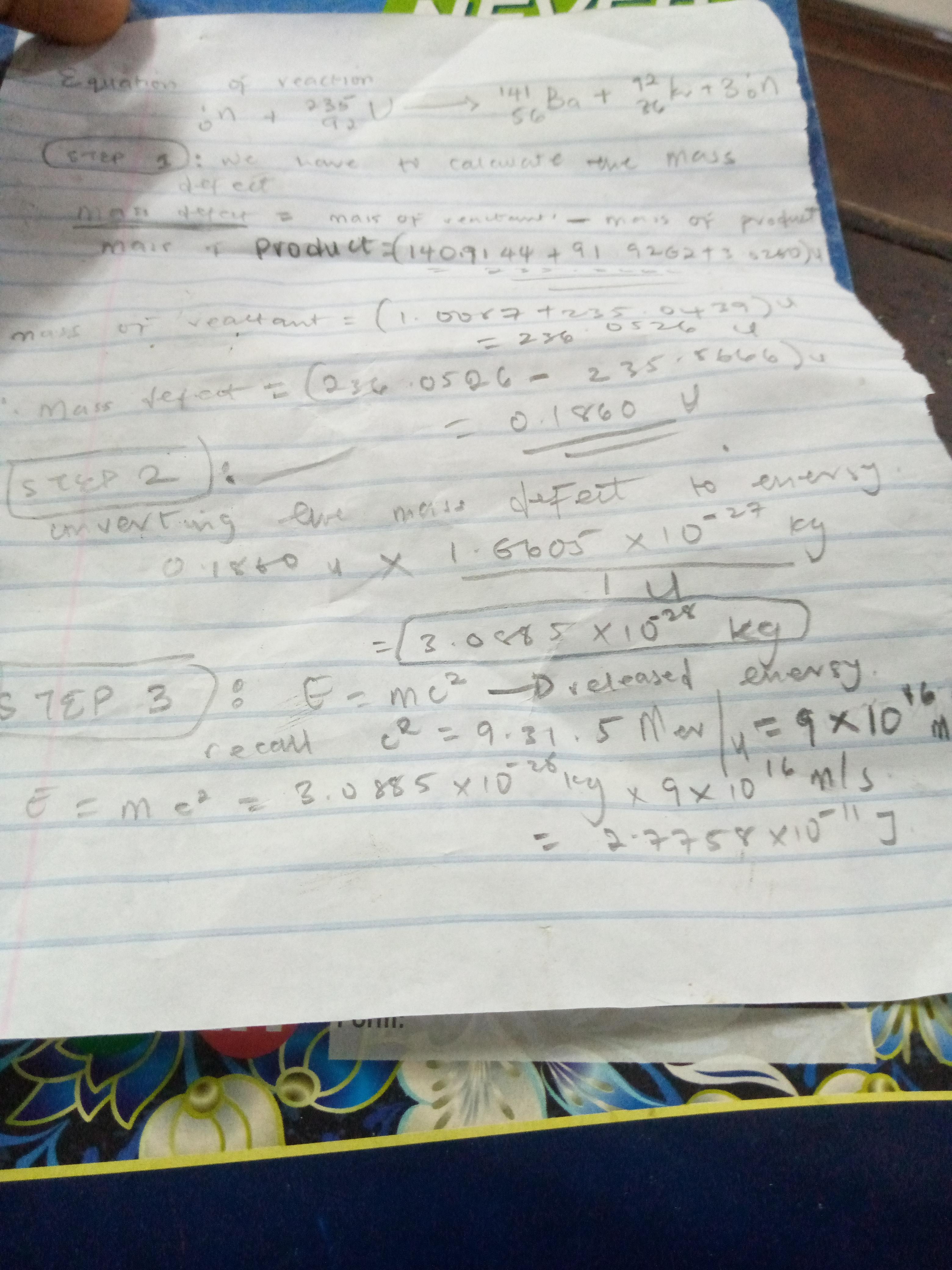
What is the reaction energy Q of this reaction? Use c2=931.5MeV/u. Express your answer in millions of electron volts to three si
emmasim [6.3K]

Answer:

Energy= 2.7758 × 10^-11 J ;

71.112×10^-6 kJ.

Mass defect in Kilogram= 3.0885×10^-28 kg.

That is; 3.1×10^-28 kg(to two significant figure).

Explanation:

(Note: Check equation of reaction in the attached file/picture).

STEP ONE: we have to calculate the Mass defect.

Mass defect= Mass of reactants -- Mass of products.

Mass of the products: (140.9144+91.9262+3.060) u.

= 235.8666 u.

Mass of reactants: (1.0087+235.0439) u= 236.0526 u.

Therefore, the Mass defect= (236.0526 -- 235.8666) u

= 0.1860 u.

STEP TWO: Converting the Mass defect to energy;

0.18860 × 1.6605 × 10^27 kg

= 3.0885× 10^-28 kg

STEP THREE: Calculating energy released . Recall(from the question) c^2= 931.5 Mev/u. This is also equals to 9×10^16 m/s.

E=Mc^2.

Where E= energy released, c= speed of light, M= Mass.

Slotting in the values;

E= 3.0885×10^-28 kg × 9×10^16 m/s.

E=2.7758 × 10^-11 J.

Know that;( 1g of uranium × 1 mol of uranium ÷ 235.0439 g of uranium) × (6.002×10^23 atom of uranium/ 1 mol of uranium) × 2.7758× 10^-11.

=7.1112×10^-10 J

= 71.112×10^6 kJ.

3 0
2 years ago
Determine ΔH for the reaction CaCO3 → CaO + CO2 given these data: 2 Ca + 2 C + 3 O2 → 2 CaCO3 ΔH = −2,414 kJ C + O2 → CO2 ΔH = −
kicyunya [14]

Answer:

The ΔH for the reaction is -456.5 KJ

Explanation:

Here we want to determine ΔH for the reaction;

Mathematically;

ΔH = ΔH(product) - ΔH(reactant)

In the case of the first reaction;

ΔH = ΔH(CaO) + ΔH(CO2) - ΔH(CaCO3)  ...........................(*)

From the other reactions, we can get the respective ΔH for the individual molecule in the reaction

In second reaction;

Kindly note that for elements, molecule of gases, ΔH = 0

What this means is that throughout the solution;

ΔH(Ca)  = 0 KJ

ΔH(O2) = 0 KJ

ΔH(C) = 0 KJ

Thus, in writing the equation for the subsequent chemical reactions, we shall need to write and equate the overall ΔH for the reaction to that of the product alone

So in the second reaction

ΔH = 2ΔH(CaCO3)

Thus;

-2414/2 = ΔH(CaCO3)

ΔH(CaCO3) = -1,207  KJ

Moving to the third reaction, we have;

ΔH = ΔH(CO2)

Hence ΔH(CO2) = -393.5 KJ

For the last reaction;

ΔH = ΔH(CaO)

Hence ΔH(CaO) = -1270 KJ

Going back to equation *

ΔH = ΔH(CaO) + ΔH(CO2) - ΔH(CaCO3)

Using the values of the ΔH  of the respective molecules given above,

ΔH  = -1270 + (-393.5) - (-1207)

ΔH  = -456.5 KJ

8 0
2 years ago
Other questions:
  • At STP, fluorine is a gas and iodine is a solid. This observation can be explained by the fact that fluorine has
    8·2 answers
  • For the reaction A+2B→C under a given set of conditions, the initial rate is 0.100 M/s.What is Δ[B]/Δt under the same conditions
    13·2 answers
  • Give the nuclide symbol for an atom that has<br> mass number 64 and 35 neutrons.
    5·1 answer
  • Among these processes, which is the slowest chemical reaction?
    13·2 answers
  • First-order reaction that results in the destruction of a pollutant has a rate constant of 0.l/day. (a) how many days will it ta
    12·1 answer
  • The mineral rhodochrosite [manganese(II) carbonate, MnCO3] is a commercially important source of manganese. Write a half-reactio
    7·1 answer
  • A solution is prepared by dissolving 91.7 g fructose in 545 g of water. Determine the mole fraction of fructose if the final vol
    12·1 answer
  • Anhydrous CoCl2 is blue; CoCl2•6H2O is red. When CoCl2•6H2O is heated and water is clearly being driven off, it becomes uniforml
    14·1 answer
  • 10 points) Given the following two half-reactions, write the overall reaction in the direction in which it is product-favored, a
    12·1 answer
  • 1. What is the significance of understanding the characteristics of the earth? essay​
    8·1 answer
Add answer
Login
Not registered? Fast signup
Signup
Login Signup
Ask question!