answer.
Ask question
Login Signup
Ask question
All categories
  • English
  • Mathematics
  • Social Studies
  • Business
  • History
  • Health
  • Geography
  • Biology
  • Physics
  • Chemistry
  • Computers and Technology
  • Arts
  • World Languages
  • Spanish
  • French
  • German
  • Advanced Placement (AP)
  • SAT
  • Medicine
  • Law
  • Engineering
lubasha [3.4K]
2 years ago
5

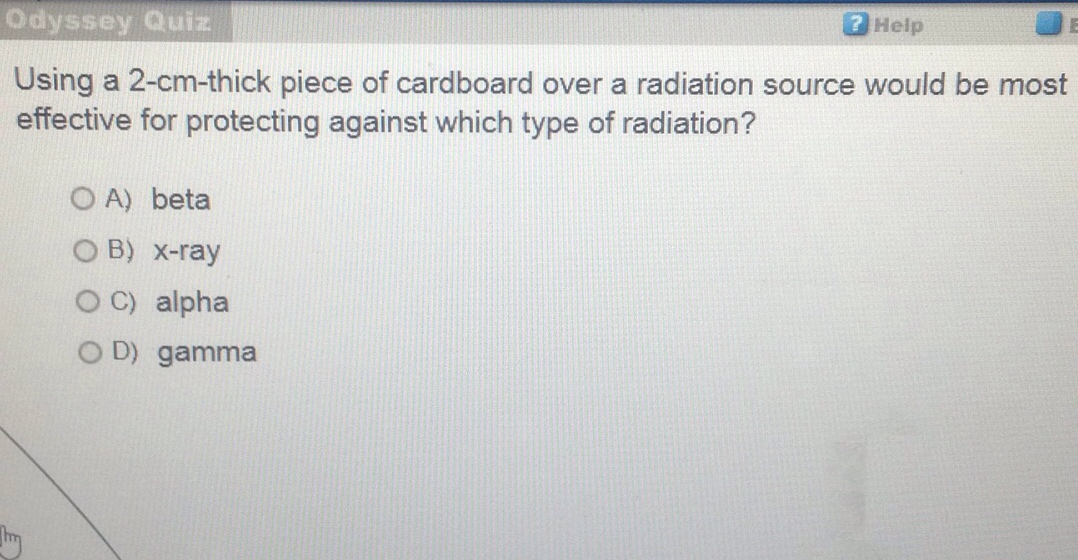
HelpUsing a 2-cm-thick piece of cardboard over a radiation source would be mosteffective for protecting against which type of ra

diation?O A) betaO B) X-rayO C) alphaO D) gamma

Chemistry
2 answers:
Studentka2010 [4]2 years ago
4 0

Answer:

I believe the answer is C) Alpha radiation.

Lisa [10]2 years ago
3 0
It would protect best against C) Alpha radiation, as Beta radiation is stopped by lighter metals such as aluminium, and Gamma radiation can only be stopped by heavier metals such as lead.
You might be interested in
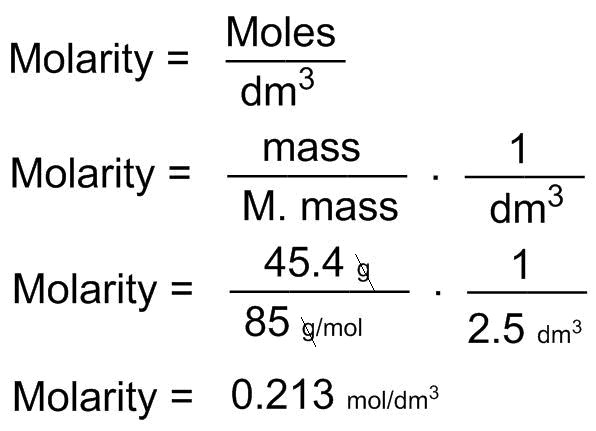
Calculate the molarity of a solution made by adding 45.4 g of nano3 to a flask and dissolving it with water to create a total vo
aleksandr82 [10.1K]
Solutions are made up of two non reacting species called solute and solvent. The amount of solute in solvent is known as concentration of that solute. Concentration is often measured in Molarity. Molarity is the amount of solute dissolved in 1 dm3 of solution. Answer to your question is as follow;

3 0
2 years ago
Read 2 more answers
How much heat is required to raise the temperature of 670g of water from 25.7"C to 66,0°C? The specific heat
inna [77]

Answer:

Explanation:

q= mc theta

where,

Q = heat gained

m = mass of the substance = 670g

c = heat capacity of water= 4.1 J/g°C    

theta =Change in temperature=( 66-25.7)

Now put all the given values in the above formula, we get the amount of heat needed.

q= mctheta

q=670*4.1*(66-25.7)

  =670*4.1*40.3

=110704.1

8 0
2 years ago
A 1.87 L aqueous solution of KOH contains 155 g of KOH . The solution has a density of 1.29 g/mL . Calculate the molarity ( M ),
lbvjy [14]

Answer:

[KOH] = 1.47 M

[KOH] = 1.22 m

KOH = 6.86 % m/m

Explanation:

Let's analyse the data

1.87 L is the volume of solution

Density is 1.29 g/mL → Solution density

155 g of KOH → Mass of solute

Moles of solute is (mass / molar mass) = 2.76 moles.

Molarity is mol/L → 2.76 mol / 1.87 L = 1.47 M

Let's determine, the mass of solvent.

Molality is mol of solute / 1kg of solvent

We can use density to find out the mass of solution

Mass of solution - Mass of solute = Mass of solvent

Density = Mass / volume

1.29 g/mL = Mass / 1870 mL

Notice, we had to convert L to mL, cause the units of density.

1.29 g/mL . 1870 mL = Mass → 2412.3 g

2412.3 g - 155 g = 2257.3 g of solvent

Let's convert the mass of solvent to kg

2257.3 g / 1000 = 2.25kg

2.76 mol / 2.25kg = 1.22 m (molality)

% percent by mass = mass of solute in 100g of solution.

(155 g / 2257.3 g) . 100g = 6.86 % m/m

5 0
2 years ago
ethylene glycol used in automobile antifreeze and in the production of polyester. The name glycol stems from the sweet taste of
Luden [163]

<u>Answer:</u> The empirical and molecular formula for the given organic compound is CH_3O and C_4H_{12}O_4

<u>Explanation:</u>

The chemical equation for the combustion of hydrocarbon having carbon, hydrogen and oxygen follows:

C_xH_yO_z+O_2\rightarrow CO_2+H_2O

where, 'x', 'y' and 'z' are the subscripts of Carbon, hydrogen and oxygen respectively.

We are given:

Mass of CO_2=9.06g

Mass of H_2O=5.58g

We know that:

Molar mass of carbon dioxide = 44 g/mol

Molar mass of water = 18 g/mol

  • <u>For calculating the mass of carbon:</u>

In 44g of carbon dioxide, 12 g of carbon is contained.

So, in 9.06 g of carbon dioxide, \frac{12}{44}\times 9.06=2.47g of carbon will be contained.

  • <u>For calculating the mass of hydrogen:</u>

In 18g of water, 2 g of hydrogen is contained.

So, in 5.58 g of water, \frac{2}{18}\times 5.58=0.62g of hydrogen will be contained.

  • Mass of oxygen in the compound = (6.38) - (2.47 + 0.62) = 3.29 g

To formulate the empirical formula, we need to follow some steps:

  • <u>Step 1:</u> Converting the given masses into moles.

Moles of Carbon =\frac{\text{Given mass of Carbon}}{\text{Molar mass of Carbon}}=\frac{2.47g}{12g/mole}=0.206moles

Moles of Hydrogen = \frac{\text{Given mass of Hydrogen}}{\text{Molar mass of Hydrogen}}=\frac{0.62g}{1g/mole}=0.62moles

Moles of Oxygen = \frac{\text{Given mass of oxygen}}{\text{Molar mass of oxygen}}=\frac{3.29g}{16g/mole}=0.206moles

  • <u>Step 2:</u> Calculating the mole ratio of the given elements.

For the mole ratio, we divide each value of the moles by the smallest number of moles calculated which is 0.206 moles.

For Carbon = \frac{0.206}{0.206}=1

For Hydrogen  = \frac{0.62}{0.206}=3

For Oxygen  = \frac{0.206}{0.206}=1

  • <u>Step 3:</u> Taking the mole ratio as their subscripts.

The ratio of C : H : O = 1 : 3 : 1

Hence, the empirical formula for the given compound is C_1H_{3}O_1=CH_3O

For determining the molecular formula, we need to determine the valency which is multiplied by each element to get the molecular formula.

The equation used to calculate the valency is:

n=\frac{\text{molecular mass}}{\text{empirical mass}}

We are given:

Mass of molecular formula = 124 amu = 124 g/mol

Mass of empirical formula = 31 g/mol

Putting values in above equation, we get:

n=\frac{124g/mol}{31g/mol}=4

Multiplying this valency by the subscript of every element of empirical formula, we get:

C_{(1\times 4)}H_{(3\times 4)}O_{(1\times 4)}=C_4H_{12}O_4

Thus, the empirical and molecular formula for the given organic compound is CH_3O and C_4H_{12}O_4

3 0
2 years ago
The electron in a ground-state H atom absorbs a photon of wavelength 97.20 nm. To what energy level does it move?
Lunna [17]

Answer:

E = h v = 6.626 x 10^{-34} x 97.20 x 10^{-9} = 6.44 x 10^{-41} J = 4.01 x 10^{-22} eV

n = Energy Level = -E^{0} / E = -13.6 / 4.01 x 10^{-22} = 3.39 x 10^{22} = 1.84 x 10^{11} energy level...

7 0
2 years ago
Other questions:
  • How many moles of cacl2 are in 250 ml of a 3.0 m of cacl2 solution?
    12·2 answers
  • What is the molar mass of 1-butene if 5.38 × 10¹⁶ molecules of 1-butene weigh 5.00 μg?
    13·1 answer
  • How many moles of MgCl2 are there in 319 g of the compound?
    5·1 answer
  • What is the molarity of potassium ions in a 0.122 M K2CrO4 solution
    12·2 answers
  • The enthalpy change for converting 1.00 mol of ice at -25.0 ∘c to water at 90.0∘c is ________ kj. the specific heats of ice, wat
    7·1 answer
  • Given the initial rate data for the reaction A + B –––&gt; C, determine the rate expression for the reaction.
    15·2 answers
  • What is the value of all conversion factors that are used in dimensional analysis?
    10·2 answers
  • A fossil is found to have a 14 C 14C level of 70.0 70.0 % compared to living organisms. How old is the fossil?
    12·1 answer
  • . A mixture of methane and air is capable of being ignited only if the mole percent of methane is between 5% and 15%. A mixture
    13·1 answer
  • Each student in a class placed a 2.00 g sample of a mixture of Cu and Al in a beaker and placed the beaker in a fume hood. The s
    7·1 answer
Add answer
Login
Not registered? Fast signup
Signup
Login Signup
Ask question!