answer.
Ask question
Login Signup
Ask question
All categories
  • English
  • Mathematics
  • Social Studies
  • Business
  • History
  • Health
  • Geography
  • Biology
  • Physics
  • Chemistry
  • Computers and Technology
  • Arts
  • World Languages
  • Spanish
  • French
  • German
  • Advanced Placement (AP)
  • SAT
  • Medicine
  • Law
  • Engineering
Ira Lisetskai [31]
2 years ago
14

Calculate the molarity of a solution made by adding 45.4 g of nano3 to a flask and dissolving it with water to create a total vo

lume of 2.50 l. express your answer to three significant figures.

Chemistry
2 answers:
Zigmanuir [339]2 years ago
5 0

The molarity of a solution made by adding 45.4 g of NaNO3 to a flask and dissolving it with water to create a total volume of 2.50 L is <u>0.213 M. </u>

<h2>Further Explanation: </h2><h3>Molarity  </h3>
  • Molarity may be defined as the concentration of a solution in moles per liter. It is calculated by dividing the number of moles of a solution, n by its volume in liters, V.  
  • That is; Molarity = n/V, where n is the number of moles and V is the volume in liters.  
  • Therefore; when given the molarity of a solution and the volume of the solution, then we can get the number of moles, by multiplying the molarity by volume;  
  • Number of moles = Molarity x Volume
  • Additionally, the number of moles of a compound or an element can also be calculated by dividing the mass of the compound by its relative molecular mass.
<h3>In this case:  </h3>
  • Mass of NaNO3 = 45.4 g  
  • But: Number of moles = Mass/ Molar mass
  • Molar mass of NaNO3 is 84.995 g/mol  
  • Thus; Number of moles = (45.4 g)/(84.995 g/mol)

                                      = 0.534 moles  

  • Volume of the solution = 2.50 L  

But; Molarity = Number of moles/ Volume  

                     = 0.534 moles/2.50 L

                     = 0.2136 Moles/Liter  

                     <u>= 0.213 M</u>  

Keywords: Molarity, Moles, Volume

<h3>Learn more about:  </h3>
  • Molarity: brainly.com/question/12834126
  • Relationship between moles, molarity and volume: brainly.com/question/12834126

Grade: Middle  School

Subject: Chemistry

Chapter: Mole and stoichiometry equations

aleksandr82 [10.1K]2 years ago
3 0
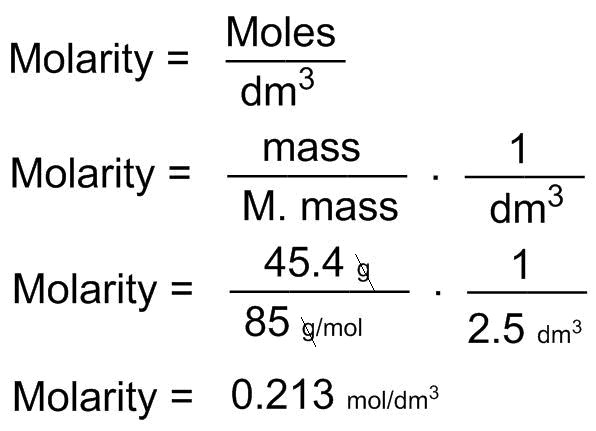
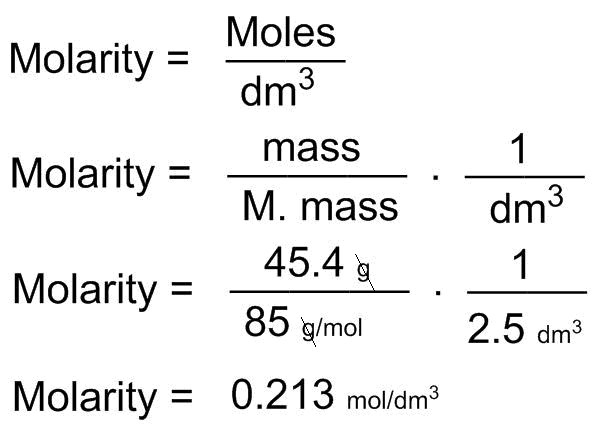
Solutions are made up of two non reacting species called solute and solvent. The amount of solute in solvent is known as concentration of that solute. Concentration is often measured in Molarity. Molarity is the amount of solute dissolved in 1 dm3 of solution. Answer to your question is as follow;

You might be interested in
Washing soda is a hydrate of sodium carbonate. Elemental analysis of a sample of washing soda gave 4.20% C and 7.05% H. What is
kozerog [31]

Answer:

Na₂CO₃ · 10H₂O

Explanation:

The formula for sodium carbonate hydrate is:

Na₂CO₃ · xH₂O

The unknown "x" is the number of water molecules contained in the hydrate.

To find "x" we have to use the hydrogen percentage in the sample, 7.05 % H.

First we calculate the molecular weight of Na₂CO₃ · xH₂O:

molecular weight of Na₂CO₃ · xH₂O = 23 × 2 + 12 + 16 × 3 + 18x

molecular weight of Na₂CO₃ · xH₂O = 106 + 18x  g/mole

Now we devise the fallowing reasoning tanking in account 1 mole of Na₂CO₃ · xH₂O:

if in        106 + 18x grams of Na₂CO₃ · xH₂O we have 2x grams of hydrogen

then in  100 grams of Na₂CO₃ · xH₂O we have 7.05 grams of hydrogen

106 + 18x = (100 × 2x) / 7.05

106 + 18x = 28.4x

106 = 28.4x - 18x

106 = 10.4x

x = 106 / 10.4

x = 10.2 ≈ 10

The formula for the washing soda is Na₂CO₃ · 10H₂O.

5 0
2 years ago
Each student in a class placed a 2.00 g sample of a mixture of Cu and Al in a beaker and placed the beaker in a fume hood. The s
Aleks [24]

Answer:

Percentage mass of copper in the sample = 32%

Explanation:

Equation of the reaction producing Cu(NO₃) is given below:

Cu(s)+ 4HNO₃(aq) ---> Cu(NO₃)(aq) + 2NO₂(g) + 2H₂O(l)

From the equation of reaction, 1 mole of Cu(NO₃) is produced from 1 mole of copper. Therefore, 0.010 moles of Cu(NO₃) will be produced from 0.010 mole of copper.

Molar mass of copper = 64 g/mol

mass of copper = number of moles * molar mass

mass of copper = 0.01 mol * 64 g/mol = 0.64 g

Percentage by mass of copper in the 2.00 g sample = (0.64/2.00) * 100%

Percentage mass of copper in the sample = 32%

3 0
2 years ago
Water treatment plants commonly use chlorination to destroy bacteria. a byproduct is chloroform (chcl3), a suspected carcinogen
antiseptic1488 [7]
<span>100. ppb of chcl3 in drinking water means  100 g of CHCl3 in 1,000,0000,000 g of water

Molarity, M

M = number of moles of solute / volume of solution in liters

number of moles of solute = mass of CHCl3 / molar mass of CHCl3

molar mass of CHCl3 = 119.37 g/mol

number of moles of solute = 100 g / 119.37 g/mol = 0.838 mol

using density of water = 1 g/ ml => 1,000,000,000 g = 1,000,000 liters

M = 0.838 / 1,000,000 = 8.38 * 10^ - 7 M <----- answer

Molality, m

m = number of moles of solute / kg of solvent

number of moles of solute = 0.838

kg of solvent = kg of water = 1,000,000 kg

m = 0.838 moles / 1,000,000 kg = 8.38 * 10^ - 7 m <----- answer

mole fraction of solute, X solute

X solute = number of moles of solute / number of moles of solution

number of moles of solute = 0.838

number of moles of solution = number of moles of solute + number of moles of solvent

number of moles of solvent = mass of water / molar mass of water = 1,000,000,000 g / 18.01528 g/mol = 55,508,435 moles

number of moles of solution = 0.838 moles + 55,508,435 moles = 55,508,436 moles

X solute = 0.838 / 55,508,435 = 1.51 * 10 ^ - 8 <------ answer

mass percent, %

% = (mass of solute / mass of solution) * 100 = (100g / 1,000,000,100 g) * 100 =

% = 10 ^ - 6 % <------- answer
</span>
7 0
2 years ago
Read 2 more answers
A sample of an unknown compound was decomposed and found to be composed of 1.36 mol oxygen, 4.10 mol hydrogen, and 2.05 mol carb
Flura [38]

Answer:

C3H6O2

Explanation:

To find the empirical formula of the compound, we divide the amount in moles of each of the elements by the amount in mole of the element with the smallest number of mole. In this question, the element with the smallest number of moles is oxygen with 1.36 mole. Hence, we divide the number of moles of each element by this.

H = 4.10/1.36 = 3

O = 1.36/1.36 = 1

C = 2.05/1.36 = 1.5

We then multiply through by 2 to yield the compound with the empirical formula C3H6O2
7 0
2 years ago
The specific heat of water is 4.18 J/g•°C. How much heat does 225.0 g of water release when it cools from 85.5°C to 50.0°C? Ente
Sergio [31]
The answer is 33400J
4 0
2 years ago
Read 2 more answers
Other questions:
  • tekanan uap jenuh air murni pada suhu 20°C adalah 18 mmHg.apabila pada temperatur yang sama sebanyak 120 gram zat x dilarutkan d
    12·1 answer
  • Impure benzoic acid was dissolved in hot water. the container of solution was placed in an ice-water bath instead of being allow
    14·1 answer
  • What is the molar mass of 1-butene if 5.38 × 10¹⁶ molecules of 1-butene weigh 5.00 μg?
    13·1 answer
  • Iodine has a lower atomic weight than tellurium (126.90 for I, 127.60 for Te) even though it has a higher atomic number (53 for
    6·2 answers
  • Please use the E/Z notation when specifying stereochemistry remembering to use parentheses and a dash. Reminder - the double bon
    5·1 answer
  • The following steps refer to various stages in transmission at a chemical synapse. 1. Neurotransmitter binds with receptors asso
    6·1 answer
  • Calculate the pOH of a solution that contains 3.9 x 10⁻⁵ M H3O+ at 25°C.
    9·1 answer
  • A beaker holds 962 g of a brine solution that is 6.20 percent salt. If 123g of water are evaporated from the beaker, how much sa
    15·1 answer
  • sekiranya kutu tinggal di badan arnab dan menghisap darah arnab , apakah jenis interaksi antara kutu dengan arnab ?​
    5·1 answer
  • 3. Which of these statements is an accurate description of the ionization energies of elements in the periodic table?
    15·1 answer
Add answer
Login
Not registered? Fast signup
Signup
Login Signup
Ask question!