answer.
Ask question
Login Signup
Ask question
All categories
  • English
  • Mathematics
  • Social Studies
  • Business
  • History
  • Health
  • Geography
  • Biology
  • Physics
  • Chemistry
  • Computers and Technology
  • Arts
  • World Languages
  • Spanish
  • French
  • German
  • Advanced Placement (AP)
  • SAT
  • Medicine
  • Law
  • Engineering
dimulka [17.4K]
2 years ago
7

Predict whether a reaction will occur when elemental chlorine and potassium iodide are mixed.

Chemistry
2 answers:
s2008m [1.1K]2 years ago
5 0

<u>Answer:</u> The reaction do take place and it leads to the formation of potassium chloride and iodine gas.

<u>Explanation:</u>

Single displacement reaction is defined as the reaction in which more reactive element displaces a less reactive element from its chemical reaction.

A+BC\rightarrow AB+C

Element A is more reactive than element B.

The chemical equation for the reaction of elemental chlorine and potassium iodide follows:

Cl_2+2KI\rightarrow 2KCl+I_2

As, chlorine gas is more reactive than iodine. So, it will easily replace iodine from its chemical reaction.

Hence, the reaction do take place and it leads to the formation of potassium chloride and iodine gas.

Goshia [24]2 years ago
3 0
Yes their will be a reaction what happens is chlorine displaces iodine from its aqueous solution since it is a more powerful oxidizing agent.
C12(aq) + 2KI(aq) = 2KCI(aq) + I2(aq)
You might be interested in
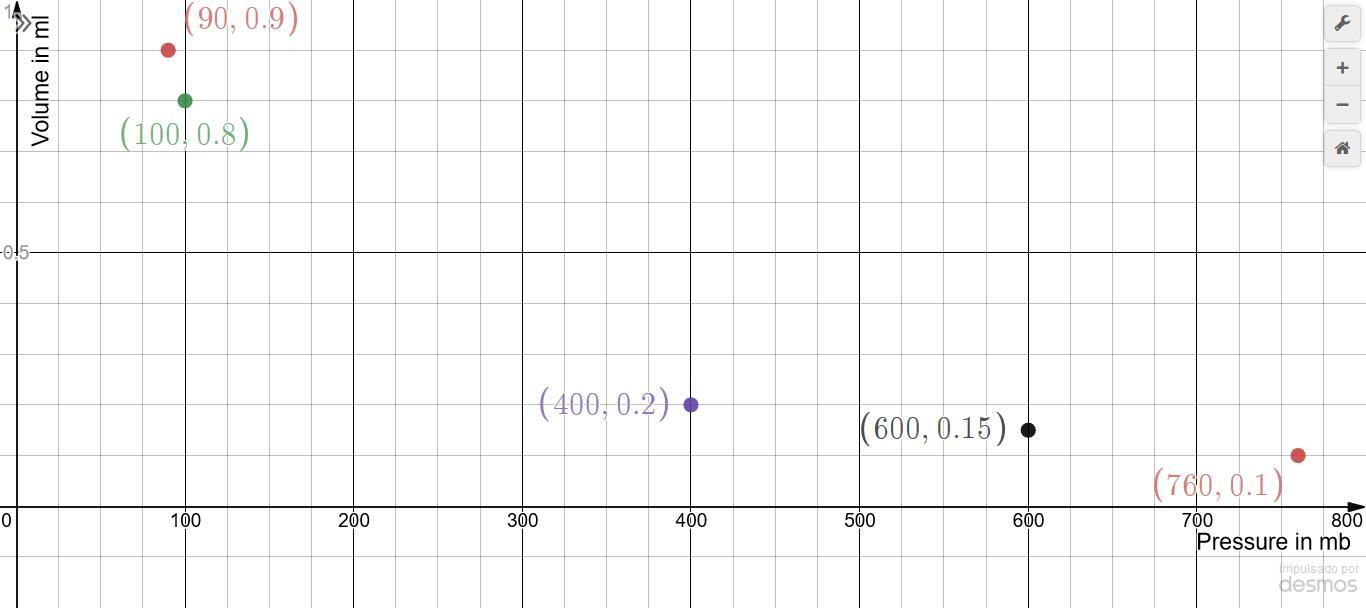
On the axes provided, label pressure on the horizontal axis from O mb to 760 mb and volume on the vertical axis from O to 1 mL.
Delicious77 [7]

Answer:

  • Please, find the graph with the labels and points located on the axes in the picture attached.

Explanation:

This is how you meet all the instructions and some important comments to understand how this kind of graphs word:

<u>1) Label pressure on the horizontal axis from O mb to 760 mb and volume on the vertical axis from O to 1 mL. </u>

The horizontal axis is used to record the independent variable and the vertical axis is used to record the dependent variable. The axes most be properly labeled with the name of the variable and the units.

In this case the origin is the point (0,0) which means that the axes cross each other, perpendicularly, at a pressure of 0 mb and a volume of 0.0 mililiters.

<u>2) Assign values to axes divisions in such a way that you occupy almost all the space on both axes. </u>

A good graph searches to occupy the whole space on both cases; to do that, find the maximum value for each variable, pressure and volume, and choose the values of the marks.

The range of the pressure (horizontal axis) is [90, 760 mb], so you should choose big divisions (marks) of 100 mb, and assign 800 mb to the right most mark on the horizontal axis. Then, you can divide each interval of 100 mb into 10 spaces, with small divisions of 10 mb (my graph uses 4 spcaes, with small divisions of 25 mb, but I recommend you use small divisions of 10 mb).

The range of the volume (vertical axis) is [0.1, 0.8], so you should choose only divisions with value of 0.1 ml.

<u>3) Now locate and label the points: </u>

  • (90, 0.9) ⇒ 90 mb, 0.9 ml
  • (100, 0.8) ⇒ 100 mb, 0.8 ml
  • (400, 0.2) ⇒ 400 mb, 0.2 ml
  • (600, 0.15) ⇒ 600 mb, 0.15 ml
  • (760, 0.1) ⇒ 760 mb, 0.1 ml

The points of the kind (x, y) are called ordered pairs, which means that the order matters, because it has a meaning: the first number represents the independent variable and the second number represents the dependent variable.

So, in the point (90, 0.9), 90 is a pressure of 90 mb and 0.9 is a volume of 0.9 ml.

To locate (600, 0.15), since the horizontal marks have value of 0.1, you must locate the second coordinate of your point between the marks 0.1 and 0.2 ml.

With that you can now locate each point on your graph.

5 0
2 years ago
Read 2 more answers
A 0.0035 M aqueous solution of a particular compound has pH = 2.46. The compound is (A) a weak base (B) a weak acid (C) a strong
slava [35]

Answer:

(a) A strong acid

Explanation:

We have given the pH of the solution is 2.46

pH=2.46  

So the concentration of H^+=10^{-pH}=10^{-2.46}=0.00346

solution having H+ concentration more than H^+=10^{-7} is acidic

Since in the given solution, H+ concentration is 0.00346 M which is more than 10^{-7}[/tex] so this is an acidic solution

Note-The concentration of H^+ decide the behavior of the solution that is, it is acidic or basic

7 0
2 years ago
A 40.0 mL sample of 0.25 M KOH is added to 60.0 mL of 0.15 M Ba(OH)2. What is the molar concentration of OH-(aq) in the resultin
solmaris [256]

Answer:

C) 0.28 M

Explanation:

Considering:

Molarity=\frac{Moles\ of\ solute}{Volume\ of\ the\ solution}

Moles =Molarity \times {Volume\ of\ the\ solution}

Potassium hydroxide will furnish hydroxide ions as:

KOH\rightarrow K^{+}+OH^-

Given :

<u>For Potassium hydroxide : </u>

Molarity = 0.25 M

Volume = 40.0 mL

The conversion of mL to L is shown below:

1 mL = 10⁻³ L

Thus, volume = 40.0×10⁻³ L

Thus, moles of hydroxide ions furnished by Potassium hydroxide is same as the moles of Potassium hydroxide as shown below:

Moles =0.25 \times {40.0\times 10^{-3}}\ moles

Moles of hydroxide ions by Potassium hydroxide = 0.01 moles

Barium hydroxide will furnish hydroxide ions as:

Ba(OH)_2\rightarrow Ba^{2+}+2OH^-

Given :

<u>For Barium hydroxide : </u>

Molarity = 0.15 M

Volume = 60.0 mL

The conversion of mL to L is shown below:

1 mL = 10⁻³ L

Thus, volume = 60.0×10⁻³ L

Thus, moles of hydroxide ions furnished by Barium hydroxide is twice the moles of Barium hydroxide as shown below:

Moles =2\times 0.15 \times {60.0\times 10^{-3}}\ moles

Moles of hydroxide ions by Barium hydroxide = 0.018 moles

Total moles = 0.01 moles + 0.018 moles = 0.028 moles

Total volume = 40.0×10⁻³ L + 60.0×10⁻³ L = 100×10⁻³ L

Concentration of hydroxide ions is:

Molarity=\frac{Moles\ of\ solute}{Volume\ of\ the\ solution}

Molarity_{OH^-}=\frac{0.028 }{100\times 10^{-3}}

<u> The final concentration of hydroxide ion = 0.28 M</u>

5 0
2 years ago
Read 2 more answers
The density of o2 gas at 16 degrees Celsius and 1.27atm is?
velikii [3]

Answer:

The density of O₂ gas is 1.71 \frac{g}{L}

Explanation:

Density is a quantity that allows you to measure the amount of mass in a given volume of a substance. So density is defined as the quotient between the mass of a body and the volume it occupies:

density=\frac{mass}{volume}

An ideal gas is characterized by three state variables: absolute pressure (P), volume (V), and absolute temperature (T). The relationship between them constitutes the ideal gas law, an equation that relates the three variables if the amount of substance, number of moles n, remains constant and where R is the molar constant of the gases:

P * V = n * R * T

So, you can get:

\frac{n}{V} =\frac{P}{R*T}

The relationship between number of moles and mass is:

n=\frac{mass}{molar mass}

Replacing:

\frac{\frac{mass}{molar mass} }{V} =\frac{P}{R*T}

\frac{mass}{V*Molar mass} =\frac{P}{R*T}

So:

\frac{mass}{V} =\frac{P*molar mass}{R*T}

Knowing that 1 mol of O has 16 g, the molar mass of O₂ gas is 32 \frac{g}{mol}.

Then:

\frac{mass}{V} =\frac{P*molar mass of O_{2} }{R*T}

In this case you know:

  • P=1.27 atm
  • molar mass of O₂= 32 \frac{g}{mol}.
  • R= 0.0821 \frac{atm*L}{mol*K}
  • T= 16 °C=  289 °K (0°C= 273°K)

Replacing:

density=\frac{mass}{V} =\frac{1.27atm*32\frac{g}{mol}  }{0.0821\frac{atm*L}{mol*K} *289 K}

Solving:

density= 1.71 \frac{g}{L}

<u><em>The density of O₂ gas is 1.71 </em></u>\frac{g}{L}<u><em></em></u>

3 0
2 years ago
What is the name and molecular formula of the gas formed when baking soda was combined with vinegar, which you identified using
sammy [17]
One of the two products of this reaction is carbonic acid (H2CO3), which immediately forms water and the gas you identified after exposure to the flaming and glowing splints. Write a balanced equation showing the decomposition of carbonic acid.
8 0
2 years ago
Other questions:
  • The fuel used in many disposable lighters is liquid butane, C4H10. Butane has a molecular weight of 58.1 grams in one mole. How
    13·2 answers
  • when a volume of a gas is changed from __ L to 4.50 L, the temperature will change from 38.1 C to 15.0C
    13·1 answer
  • astronauts brought back 500 lb rock samples from the moon. how many kilograms did they bring back (1 kg = 2.20 lbs)
    12·2 answers
  • Recalling that a beaker of water is two dimensional, what is the three dimensional shape of the micelle
    12·1 answer
  • How many liters of radon gas would be in 3.43 moles at room temperature and pressure (293 K and 100 kPa)?
    11·1 answer
  • The boiling point of chlorine is −34 °C. Which of the following best predicts the boiling point of iodine?
    7·2 answers
  • A plot of velocity versus substrate concentration for a simple enzyme-catalyzed reaction produces a _____. This indicates that a
    11·1 answer
  • The acids and bases shown right cover a range of pH values. Use what you know about acids, bases, and concentration to label the
    6·2 answers
  • Describe how the Rube Goldberg device design that you created follows the law of conservation of energy. Be sure to include both
    15·1 answer
  • How many moles of copper are in 6,000,000 atoms of copper?
    9·1 answer
Add answer
Login
Not registered? Fast signup
Signup
Login Signup
Ask question!