<u>QUESTION 1a</u>
We want to change  to a fraction in the simplest form.
We need repeatedly multiply by multiples of 10, until we obtain an integer(the least integer). We then divide by the same value that we used to multiply to get,

This implies that,


We cancel out the common factors to get,

<u>QUESTION 1b</u>
We want to convert  to a fraction in the simplest form.
We need repeatedly multiply by multiples of 10, until we obtain an integer(the least integer). We then divide by the same value that we used to multiply to get,

This implies that,


We cancel out the common factors to get,

Or as mixed numbers, we have

<u>QUESTION 1c</u>
We want to convert  to a fraction in the simplest form.
We need repeatedly multiply by multiples of 10, until we obtain an integer(the least integer). We then divide by the same value that we used to multiply to get,

This implies that,

Or as mixed numbers, we have

<u>QUESTION 1d</u>
We want to change  to a fraction in the simplest form.
We need repeatedly multiply by multiples of 10, until we obtain an integer(the least integer). We then divide by the same value that we used to multiply to get,

This implies that,

<u>Question 2a</u>
We want to convert  into decimal.
This fraction is having a denominator of 10 so we just have to move the decimal point back once to get,

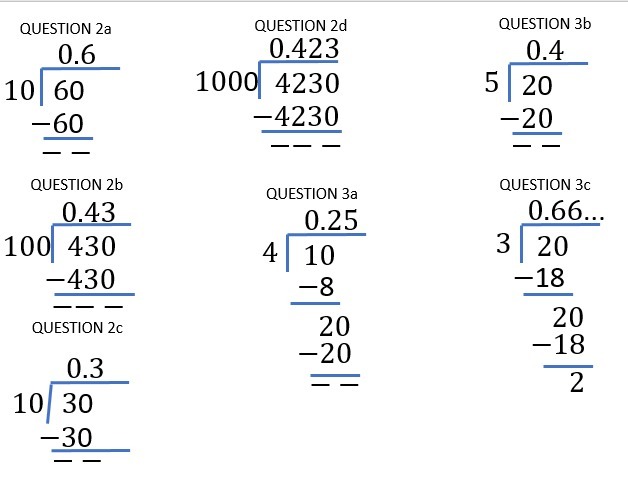
Check attachment for long division.
<u>QUESTION 2b</u>
We want to convert  into decimal.
This fraction is having a denominator of 100 so we just have to move the decimal point back twice to get,

Check attachment for long division.
<u>QUESTION 2c</u>
We want to change  into decimal.
This fraction is having a denominator of 10 so we just have to move the decimal point back once to get,

Check attachment for long division.
<u>QUESTION 2d</u>
The given fraction is  .
.
This fraction is having a denominator of 1000 so we just have to move the decimal point back three times to obtain,

Check attachment for long division.
<u>QUESTION 3a</u>
The given fraction is  .
.
We can make the denominator 100 by multiplying both the numerator and the denominator by  to obtain,

This implies that,

We move the decimal point back twice to obtain,

See attachment for long division
<u>QUESTION 3b</u>
The given fraction is  .
.
We can make the denominator 10 by multiplying both the numerator and the denominator by  to obtain,

This implies that,

We move the decimal point back twice to obtain,

See attachment for long division
<u>QUESTION 3c</u>
We want to change  into decimals.
We use long division as shown in the attachment to obtain;

<u>QUESTION 3d</u>
The given fraction is  .
.
We can make the denominator 100 by multiplying both the numerator and the denominator by to obtain,

This implies that,

We move the decimal point back twice to obtain,

<u>QUESTION 4a</u>
We want to simplify

We arrange to obtain,


+ 
----------------------------

----------------------------
<u>QUESTION 4b</u>
We want to simplify

We rearrange and carry out the operation as follows;


+
----------------------

-----------------------
<u>QUESTION 4c</u>
We want to simplify

We rearrange and perform the operation as follows;

-
--------------------

--------------------
QUESTION 4d
We want to simplify,

We rearrange and carry out the operations as follows;


---------------------

---------------------
QUESTION 4e
We want to simplify the product;


<u>The rest of the solutions will be in the attachment</u>