answer.
Ask question
Login Signup
Ask question
All categories
  • English
  • Mathematics
  • Social Studies
  • Business
  • History
  • Health
  • Geography
  • Biology
  • Physics
  • Chemistry
  • Computers and Technology
  • Arts
  • World Languages
  • Spanish
  • French
  • German
  • Advanced Placement (AP)
  • SAT
  • Medicine
  • Law
  • Engineering
kirill115 [55]
2 years ago
3

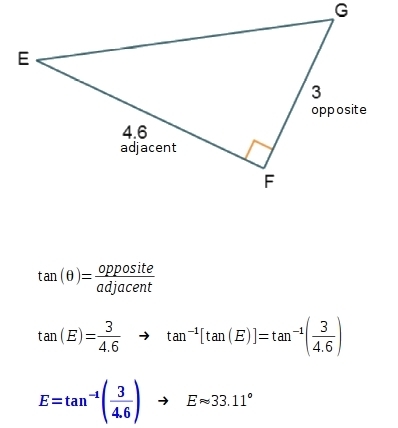
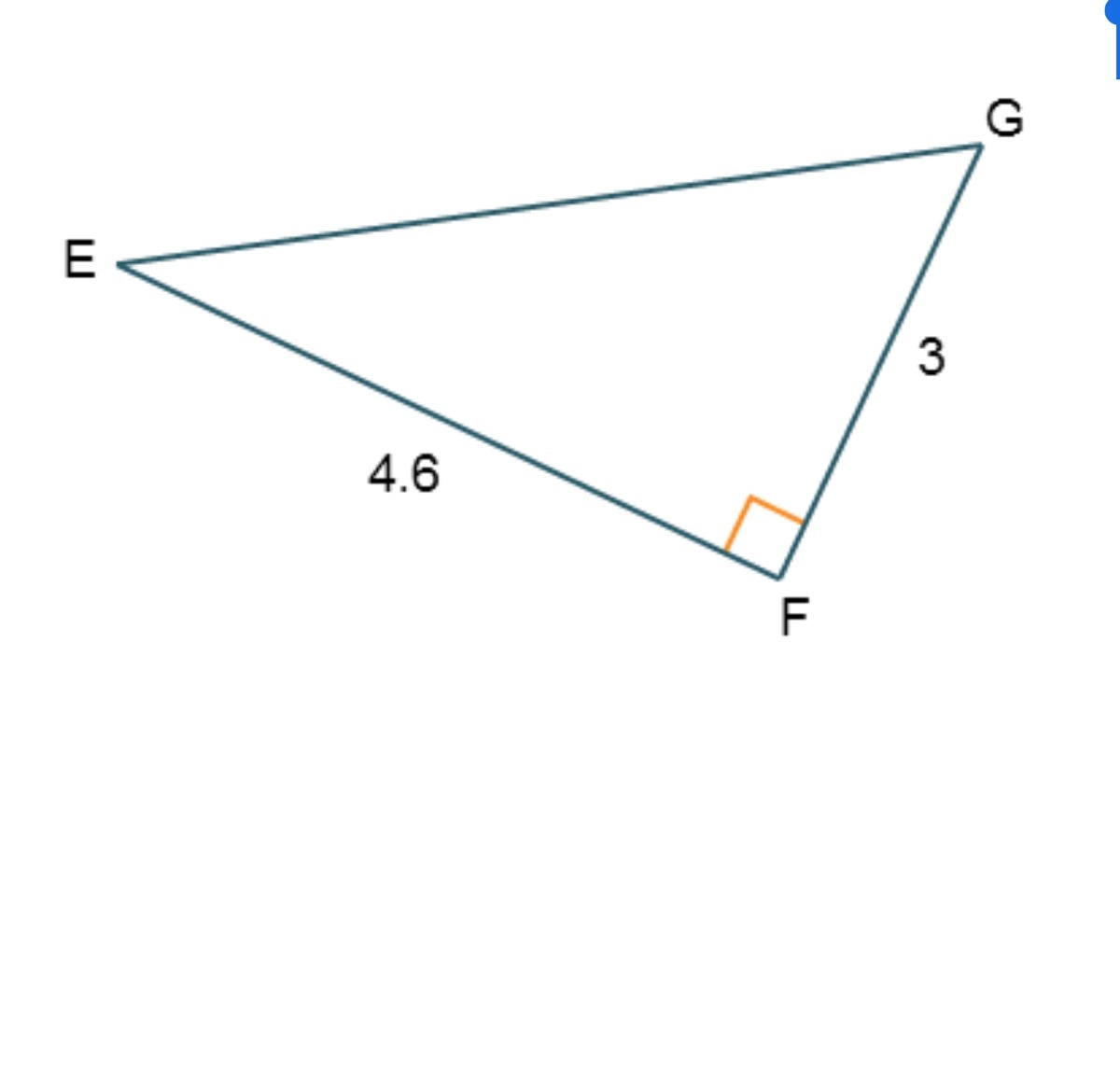
Which equation could be used to find m∠E in △EFG? m∠E = cos–1 m∠E = cos–1 m∠E = tan–1 m∠E = tan–1

Mathematics
2 answers:
Alexxx [7]2 years ago
8 0

Check the picture below.

Mkey [24]2 years ago
5 0

Answer:C)m∠E = tan–1

Step-by-step explanation:

i took the assignment

You might be interested in
In Littletown, the probability that a baseball team goes to the city playoffs is 0.30. the probability that the team goes to the
dimaraw [331]

Answer:

0.06

Step-by-step explanation:

5 0
2 years ago
Read 2 more answers
If Patricia drives at two-third of her usual speed, she covers a certain distance in one hour more than the time she takes while
zalisa [80]
Let r = usual driving rate
let t = usual driving time
We need to figure out t

The distance she covers in her usual time at her usual rate is r*t

The distance she covers in her new time at her new rate is:
(1+t)*((2/3)r)

Set this equal to each other and solve for t.

rt = (2/3)r + (2/3)rt
(1/3)rt = (2/3)r
(1/3)t = (2/3)
t = 2

So her usual time is 2 hours. (There's probably a faster way to do this)
3 0
2 years ago
A brewery produces cans of beer that are supposed to contain exactly 12 ounces. But owing to the inevitable variation in the fil
MArishka [77]

Answer:

T \sim N (\mu = 6*12=72 , \sigma= \sqrt{6} *0.3=0.735)

P(T \leq 72) = P(Z< \frac{72-72}{0.735}) = P(Z

Step-by-step explanation:

Previous concepts

Normal distribution, is a "probability distribution that is symmetric about the mean, showing that data near the mean are more frequent in occurrence than data far from the mean".

The Z-score is "a numerical measurement used in statistics of a value's relationship to the mean (average) of a group of values, measured in terms of standard deviations from the mean".  

Solutio to the problem

Let X the random variable that represent the amount of beer in each can of a population, and for this case we know the distribution for X is given by:

X \sim N(12,0.3)  

Where \mu=12 and \sigma=0.3

For this case we select 6 cans and we are interested in the probability that the total would be less or equal than 72 ounces. So we need to find a distribution for the total.

The definition of sample mean is given by:

\bar X = \frac{\sum_{i=1}^n X_i}{n} = \frac{T}{n}

If we solve for the total T we got:

T= n \bar X

For this case then the expected value and variance are given by:

E(T) = n E(\bar X) =n \mu

Var(T) = n^2 Var(\bar X)= n^2 \frac{\sigma^2}{n}= n \sigma^2

And the deviation is just:

Sd(T) = \sqrt{n} \sigma

So then the distribution for the total would be also normal and given by:

T \sim N (\mu = 6*12=72 , \sigma= \sqrt{6} *0.3=0.735)

And we want this probability:

P(T\leq 72)

And we can use the z score formula given by:

z = \frac{x-\mu}{\sigma}

P(T \leq 72) = P(Z< \frac{72-72}{0.735}) = P(Z

6 0
2 years ago
Ali and Steve share some sweets in the ratio 2 : 7
Ivahew [28]

Answer: 30 - 5 = 25 (the difference between the two is 5)

4 0
2 years ago
The following histogram presents the amounts of silver (in parts per million) found in a sample of rocks. One rectangle from the
gladu [14]

Answer:

  • <u><em>The height of the missing rectangle is 0.15</em></u>

Explanation:

The image attached has the mentioned <em>histogram</em>.

Such histogram presents the relative frequencies for the clases [0,1], [1,2],[2,3], [4,5], and [5,6] Silver in ppm.

Only the rectangle for the class [3,4] is missing.

The height of each rectangle is the relative frequency of the corresponding class.

The relative frequencies must add 1, because each relative frequency is calculated dividing the absolute class frequency by the total number in the sample; hence, the sum of all the relative frequencies is equal to the total absolute class frequencies divided by the same number, yielding 1.

In consequence, you can sum all the known relative frequencies and subtract from 1 to get the missing relative frequency, which is the height of the missing rectangle.

<u>1. Sum of the known relative frequencies</u>:

  • 0.2 + 0.3 + 0.15 + 0.1 + 0.1 = 0.85

<u>2. Missing frequency</u>:

  • 1 - 0.85 = 0.15

<u>3. Conclusion</u>:

  • The height of the missing rectangle is 0.15
4 0
2 years ago
Other questions:
  • the chorus has 35 members. which expression represents the number of ways a group of 6 members can be chosen to do a special per
    6·2 answers
  • What is −34, 0.5, 23,−73, 1.2 in order from least to greatest?
    13·1 answer
  • Ava’s mother is 3 times as old as Ava. Her grandmother is twice as old as Ava’s mother. The sum of their three ages is 120. How
    9·2 answers
  • Four numbers from the set 0 to 9, including 0 and 9, are used to create a personal identification number. Once a number is used,
    14·2 answers
  • Mr zuro finds the mean height of all 14 students in his class to be 69.0 inches. Just as Mr Zuro finishes explaining how to get
    7·1 answer
  • A 2-column table with 6 rows. The first column is labeled x with entries negative 1, 0, 1, 2, 3, 4. The second column is labeled
    11·2 answers
  • Order 93% nine tenths 0.099 0.915% and 0.092 from least to greatest
    12·1 answer
  • I have a bag with 6 marbles numbered from 1 to 6. Mathew has a bag with 12 marbles numbered from 1 to 12. Matthew chooses one ma
    15·1 answer
  • The paper cup is 9 cm tall and the circular opening has a radius of 2.5 cm.
    14·1 answer
  • Cherries cost $5.68 a pound. Will $20 be enough to buy a 4.1-pound bag of cherries? Explain how to determine whether $20 is the
    10·2 answers
Add answer
Login
Not registered? Fast signup
Signup
Login Signup
Ask question!