answer.
Ask question
Login Signup
Ask question
All categories
  • English
  • Mathematics
  • Social Studies
  • Business
  • History
  • Health
  • Geography
  • Biology
  • Physics
  • Chemistry
  • Computers and Technology
  • Arts
  • World Languages
  • Spanish
  • French
  • German
  • Advanced Placement (AP)
  • SAT
  • Medicine
  • Law
  • Engineering
Serjik [45]
2 years ago
11

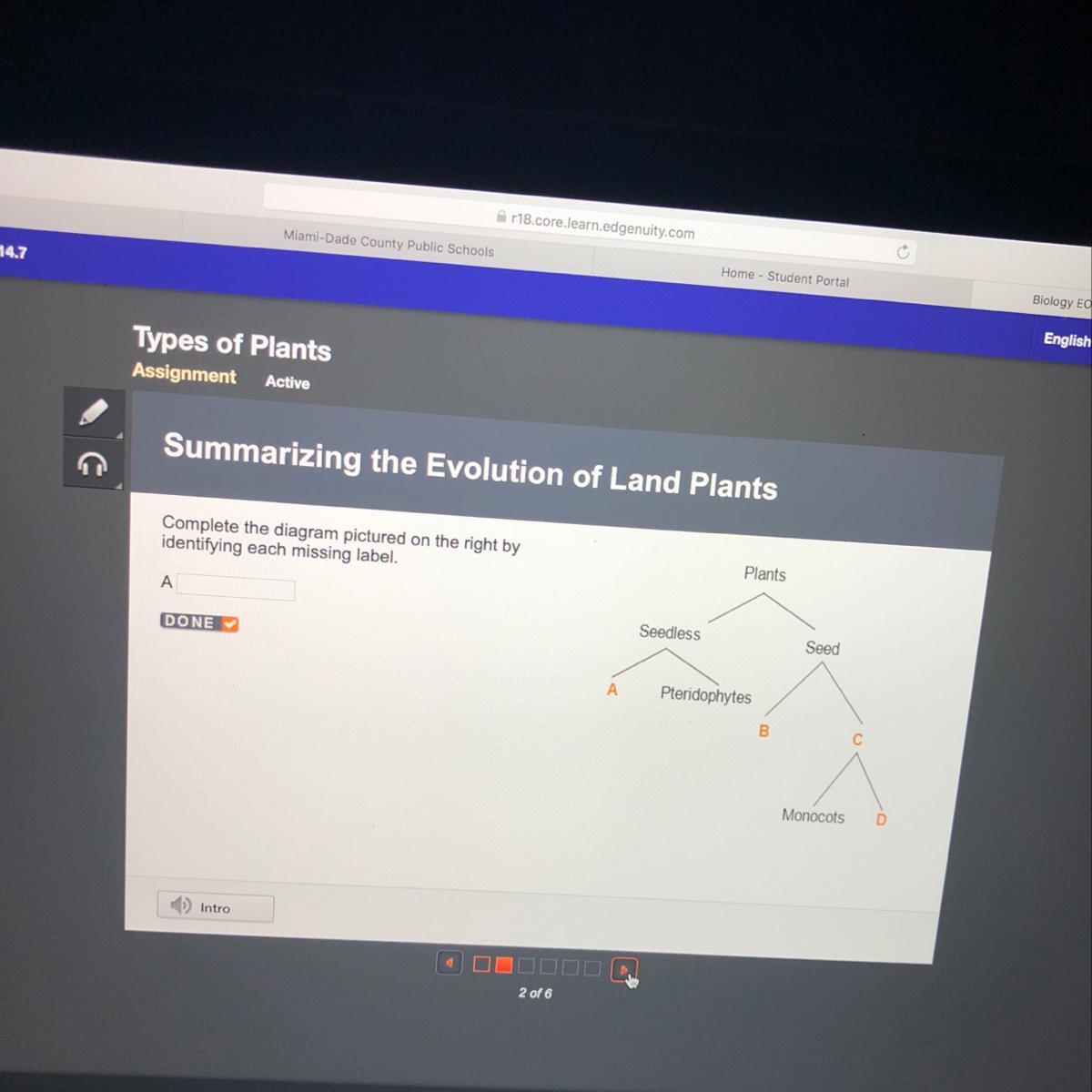
Complete the diagram pictured on the right by identifying each missing label

Biology
1 answer:
alekssr [168]2 years ago
8 0

<u>Answer</u>: A - Bryophytes

            B - Gymnosperms

            C - Angiosperms

            D - Dicots

Land plants are divided into non-vascular and vascular plants, according to the presence or absence of a conducting tissue. The diagram in the picture illustrates the division of vascular plants.

The non-vascular plants are divided in turn into Bryophytes and Pterophytes. The Bryophytes are divided into three groups: the liverworts, hornworts and mosses. The vascular plants are also divided into two groups gymnosperms (unprotected seeds) and angiosperms (seeds enclosed within a carpel).  

Angiosperms are further divided into monocots and dicots depending on the number of the cotyledons. These are a significant part of the embryo contained within a seed and the first part to emerge from the soils. Monocots (mono - one/single) as is illustrated by their name have only one whereas dicots two (di - two).  

You might be interested in
Suppose you're studying levels of job stress and measures of job efficiency in a nursing home. Which one of the following statem
Mariulka [41]
D-As stress levels increase, job efficiency increases is the correct answer.
6 0
2 years ago
When water dissolves a substance, weak charges on water molecules attract oppositely charged portions of the substance, pulling
guapka [62]

Answer:

C) polarity

Explanation:

The polar nature of water molecules allows it to dissolve like molecules, such molecules are also polar.

  • In water molecules hydrogen bonds provides a special dipole - dipole attraction.
  • Here, the hydrogen atom is directly joined to a highly electronegative atom(oxygen, nitrogen or fluorine).
  • This leads to a charge separation in which the hydrogen atom has net positive charge and the electronegative one has negative charge.
  • This makes the molecule of water polar.
  • By this property water easily attracts oppositely charged portions of another substance and then pull them into solution.

This property of water is polarity of water.

4 0
2 years ago
Can man alter Mars environment to make it more suitable for human habitation?how?
Charra [1.4K]
Yes, terraforming. Pretty much an oversize greenhouse. It takes a while to get a small portion of mars changed, but it would work.
3 0
2 years ago
Ventricular systole begins during the __________ phase of the cardiac cycle. Ventricular systole begins during the __________ ph
Zina [86]

Answer

              Ventricular systole begins during the  <u>isovolumetric contraction </u>phase of the cardiac cycle.

Explanation

1. Ventricular ejection

The forceful expulsion of blood from the ventricles into the aorta and the pulmonary arteries.

2. Isovolumetric contraction

                     The interval between the closing of the AV valves and the opening of the semilunar valves (aortic and pulmonary valves) is known as isovolumetric contraction. it is the beginig of systole. it is the first chamber systolic event. The myocardial muscle fibers have begun to shorten but have not developed enough pressure in the ventricles to overcome the aortic and pulmonary end-diastolic pressures and open the aortic and pulmonary valves. During this period of muscle fiber contraction, the ventricular volumes do not change.

3. Ventricular filling  

                 In this stage AV valve is opened and the blood that has accumulated in atria flow rapidly into ventricles. The ventricular volume increase rapidly. A third heart sound known as S3 is heared during this stage.

4. Isovolumetric relaxation

                  It is the beginning of diastole. The AV valve are closed at beginig. The atrium in diastole has been filling with blood on top of the closed AV valve, causing atrial pressure to rise gradually. The pressure in the ventricles continues to drop. Ventricular volume is at a minimum and is ready to be filled again with blood.


5 0
2 years ago
The density of an object is .835 g/cm3. If its volume is 34 cm3, what is the mass of the object? (Density: D = )
alisha [4.7K]
D = m/v

Given:
D: .835 g/cm3
V: 34 cm3
M: ?

M= Dxv

M= .835 g/cm3 x 34 cm3
M= 28.39 g
5 0
2 years ago
Read 2 more answers
Other questions:
  • Jennifer has been depressed for several months, and she decided to take an overdose of sleeping pills. after taking the pills, h
    6·1 answer
  • Explain have a fats sugars and or starch contained in seeds or milk are useful for the plant sprouting from the seed or the baby
    8·1 answer
  • Cellulose, chitin, and peptidoglycan function as structural molecules and withstand pulling and pushing forces well. which struc
    12·2 answers
  • Which of these will subtract members from a population?
    7·1 answer
  • A child who constantly hears negative statements about himself or herself is likely to _____.
    9·2 answers
  • Do you think flowchart is the best way to explain how the nervous system works to someone who's unfamiliar with the concept? Exp
    8·1 answer
  • The cerebral cortex plays a major role in all of the following except
    5·1 answer
  • How can the finite growth multiplier be used to predict future values of population density, N(t) ?
    5·1 answer
  • Which statement best describes both insulin and glucagon? They both provide structural support, but only insulin is a carbohydra
    14·2 answers
  • Carol wants to become a medical assistant. She is wondering why it is necessary to spend the time learning the roots, suffixes,
    9·1 answer
Add answer
Login
Not registered? Fast signup
Signup
Login Signup
Ask question!
