answer.
Ask question
Login Signup
Ask question
All categories
  • English
  • Mathematics
  • Social Studies
  • Business
  • History
  • Health
  • Geography
  • Biology
  • Physics
  • Chemistry
  • Computers and Technology
  • Arts
  • World Languages
  • Spanish
  • French
  • German
  • Advanced Placement (AP)
  • SAT
  • Medicine
  • Law
  • Engineering
Alexeev081 [22]
2 years ago
4

Dan used the following method to convert 27.7778 cm/s to km/h. An equation is shown. The expression on the left has three terms

separated by the multiplication sign. The first term is 27.7778 cm by 1 h. The second term is 1 km by 100,000 cm. The third term is 1 s by 0.000277778 h. The number on the right of the equal to sign is 1 km per hour. (1 km = 100,000 cm and 1 s = 0.000277778 h) What is the error in Dan's conversion method?
A. 1 h should be written as 1 s.

B. 1 km should be written as 1 cm.

C. 27.7778 cm should be written as 27.7778 km.

D. 0.000277778 h should be written as 0.000277778 s.
Chemistry
2 answers:
Olegator [25]2 years ago
6 0

A is correct (1 h should be written as 1 s)

I just took this exam. :)

Varvara68 [4.7K]2 years ago
6 0

Answer:

Your correct answer is A. 1 h should be written as 1 s.

Explanation:

You might be interested in
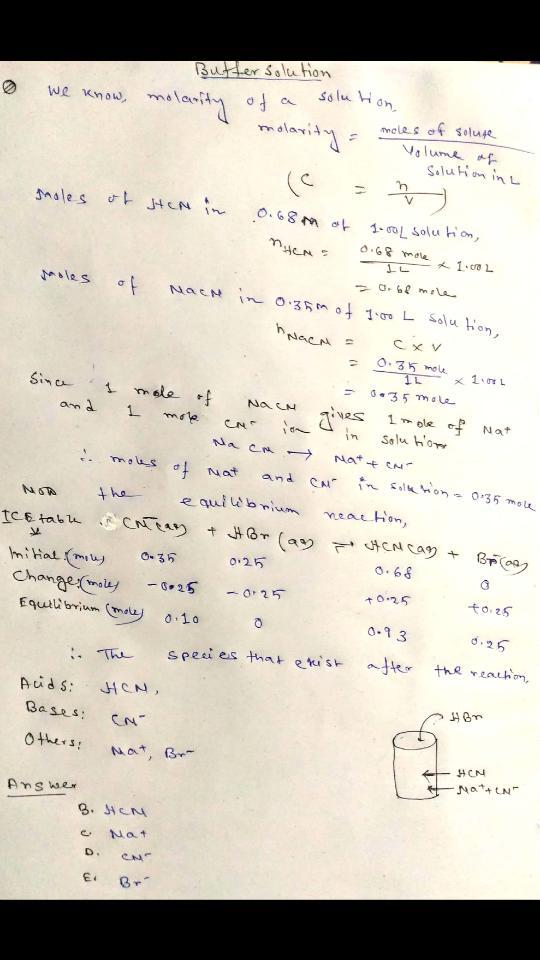
g A 0.25 mol sample of HBr is added to a 1.00 L buffer solution consisting of 0.68 M HCN and 0.35 M NaCN. Identify all species t
salantis [7]

Answer:

See explaination for details and diagram

Explanation:

We can say that Chemical reaction is a process in which one or more substances, the reactants, are converted to one or more different substances, the products. Substances are either chemical elements or compounds.

A chemical reaction rearranges the constituent atoms of the reactants to create different substances as products.

See attachment for the buffer of the chemical reaction.

7 0
2 years ago
A 200.-milliliter sample of CO2(g) is placed in a sealed, rigid cylinder with a movable piston at 296 K and 101.3 kPa. Determine
bagirrra123 [75]

Answer:

The final volume of the sample of gas V_{2} = 0.000151 m^{3}

Explanation:

Initial volume V_{1} = 200 ml = 0.0002 m^{3}

Initial temperature T_{1} = 296 K

Initial pressure P_{1} = 101.3 K pa

Final temperature T_{2} = 336 K

Final pressure P_{2} =  K pa

Relation between P , V & T is given by

P_{1} \frac{V_{1} }{T_{1} } = P_{2} \frac{V_{2} }{T_{2} }

Put all the values in the above equation we get

101.3 (\frac{0.0002}{296} )= 152 (\frac{V_{2} }{336} )

V_{2} = 0.000151 m^{3}

This is the final volume of the sample of gas.

4 0
2 years ago
Which statement describes the transfer of heat energy that occurs when an ice cube is added to an insulated container with 100 m
nadya68 [22]
Number 3 is the most likely answer
4 0
2 years ago
Given these reactions, where X represents a generic metal or metalloid 1) H2(g)+12O2(g)⟶H2O(g)ΔH1=−241.8 kJ 1) H2(g)+12O2(g)⟶H2O
Bond [772]

Answer:

ΔH = -793,6 kJ

Explanation:

It is possible to obtain ΔH of this reaction using Hess's law that says you can sum the half-reactions ΔH to obtain the ΔH of the global reaction:

If half-reactions are:

1) H₂(g) + ¹/₂O₂(g) ⟶ H₂O(g) ΔH₁ = −241.8 kJ

2) X(s) + 2Cl₂(g) ⟶ XCl₄(s) ΔH₂ = +356.9 kJ  

3) ¹/₂H₂(g) + ¹/₂Cl₂(g) ⟶ HCl(g) ΔH₃ = −92.3 kJ

4) X(s) + O₂(g) ⟶ XO₂(s) ΔH₄ = −639.1 kJ

5) H₂O(g) ⟶ H₂O(l) ΔH₅ = −44.0 kJ

The sum of (4) + 4×(3) - (2) - 2×(1) - 2×(5) is:

(4) X(s) + O₂(g) ⟶ XO₂(s) ΔH = −639.1 kJ

+4×(3) 2H₂(g) + 2Cl₂(g) ⟶ 4HCl(g) ΔH = −369,2 kJ

-(2) XCl₄(s) ⟶ X(s) + 2Cl₂(g) ΔH = -356,9 kJ

-2×(1) 2H₂O(g) ⟶ 2H₂(g) + O₂(g) ΔH = +483,6 kJ

-2×(5) 2H₂O(l) ⟶ 2H₂O(g) ΔH = +88.0 kJ

= <em>XCl₄(s) + 2H₂O(l) ⟶ XO₂(s) + 4HCl(g)</em>

Where ΔH is:

ΔH = -639,1 kJ -369,2 kJ -356,9 kJ +483,6 kJ +88,0 kJ

<em>ΔH = -793,6 kJ</em>

I hope it helps!

5 0
2 years ago
El cuerpo humano tiene unos 6 billones de células (6,0x10¹²) y la población de la Tierra es de unos 8 000 millones de personas.
zloy xaker [14]

Answer:

En toda la población del mundo hay <u>0.0797 moles de células</u>

Explanation:

1.0 mol of cells = 6.022 * 10∧23 cells

X mol of cells  = 6.0 * 10∧12 cells

- X is cleared to find out how many moles of cells are in a human body:

  • X = 6.0 * 10∧12 cells / 6.022 * 10∧23 cells
  • X = 9,963 * 10∧-12 moles of cells per person

In the world there are 8 * 10∧9 people, how many moles in total will there be?

8 * 10∧9 people * 9,963 * 10∧-12 moles of cells per person  =

<u>0.0797 moles of molecules in the entire population of the earth.</u>

4 0
2 years ago
Other questions:
  • What is the mass in grams of 6.022×10²³ atoms of mass 16.00 amu?
    10·1 answer
  • Which of the following would most likely contain a fossil?
    11·2 answers
  • Looking at the same nonmetal group on the periodic table, how does the reactivity of an element in period 2 compare to the react
    12·2 answers
  • A molecular biologist measures the mass of cofactor a in an average yeast cell. the mass is 41.5 pg . what is the total mass in
    14·2 answers
  • The Lewis structures of four compounds are given. In the first molecule sufur is the central atom. There are two oxygen atoms bo
    11·1 answer
  • 8. Balance the following nuclear equations:<br> ^65/30Ca -&gt; ^65/29Sc +_______
    15·1 answer
  • A 150 W electric heater operates for 12.0 min to heat an ideal gas in a cylinder. During this time, the gas expands from 3.00 L
    11·1 answer
  • How many moles are equal to 47.2 g of K2O
    15·2 answers
  • What volume of water should be used to dissolve 19.6 g of LiF to create a 0.320 M solution?
    14·1 answer
  • 5. Rubbing alcohol is a commonly used disinfectant and has a cooling effect when applied to the skin. The active ingredient in r
    12·1 answer
Add answer
Login
Not registered? Fast signup
Signup
Login Signup
Ask question!