answer.
Ask question
Login Signup
Ask question
All categories
  • English
  • Mathematics
  • Social Studies
  • Business
  • History
  • Health
  • Geography
  • Biology
  • Physics
  • Chemistry
  • Computers and Technology
  • Arts
  • World Languages
  • Spanish
  • French
  • German
  • Advanced Placement (AP)
  • SAT
  • Medicine
  • Law
  • Engineering
kozerog [31]
2 years ago
4

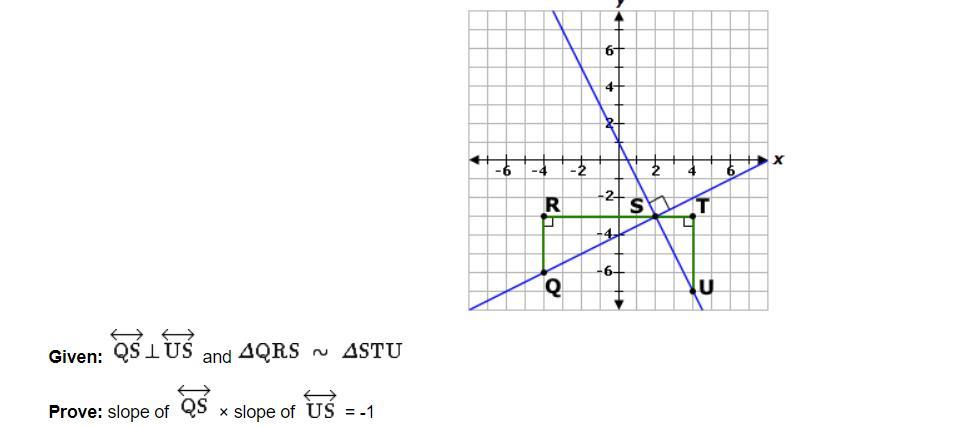
Please help! The table shows the proof of the relationship between the slopes of two perpendicular lines. What is the missing st

atement in step 5?
A. slope of QS x (-slope of US) = 1


B. slope of QS x slope of US = 1


C. slope of QS x slope of US = \frac{ST}{TU} x \frac{TU}{ST}


D. slope of QS x slope of US = - \frac{ST}{TU} x \frac{TU}{ST}

Mathematics
2 answers:
Svetradugi [14.3K]2 years ago
8 0

line D is correct since it was shown than QR/RS = ST/TU

ira [324]2 years ago
5 0

Answer:

Option D is correct.

Step-by-step explanation:

The given table shows the proof of the relationship between the slopes of two perpendicular lines.The missing statement in step 5 is given by option D. slope of QS x slope of US = -\frac{ST}{TU}*\frac{TU}{ST}

As we can see its already given in second statement in picture 2 that \frac{QR}{RS}=\frac{ST}{TU}

You might be interested in
I WILL AWARD BRAINLIEST!! PLEASE HELP!!! The figure below shows the movement of a pedestrian from point B to point E. Using the
MissTica

A) The speed of the pedestrian BC is 5 km/h

    The speed of the pedestrian CD is 0 km/h

    The speed of the pedestrian DE is 5 km/h

B) He arrived E since the stop after 6 hours

C) The formula for section BC is d(t) = 40 - 5t

    The formula for section CD is d(t) = 20

    The formula for section DE is d(t) = 50 - 5t

Step-by-step explanation:

A)

In the time-distance graph the speed is the rate of change of distance

and that mean speed = Δd/Δt ⇒ (slope of the line)

In line BC:

1. Δd = 40 - 20 = 20 km

2. Δt = 4 - 0 = 4 hours

3. The speed = 20 ÷ 4 = 5 km/h

The speed of the pedestrian BC is 5 km/h

In line CD:

1. Δd = 20 - 20 = 0 km

2. Δt = 6 - 4 = 2 hours

3. The speed = 0 ÷ 2 = 0 km/h

The speed of the pedestrian CD is 0 km/h

In line DE:

1. Δd = 20 - 0 = 20 km

2. Δt = 10 - 6 = 4 hours

3. The speed = 20 ÷ 4 = 5 km/h

The speed of the pedestrian DE is 5 km/h

B)

∵ He stop at t = 4 hours

∵ He arrived at point E at t = 10 hours

∵ 10 - 4 = 6 hours

He arrived E since the stop after 6 hours

C)

The speeds are represented by lines

The form of the equation of a line is f(x) = mx + c, where m represents

the slope of the line and c is the y-intercept (y when x = 0)

1. f(x) is d(t)

2. m is the speed

3. x is t

4. You can find c by substitute d and t by any point on the line

Line BC

Line BC has negative slope because d decreases when t increases

∵ m = -5 and c = 40

∴ d(t) = 40 - 5t

The formula for section BC is d(t) = 40 - 5t

Line CD

Line CD is a horizontal line (equation any horizontal line is y = c)

∴ m = 0 and c = 20

∴ d(t) = 20

The formula for section CD is d(t) = 20

Line DE

Line DE has negative slope because d decreases when t increases

∵ m = -5

∴ d(t) = -5t + c

To find c substitute the coordinates of point D in the equation

∵ The coordinates of point D are (6 , 20)

∴ 20 = -5(6) + c

∴ 20 = -30 + c

Add 30 to both sides

∴ c = 50

∴ d(t) = 50 - 5t

The formula for section DE is d(t) = 50 - 5t

Learn more:

You can learn more about the distance, speed, and time in

brainly.com/question/5102020

#LearnwithBrainly
3 0
2 years ago
Carla packed this box with 1 centimeter cubes what is the volume of the box
shusha [124]

Answer: 60\ cm^3

Step-by-step explanation:

<h3> The complete exercise is attached.</h3>

You can observe in the picture attached that the box is a rectangular prism.

The volume of a rectangular prism can be found with this formula:

V=lwh

Where "l" is the length, "w" is the width and "h" is the height.

You know that the lenght of each side of those cubes is 1 centimeter. Therefore, you can multiply the number of cubes on each side of the box by 1 centimeter in order to find the lenght, the width and the height of the box:

 l=(4)(1\ cm)=4\ cm\\\\w=(3)(1\ cm)=3\ cm\\\\h=(5)(1\ cm)=5\ cm

Now you can substitute the lenght, the width and the height of the box into the formula shown at the beginning of the explanation:

V=(4\ cm)(3\ cm)(5\ cm)

Finally, evaluating, you get that the volume of the box is:

V=60\ cm^3

4 0
2 years ago
Un guardia forestal divisa, desde un punto de observación A, un incendio en la dirección N27° 10’ E. Otro guardia, que se encuen
Inga [223]

Answer:

la distancia del punto de observación A al incendio = 5.5 millas

la distancia del punto de observación B al incendio = 3.8 millas

Step-by-step explanation:

La expresión esquemática de la pregunta se puede ver en la imagen adjunta a continuación :

Del siguiente diagrama;

Usando la sine regla:

\dfrac{sin \  F}{f} = \dfrac{sin  \ A }{a}

\dfrac{sIn \  79}{6} = \dfrac{sin \   63}{a}

a sin 79 = 6 sin 63

a =\dfrac{6 \times sin \ 63}{sin \ 79}

a =\dfrac{6 \times 0.8910}{0.9816}

a = 5.446 millas

la distancia del punto de observación A al incendio = 5.5 millas (a la décima más cercana)

\dfrac{sin \  F}{f} = \dfrac{sin  \ B}{b}

\dfrac{sin \  79}{6} = \dfrac{sin  \ 38}{b}

b sin 79 = 6 sin 38

b  = \dfrac{6 \times sin  \ 38}{sin \  79}

b  = \dfrac{6 \times0.6157 }{0.9816}

b = 3.7635 millas

la distancia del punto de observación B al incendio = 3.8 millas (a la décima más cercana)

8 0
2 years ago
What is the worst thing to make in pottery class
Shkiper50 [21]
Something inappropriate
7 0
2 years ago
Read 2 more answers
Prove this (sinx-tanx)(cosx-cotx)=(sinx-1)(cosx-1)
Ilya [14]

<span><span>(<span>sinx</span>−<span>tanx</span>)</span><span>(<span>cosx</span>−<span>cotx</span>)</span></span>

<span>=<span>(<span>sinx</span>−<span><span>sinx</span><span>cosx</span></span>)</span><span>(<span>cosx</span>−<span><span>cosx</span><span>sinx</span></span>)</span></span>

<span>=<span>sinx</span><span>(1−<span>1<span>cosx</span></span>)</span><span>cosx</span><span>(1−<span>1<span>sinx</span></span>)</span></span>

<span>=<span>sinx</span><span>(<span><span>cosx</span><span>cosx</span></span>−<span>1<span>cosx</span></span>)</span><span>cosx</span><span>(<span><span>sinx</span><span>sinx</span></span>−<span>1<span>sinx</span></span>)</span></span>

<span>=<span><span>sinx</span><span>cosx</span></span><span>(<span>cosx</span>−1)</span><span><span>cosx</span><span>sinx</span></span><span>(<span>sinx</span>−1)</span></span>

<span>=<span>(<span>cosx</span>−1)</span><span>(<span>sinx</span>−1<span>)</span></span></span>

6 0
2 years ago
Read 2 more answers
Other questions:
  • Percy buys tomatoes that cost $0.58 per pound he pays $2.03 for the tomatoes how many pounds of tomatoes does he buy show your w
    7·2 answers
  • Gym A charges $65 a month plus $7 per visit. The monthly cost at Gym B is represented by y = 7x + 55, where x is the number of v
    13·1 answer
  • Peter bought 5kg of meat he used 1.10kg to make hamburgers the rest he used to make 13 portions of spaghetti how much meat did h
    6·1 answer
  • a multiple choice test contains 50 questions with 4 answer choices. what is the probability of correctly answering 15 questions
    9·1 answer
  • How long is a distance of 8 km if measured on a map with a scale of 1:50,000
    10·1 answer
  • The scores of eighth-grade students in a math test are normally distributed with a mean of 57.5 and a standard deviation of 6.5.
    14·2 answers
  • The graph of a limacon curve is given. Without using your graphing calculator, determine which equation is correct for the graph
    12·1 answer
  • 54 equals 9 more than a number t .
    7·1 answer
  • The result of which expression will best estimate the actual product of (Negative four-fifths) (three-fifths) (Negative StartFra
    6·1 answer
  • A factory produces 125 bags of jelly beans every 10 seconds. Is there a linear function proportional? How do you know?
    6·1 answer
Add answer
Login
Not registered? Fast signup
Signup
Login Signup
Ask question!
