answer.
Ask question
Login Signup
Ask question
All categories
  • English
  • Mathematics
  • Social Studies
  • Business
  • History
  • Health
  • Geography
  • Biology
  • Physics
  • Chemistry
  • Computers and Technology
  • Arts
  • World Languages
  • Spanish
  • French
  • German
  • Advanced Placement (AP)
  • SAT
  • Medicine
  • Law
  • Engineering
Sergeeva-Olga [200]
2 years ago
9

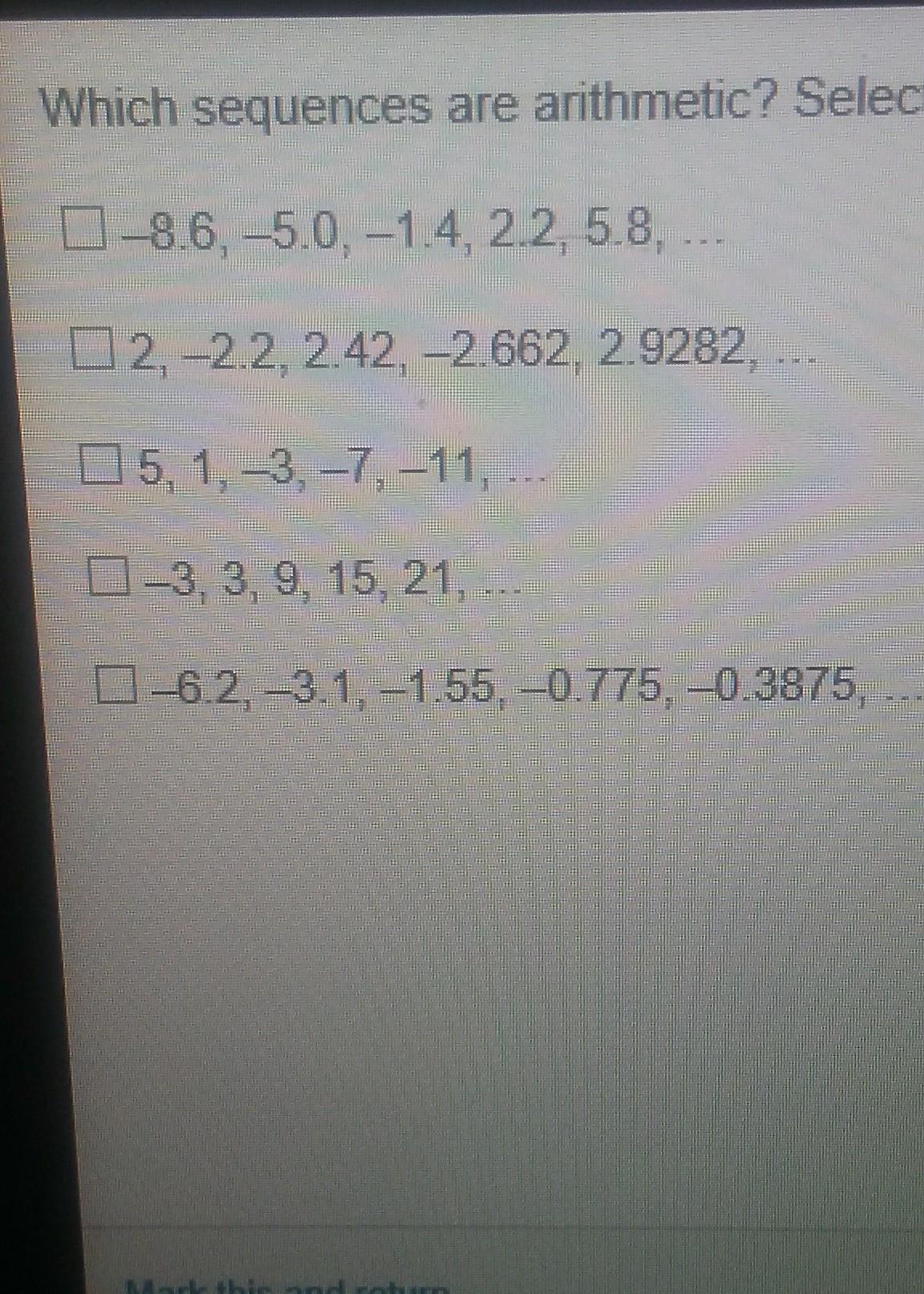
Which sequences are arithmetic? select three options​

Mathematics
2 answers:
Gemiola [76]2 years ago
6 0

Answer:

The sequences are arithmetic

1).-8.6, -5.0, -1.4, 2.2, 5.8

2).  5, 1, -3, -7, -11

3). -3, 3, 9, 15, 21

Step-by-step explanation:

If a sequence is a an AP then there is a common difference d.

<u>1) Check sequence 1</u>

-8.6, -5.0, -1.4, 2.2, 5.8

-5.0 - - 8.6 = 3.6

-1.4 - -5.4 = 3.6  It is an AP

<u>2) Check sequence 2</u>

2, -2.2,2.42, -2.662, 2.9282

-2.2 - 2 = -4.2

-2.662 - 2.42 = -5.082 Not AP

Similarly AP sequences are

5, 1, -3, -7, -11

-3, 3, 9, 15, 21

kaheart [24]2 years ago
6 0

Answer:

Options 1, 3 and 4.

Step-by-step explanation:

As we know in an arithmetic sequence each successive term has a common difference.

Let's check each option for Arithmetic sequence.

Option 1.

-8.6, -5.0, -1.4, 2.2, 5.8,....

Difference between 2nd and 1st term

-5 - (-8.6) = -5 + 8.6

= 3.6

Difference between 4th and 3rd term

-1.4 - (-5) = -1.4 + 5

= 3.6

This proves that there is a common difference of 3.6 which shows that the sequence is an arithmetic sequence.

Option 2.

2, -2.2, 2.42, -2.662, 2.9282,....

2nd term - 1st term = (-2.2) - 2 = -4.2

3rd term - 2nd term = 2.42 - (-2.2) = 2.42 + 2.2 = 4.62

Here difference in each term of the sequence is not common so it's not an arithmetic sequence.

Option 3.

5, 1, -3, -7, -11,.......

2nd term - 1st term = 1 - 5 = -4

3rd term - 2nd term = -3 - 1 = -4

Therefore, the given sequence is an arithmetic sequence.

Option 4.

-3, 3, 9, 15, 21,.......

2nd term - 1st term = 3 - (-3) = 3+ 3 = 6

3rd term - 2nd term = 9 - 3 = 6

There is a common difference of 6 in each term so it's an arithmetic sequence.

Option 5.

-6.2, -3.1, -1.55, -0.775, -0.3875,.........

2nd term - 1st term = -3.1 - (-6.2) = 6.2 - 3.1 = 3.1

3rd term - 2nd term = -1.55 - (-3.1) = 3.1 - 1.55 = 1.55

And 3.1 ≠ 1.55 which shows that this sequence is not an arithmetic sequence.

Options 1, 3 and 4 are arithmetic sequences.

You might be interested in
Please answer these questions thanks
xz_007 [3.2K]
Well...
$6.50/64= about $0.10
assuming that the cost of the 48oz bottle is $4.20,
$4.20/48= about $0.08

the 48oz is better buy, as it is $0.08/oz
(/ means per)

7 0
2 years ago
Trapezoid STUV with vertices S(-3,6),T(0,7),U(1,4),and V(-5,2): (x,y)&gt;(x+7,y-9)​
hjlf

Answer:

See below

Step-by-step explanation:

<u>Given points:</u>

  • S(-3,6),T(0,7),U(1,4),and V(-5,2)

<u>Translation rule: </u>

  • (x,y) → (x+7,y-9)​

<u>New coordinates by applying the rule:</u>

  • S'(4, -3), T'(7, -2), U'(8, -5), V'(2, -7)

See attached for the graph

The blue trapezoid is STUV and the red one is S'T'U'V'

7 0
2 years ago
The cost, c(x), for a taxi ride is given by c(x) = 3x + 2.00, where x is the number of minutes. What does the slope mean for thi
xxTIMURxx [149]
Simple...

you have: C(X)=3x+2.00

x=number of minutes

Pay attention to the y=mx+b form where m=slope-->>

3x is the slope...

so it's 3(times the number of minutes) <<---or (x)

This means that the slope is 3, or the fancy way of saying it-->>"rate of change."

The rate of change of the cost of the taxi ride is $3.00 per minute.

Thus, your answer.


7 0
2 years ago
"An ordinance requiring that a smoke detector be installed in all previously constructed houses has been in effect in a particul
Galina-37 [17]

Answer:

a) Probability that the claim is rejected when the actual value of p is 0.8 = P(X ≤ 15) = 0.0173

b) Probability of not rejecting the claim when p = 0.7, P(X > 15) = 0.8106

when p = 0.6, P(X > 15) = 0.4246

c) Check Explanation

The error probabilities are evidently lower when 15 is replaced with 14 in the calculations.

Step-by-step explanation:

p is the true proportion of houses with smoke detectors and p = 0.80

The claim that 80% of houses have smoke detectors is rejected if in a sample of 25 houses, not more than 15 houses have smoke detectors.

If X is the number of homes with detectors among the 25 sampled

a) Probability that the claim is rejected when the actual value of p is 0.8 = P(X ≤ 15)

This is a binomial distribution problem

A binomial experiment is one in which the probability of success doesn't change with every run or number of trials (probability that each house has a detector is 0.80)

It usually consists of a number of runs/trials with only two possible outcomes, a success or a failure (we are sampling 25 houses with each of them either having or not having a detector)

The outcome of each trial/run of a binomial experiment is independent of one another.

Binomial distribution function is represented by

P(X = x) = ⁿCₓ pˣ qⁿ⁻ˣ

n = total number of sample spaces = 25 houses sampled

x = Number of successes required = less than or equal to 15

p = probability of success = probability that a house has smoke detectors = 0.80

q = probability of failure = probability that a house does NOT have smoke detectors = 1 - p = 1 - 0.80 = 0.20

P(X ≤ 15) = Sum of probabilities from P(X = 0) to P(X = 15) = 0.01733186954 = 0.01733

b) Probability of not rejecting the claim when p= 0.7 when p= 0.6

For us not to reject the claim, we need more than 15 houses with detectors, hence, th is probability = P(X > 15), but p = 0.7 and 0.6 respectively for this question.

n = total number of sample spaces = 25 houses sampled

x = Number of successes required = more than 15

p = probability that a house has smoke detectors = 0.70, then 0.60

q = probability of failure = probability that a house does NOT have smoke detectors = 1 - p = 1 - 0.70 = 0.30

And 1 - 0.60 = 0.40

P(X > 15) = sum of probabilities from P(X = 15) to P(X = 25)

When p = 0.70, P(X > 15) = 0.8105639765 = 0.8106

When p = 0.60, P(X > 15) = 0.42461701767 = 0.4246

c) How do the "error probabilities" of parts (a) and (b) change if the value 15 in the decision rule is replaced by 14.

The error probabilities include the probability of the claim being false.

When X = 15

(Error probability when p = 0.80) = 0.0173

when p = 0.70, error probability = P(X ≤ 15) = 1 - P(X > 15) = 1 - 0.8106 = 0.1894

when p = 0.60, error probability = 1 - 0.4246 = 0.5754

When X = 14

(Error probability when p = 0.80) = P(X ≤ 14) = 0.00555

when p = 0.70, error probability = P(X ≤ 14) = 0.0978

when p = 0.60, error probability = P(X ≤ 14) = 0.4142

The error probabilities are evidently lower when 15 is replaced with 14 in the calculations.

Hope this Helps!!!

6 0
2 years ago
In the following diagram \overline{DE} \parallel \overline{FG}
Gnesinka [82]

Answer:

<x = 31°

Step-by-step explanation:

m<BCA = m<GCJ (vertical angles)

m<BCA = 59° (substitution)

Since line KL is perpendicular to line FG, the angle formed at point B is 90°.

Therefore, m<ABC = 90°

m<BAC + m<ABC + m<BCA = 180° (sum of triangle)

m<BAC + 90° + 59° = 180° (Substitution)

m<BAC + 149° = 180°

m<BAC = 180° - 149°

m<BAC = 31°

<x = <BAC (vertical angles)

m<x = 31° (substitution)

7 0
2 years ago
Other questions:
  • Which describes the difference between secured and unsecured credit?
    16·2 answers
  • Gena wants to estimate the quotient of –21.87 divided by 4.79. Which expression shows the best expression to estimate the quotie
    15·2 answers
  • An elevator ascends or goes up at a rate of 750 feet per minute. Is the height to which the elevator ascends proportional to the
    11·1 answer
  • The table shows the maximum daily temperatures, in degrees Fahrenheit, recorded in a Texas town in May. 84 86 84 88 83 85 90 84
    5·2 answers
  • Find the 6th term of the arithmetic sequence -4, 0, 4, 8,
    8·2 answers
  • Purnima took a loan of RS.100,000 from bank at the rate of 10 % compound interest . Immediately she lent the whole amount to her
    6·1 answer
  • Jenna concludes that (4,9) is the solution to the system of these two equations. which of the following justifies her conclusion
    5·1 answer
  • Herb, a tennis player, has been struggling to develop a more consistent serve. He made the following remark to his partner durin
    11·1 answer
  • Which of the three following graphs display the same data?
    7·2 answers
  • Use the given sample data to construct the indicated confidence interval for the population mean. The principal randomly selecte
    10·1 answer
Add answer
Login
Not registered? Fast signup
Signup
Login Signup
Ask question!