answer.
Ask question
Login Signup
Ask question
All categories
  • English
  • Mathematics
  • Social Studies
  • Business
  • History
  • Health
  • Geography
  • Biology
  • Physics
  • Chemistry
  • Computers and Technology
  • Arts
  • World Languages
  • Spanish
  • French
  • German
  • Advanced Placement (AP)
  • SAT
  • Medicine
  • Law
  • Engineering
snow_lady [41]
2 years ago
6

A composite wall consists of 20 mm thick steel plate backed by insulation brick (k = 0.39 W/mK) of 50 cm thickness and overlaid

by mineral wool of 20 cm thickness (k = 0.05 W/mK) and 70 cm layer of brick of (k = 0.39 W/mK). The inside is exposed to convection at 650°C with h = 65 W/ m2K. The outside is exposed to air at 35°C with a convection coefficient of 15 W/m2K. Determine the heat loss per unit area, interface temperatures and temperature gradients in each materials.

Engineering
1 answer:
jeyben [28]2 years ago
6 0

Answer:

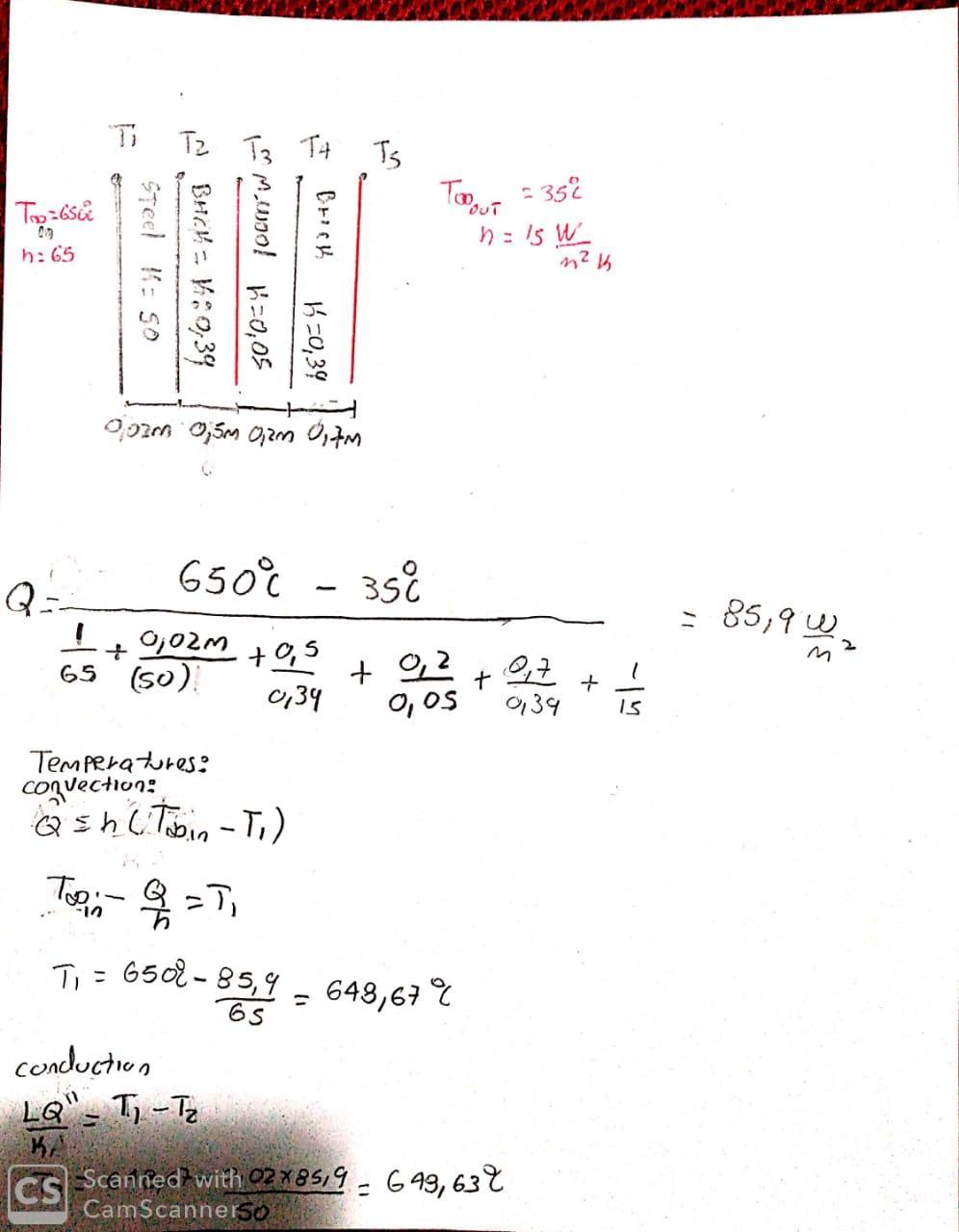
Heat loss=85.9W/m^2

ΔT1(Steel)=0.04C

ΔT2(Brick1)=110.13C

ΔT3(Mwood)=343.6C

ΔT1(Brick2)=154.18C

Explanation:

raise the heat transfer equation from the air inside the wall to the outside air from the wall, because that is where you have the temperature data, to find the heat.

To find the temperatures you use the heat found in the previous step, and you use the conduction and convection equations in each wall layer.

I attached the procedure

You might be interested in
A sample of normally consolidated clay was subjected to a CU triaxial compression test that was carried out until the specimen f
QveST [7]

Answer:

Check the explanation

Explanation:

Given

1) CU traixial compression test

2) Devatoric stress at failure  = бd = 50 kN/m^2

3) Confining pressure at failure  = бd = 48 kN/m^2

4) Pore pressure at failure  = u = 18 kN/m^2

5) Unconfined compression stress  = q = 20 kN/m^2

6) Undrained cohesion  = q/2 = 20 kN/m^2

To find:

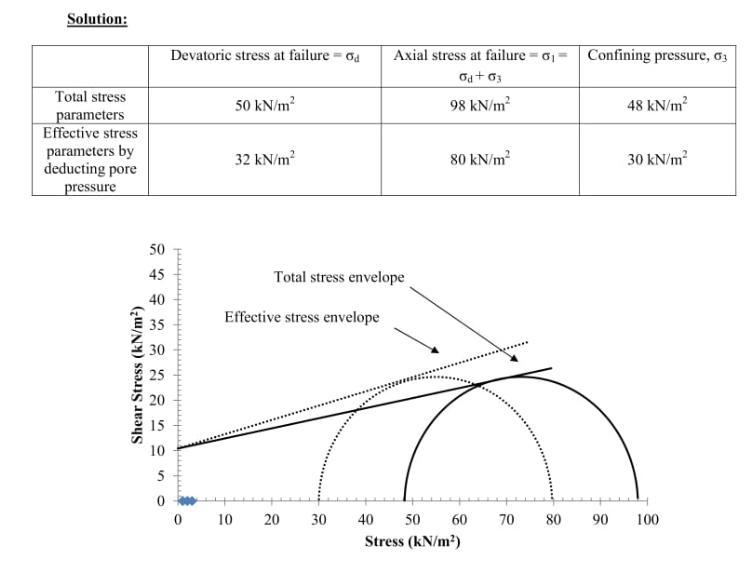
1) Effective and total stress strength failure envelope

Kindly check the attached image below .

7 0
2 years ago
Water is flowing in a metal pipe. The pipe OD (outside diameter) is 61 cm. The pipe length is 120 m. The pipe wall thickness is
Yuki888 [10]

Answer:

1113kN

Explanation:

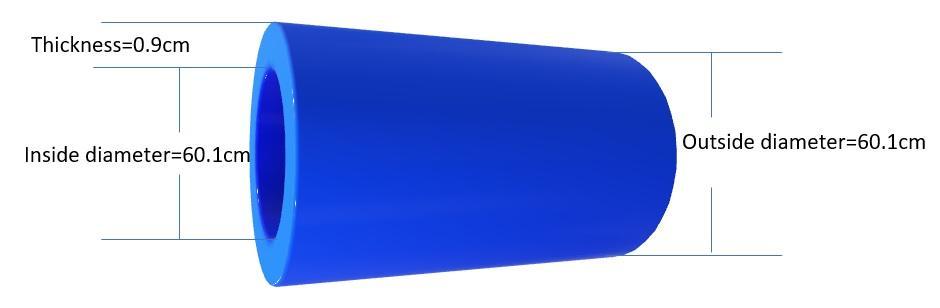
The ouside diameter OD of the pipe is 61cm and the thickness T is 0.9cm, so the inside diameter ID will be:

Inside Diameter = Outside Diameter - Thickness

Inside Diameter = 61cm - 0.9cm = 60.1cm

Converting this diameter to meters, we have:

60.1cm*\frac{1m}{100cm}=0.601m

This inside diameter is useful to calculate the volume V of water inside the pipe, that is the volume of a cylinder:

V_{water}=\pi  r^{2}h

V_{water}=\pi (\frac{0.601m}{2})^{2}*120m

V_{water}=113.28m^{3}

The problem gives you the water density d as 1.0kg/L, but we need to convert it to proper units, so:

d_{water}=1.0\frac{Kg}{L}*\frac{1L}{1000cm^{3}}*(\frac{100cm}{1m})^{3}

d_{water}=1000\frac{Kg}{m^{3}}

Now, water density is given by the equation d=\frac{m}{V}, where m is the water mass and V is the water volume. Solving the equation for water mass and replacing the values we have:

m_{water}=d_{water}.V_{water}

m_{water}=1000\frac{Kg}{mx^{3}}*113.28m^{3}

m_{water}=113280Kg

With the water mass we can find the weight of water:

w_{water}=m_{water} *g

w_{water}=113280kg*9.8\frac{m}{s^{2}}

w_{water}=1110144N

Finally we find the total weight add up the weight of the water and the weight of the pipe,so:

w_{total}=w_{water}+w_{pipe}

w_{total}=1110144N+2500N

w_{total}=1112644N

Converting this total weight to kN, we have:

1112644N*\frac{0.001kN}{1N}=1113kN

7 0
2 years ago
A single crystal of a metal that has the FCC crystal structure is oriented such that a tensile stress is applied parallel to the
morpeh [17]

The magnitude of applied stress in the direction of 101 is 12.25 MPA and in the direction of 011, it is not defined.                                          

<u>Explanation</u>:        

<u>Given</u>:

tensile stress is applied parallel to the [100] direction

Shear stress is 0.5 MPA.

<u>To calculate</u>:

The magnitude of applied stress in the direction of [101] and [011].

<u>Formula</u>:

zcr=σ cosФ cosλ

<u>Solution</u>:

For in the direction of 101

cosλ = (1)(1)+(0)(0)+(0)(1)/√(1)(2)

cos λ = 1/√2

The magnitude of stress in the direction of 101 is 12.25 MPA

In the direction of 011

We have an angle between 100 and 011

cosλ = (1)(0)+(0)(-1)+(0)(1)/√(1)(2)

cosλ  = 0

Therefore the magnitude of stress to cause a slip in the direction of 011 is not defined.                                                                                                                                                                      


5 0
2 years ago
Poles are values of Laplace transform variable, s, that make denominator of transfer function zero. Zeros are values of Laplace
Ostrovityanka [42]

Answer:

Zero 1 = -1

Zero 2 = -3

Pole 1 = 0

Pole 2 = -2

Pole 3 = -4

Pole 4 = -6

Gain = 4

Explanation:

For any given transfer function, the general form is given as

T.F = k [N(s)] ÷ [D(s)]

where k = gain of the transfer function

N(s) is the numerator polynomial of the transfer function whose roots are the zeros of the transfer function.

D(s) is the denominator polynomial of the transfer function whose roots are the poles of the transfer function.

k [N(s)] = 4s² + 16s + 12 = 4[s² + 4s + 3]

it is evident that

Gain = k = 4

N(s) = (s² + 4s + 3) = (s² + s + 3s + 3)

= s(s + 1) + 3 (s + 1) = (s + 1)(s + 3)

The zeros are -1 and -3

D(s) = s⁴ + 12s³ + 44s² + 48s

= s(s³ + 12s² + 44s + 48)

= s(s + 2)(s + 4)(s + 6)

The roots are then, 0, -2, -4 and -6.

Hope this Helps!!!

3 0
2 years ago
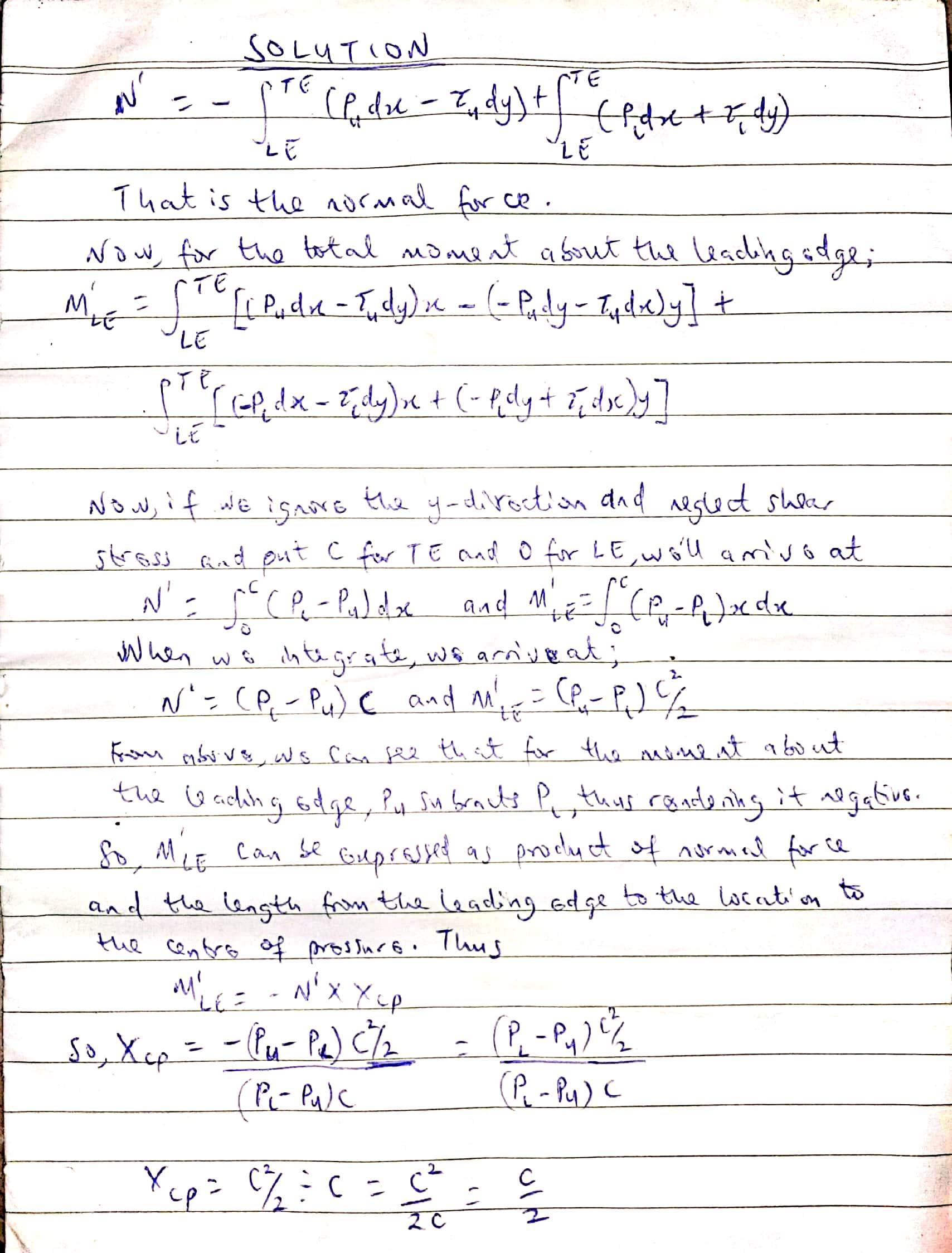
Consider an infinitely thin flat plate of chord c at an angle of attack α in a supersonic flow. The pressure on the upper and lo
amm1812

Answer:

X_cp = c/2

Explanation:

We are given;

Chord = c

Angle of attack = α

p u (s) = c 1

​p1(s)=c2,

and c2 > c1

First of all, we need to find the resultant normal force on the plate and the total moment about leading edge.

I've attached the solution

4 0
2 years ago
Other questions:
  • Mary is interested in developing new machines that would increase the productivity of small scale farmers. After high school, wh
    8·1 answer
  • Which of the two materials (brittle vs. ductile) usually obtains the highest ultimate strength and why?
    5·1 answer
  • Consider a plane composite wall that is composed of two materials of thermal conductivities kA 0.1 W/mK and kB 0.04 W/mK and thi
    14·1 answer
  • PDAs with two stacks are strictly more powerful than PDAs with one stack. Prove that 2-stack PDAs are not a valid model for CFLs
    12·1 answer
  • 5 kg of steam contained within a piston-cylinder assembly undergoes an expansion from state 1, where the specific internal energ
    7·1 answer
  • 2. A ¼ in. diameter rod must be machined on a lathe to a smaller diameter for use as a specimen in a tension test. The rod mater
    9·1 answer
  • The purification of hydrogen gas is possible by diffusion through a thin palladium sheet. Calculate the number of kilograms of h
    8·1 answer
  • Write cout statements with stream manipulators that perform the following:
    8·1 answer
  • Explain why failure of this garden hose occurred near its end and why the tear occurred along its length. Use numerical values t
    12·1 answer
  • Toeboards are usually ___ inches high and used on landings and balconies.
    8·1 answer
Add answer
Login
Not registered? Fast signup
Signup
Login Signup
Ask question!