answer.
Ask question
Login Signup
Ask question
All categories
  • English
  • Mathematics
  • Social Studies
  • Business
  • History
  • Health
  • Geography
  • Biology
  • Physics
  • Chemistry
  • Computers and Technology
  • Arts
  • World Languages
  • Spanish
  • French
  • German
  • Advanced Placement (AP)
  • SAT
  • Medicine
  • Law
  • Engineering
8_murik_8 [283]
2 years ago
11

The atomic radii of Mg2+ and Fions are 0.072 and 0.133 nm, respectively. (a) Calculate the force of attraction between these two

ions at their equilibrium interionic separation (i.e., when the ions just touch one another) b) What is the force of repulsion at this same separation distance

Chemistry
2 answers:
finlep [7]2 years ago
7 0

Answer:

F_{attraction}=1.09923\times 10^{-8}\ N

F_{repulsion}=-1.09923\times 10^{-8}\ N

Explanation:

The force of attraction can be written as:

F=\frac {K\times |Z_{cation}|e\times |Z_{anion}|e}{r^2}

Where,  

K is the Coulomb's constant having value 9×10⁹ N. m²/C²

Z_{cation}  is the charge on the cation

Z_{anion}  is the charge on the anion

e is electronic charge = 1.602\times 10^{-19}\ C

r is the distance between the cation and anion and in bond, it is the sum of the ionic radius of cation and anion

r=r_{cation}+r_{anion}

r_{cation} = 0.072 nm

r_{anion} = 0.133 nm

Thus,  

r=0.072\ nm+0.133 nm

r = 0.205 nm

Also, 1 nm = 10⁻⁹ m

So, r=2.05\times 10^{-10}\ m

Given,

Z_{cation}=2,\ Z_{anion}=1

Applying in the equation,  

F=\frac{9\times \:10^9\times \:2\times \:1.602\times \:10^{-19}\times \:1\times \:1.602\times \:10^{-19}}{\left(2.05\times \:\:10^{-10}\right)^2}

F=\frac{10^{-29}\times \:46.195272}{\left(10^{-10}\times \:2.05\right)^2}

F_{attraction}=1.09923\times 10^{-8}\ N

Force of attraction = - Force of repulsion

So,

F_{repulsion}=-1.09923\times 10^{-8}\ N

Makovka662 [10]2 years ago
5 0

Answer:

\large \boxed{\text{(a) }-1.10 \times 10^{-8} \text{ N}; \text{(b) }+1.10 \times 10^{-8} \text{ N}}

Explanation:

(a) Attractive force

To calculate the attractive force (F), we can use Coulomb's Law:

F =k\dfrac{Q_{1}Q_{2}}{r^{2}}

where  

Q₁ and Q₂ are the charges on the ions,

r is the distance between them, and

k = the Coulomb constant

Data:

Q₁ = 2+

Q₂ = 1-

r₊ = 0.072 nm

r₋ = 0.133 nm

k = 8.988 × 10⁹ N· m²C⁻²

Calculations:

Q₁ = (+2) × 1.602 × 10⁻¹⁹ C = +3.204 × 10⁻¹⁹ C

Q₂ = (-1) × 1.602 × 10⁻¹⁹ C = -1.602 × 10⁻¹⁹ C

r = r₊ + r₋ = 0.072 nm + 0.133 nm = 0.205 nm = 0.205 × 10⁻⁹ m

\begin{array}{rcl}F & = & 8.988 \times 10^{9}\times\dfrac{3.204 \times 10^{-19} \times (-1.602) \times 10^{-19}}{(0.205 \times 10^{-9})^{2}}\\\\& = & \mathbf{-1.10 \times 10^{-8}} \textbf{ N}\\\end{array}\\\text{The attractive force between the two ions is $\large \boxed{\mathbf{-1.10 \times 10^{-8}} \textbf{ N}}$}

(b) Repulsive force

The equilibrium position is reached when the ions just touch each other. If they come any closer, the nuclear repulsions will outweigh the Coulomb attraction.

Thus, the repulsive force is equal and opposite to the attractive force.

\text{The repulsive force is $\large \boxed{\mathbf{+1.10 \times 10^{-8}} \textbf{ N}}$}

You might be interested in
Using the following data table and graph, calculate the average k from the data. Amount CO2 (mL) Amount of White Solid (g) y x 1
UkoKoshka [18]
The k is the proportionality constant of the reaction. Graphically, this is the slope of the graph. Since the graph is linear, then there is only 1 value of k. To calculate this, choose two random points in the line. Suppose we use (0.15,10) and (0.30,20), calculate for the slope.

Slope = k = (10 - 20)/(0.15 - 0.30) = 66.67 mL CO₂/g CaCO₃
8 0
2 years ago
Read 2 more answers
A certain electrochemical cell has for its cell reaction: zn + hgo → zno + hg which is the half-reaction occurring at the anode?
Leya [2.2K]
It is b because I'm just going around the house with me to the mall to get u at the moment I don't have any plans tonight or naw
3 0
2 years ago
Before landing, the brakes and the tires of an airliner have a temperature of 15.0∘C. Upon landing, the 90.7 kg carbon fiber bra
Goryan [66]

Answer:

0.921 J/g degrees C

Explanation:

Recall that the First Law of Thermodynamics demands that the total internal energy of an isolated system must remain constant. Any amount of energy lost by the brakes must be gained by the tires (in the form of heat in this situation).  Therefore, heat given off by the brakes = −heat taken in by tires, or:

−qbrakes=qtires

The equation used to calculate the quantity of heat energy exchanged in this process is:

−qbrakes=−cbrakes mbrakes ΔTbrakes=ctires mtires ΔTtires=qtires

First we must convert the mass of the tires and the brakes from  kg to  g.

massbrakes=90.7 kg×1,000. g1 kg=9.07×10⁴ g

masstires=123 kg×1,000. g1 kg=1.23×10⁵ g

Next, substitute in known values and rearrange to solve for ctires. Note that the final temperature for both the tires and the brakes is 172∘C, the initial temperature of the brakes is 312∘C and the initial temperature of the tires is 15∘C.

−(1.400Jg∘C)(9.07×10⁴ g)(172∘C−312∘C)=(ctires)(1.23×10⁵ g)(172∘C−15∘C)

ctires=−(1.400 Jg∘C)(9.07×10⁴ g)(−140∘C)(1.23×10⁵ g)(157∘C)=17,777,200 J19311000 g∘C=0.9206Jg∘C

The answer should have three significant figures, so round to 0.921Jg∘C.
6 0
2 years ago
what mass of lithium chloride, licl must be dissolved to make a 0.194M solution that has volume of 1.00 l
Bogdan [553]
MXV= (0.194M)(1.00L)=0.194moles
42.39LiClg/molex0.194moles=8.2g LiCl
6 0
2 years ago
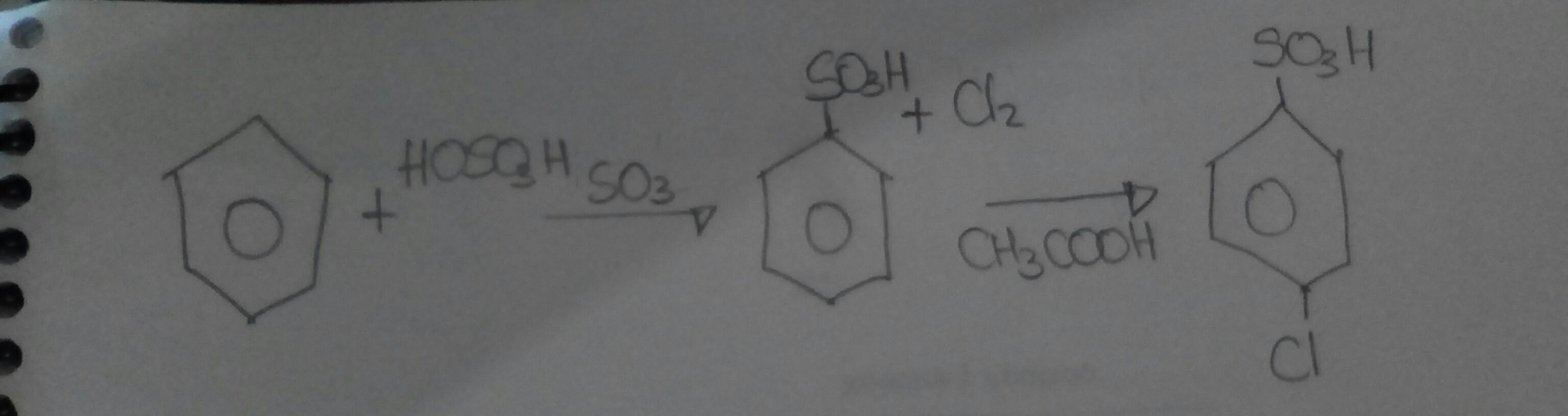
Synthesis of disubstituted benzenes involves two steps, each introducing one of the functional groups. For the synthesis of p-ch
Setler79 [48]

Answer:

The synthesis of p-chlorobenzenesulfonic acid with the reagents for each step and the structure of the monosubstituted intermediate compound is shown in the drawing below.

Explanation:

Benzenesulfonic acid is obtained from the sulfonation of benzene, using concentrated smoking sulfuric acid.

Chlorination of benzenesulfonic acid with chlorine without catalyst requires a polar solvent, such as acetic acid to obtain the selectivity in the position for and the ortho derivative in a low proportion.

7 0
2 years ago
Other questions:
  • Elements that can be described by the hardness shininess and ductility
    9·1 answer
  • Give the atomic symbol for an element that does not exist as a molecule or extended structure. that is, an element that exists o
    14·2 answers
  • The empirical formula for a compound is CH2. If n is a whole number, which shows a correct relationship between the molecular fo
    15·2 answers
  • If 35.50 cm3 of a NaOH solution are required for the complete neutralization of a 25.00cm3 sample of 0.200mol dm-3 H2SO4, what i
    5·1 answer
  • Match each type of titration to its ph at the equivalence point for solutions at 25 ∘c. drag each item to the appropriate bin. v
    12·1 answer
  • Consider the following reaction: A2 + B2 → 2AB ΔH = –321 kJ Bond energy (A2) = 1/2AB Bond energy (B2) =393 kJ/mol. What is the n
    7·1 answer
  • Hydrogen is unique among the elements because ________. 1. It is not really a member of any particular group. 2. Its electron is
    7·1 answer
  • Reserpine is a natural product isolated from the roots of the shrub Rauwolfia serpentina. It was first synthesized in 1956 by No
    9·1 answer
  • A 5-column table with 2 rows. Column 1 is labeled number of protons, with entries A and D; column 2 is number of neutrons, with
    8·1 answer
  • In an experiment, the reaction of 100.0 g of iodine produced 144.9 g of a compound formed from iodine and fluorine.
    14·1 answer
Add answer
Login
Not registered? Fast signup
Signup
Login Signup
Ask question!