answer.
Ask question
Login Signup
Ask question
All categories
  • English
  • Mathematics
  • Social Studies
  • Business
  • History
  • Health
  • Geography
  • Biology
  • Physics
  • Chemistry
  • Computers and Technology
  • Arts
  • World Languages
  • Spanish
  • French
  • German
  • Advanced Placement (AP)
  • SAT
  • Medicine
  • Law
  • Engineering
trapecia [35]
2 years ago
7

In the electron transport system

Biology
1 answer:
antoniya [11.8K]2 years ago
5 0

Answer:

A. NADH and FADH2 both donate electrons at the same location.

Explanation:

In the respiratory chain, four large protein complexes inserted into the mitochondrial inner membrane transport NADH and FADH₂ electrons (formed in glycolysis and the Krebs cycle) to oxygen gas, reducing them to NAD⁺ and FAD, respectively.

These electrons have great affinity for oxygen gas and, when combined with it, reduce it to water molecules at the end of the reaction.

Oxygen gas effectively participates in cellular respiration at this stage, so its absence would imply interruption of the process.

NADH and FADH₂ electrons, when attracted to oxygen, travel a path through protein complexes, releasing energy in this process.

The energy released by the NADH and FADH₂ electrons in the respiratory chain in theory yields <u>34</u> <u>ATP</u>, however, under normal conditions an average of 26 ATP molecules is formed.

If we consider that these 26 molecules are added to the two ATP formed in glycolysis and two ATP formed in the Krebs cycle, it can be said that cellular respiration reaches a maximum yield of 30 ATP per glucose molecule, although theoretically this number was 38 ATP per glucose molecule.


You might be interested in
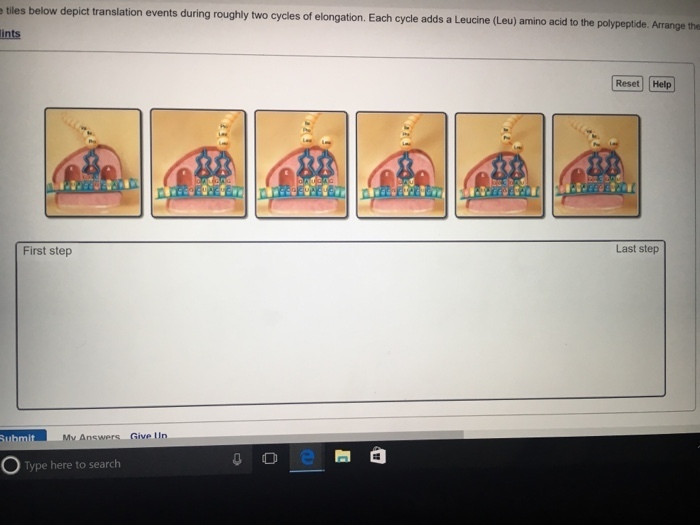
The tiles below depict translation events during roughly two cycles of elongation. each cycle adds a leucine (leu) amino acid to
sergij07 [2.7K]
I found the attached image on the internet and I believe it has the tiles referred to on the question.
As we can see on the image, the A-site, P-site, and E-site are represented. The A-site is occupied by the tRNA linked to the growing peptide chain. The P-site is the one occupied by the tRNA that works accepting the growing protein for peptide bond formation.
Firstly, the protein is formed, it is the first tile from the left.
Then, the first tile from the right is where the Leu is formed.
On the second tile from the right the Leu is then added to the protein.
The process is then repeated again as there are two cycles of elongation adding a Leu in each of them: third tile from the right, third tile from the left, second tile from the left.

7 0
2 years ago
Everything in the universe is composed of energy and matter. Which one of these examples does not represent matter? * An atom of
sdas [7]
I’m not very sure but I think it’s an atom of gold or if it isn’t, it could be heat from the sun
5 0
2 years ago
Describe three main features inside a prokaryotic cell.
Art [367]
The three main features of a prokaryotic cell
We have its insides: <span><span>1.   </span>Cytoplasm. Cytoplasm is where its organelles are suspended.</span> <span><span>2.   </span>Ribosomes. These ribosomes facilitate in manufacturing the cell’s proteins used in many cellular activities.</span> <span><span>3.   </span>Plasmid. It is a tiny DNA molecule.</span> <span><span>4.   </span>Nucleoid. The genophore of a prokaryotic cell where its genetical material are found.</span>

Externally prokaryotic cells have: <span><span>1.   </span>Capsules.</span> <span><span>2.   </span>Flagellum. A tail</span> <span><span>3.   </span>Pili. A hair-like structure on its surface.</span>


8 0
2 years ago
Read 2 more answers
What universal human condition(s) does wilson's play fences exhibit?
Mariulka [41]
The conditions exhibited revolve around the plight of the African American family.... the lack of opportunity, the dream of something better, the disappointments of the past, and a fear of the future.
8 0
2 years ago
Which healthy gamete could not result from the parent cell shown?
EleoNora [17]

Answer:

Gamete C

Explanation:

During the formation of gametes, the DNA is first duplicated, and 2 separate cell divisions take place to make a haploid cell.

In the first division, the homologous chromosomes are separated

Before the first cell division, the homologous chromosomes align in the centre. In this cell, the light green and dark green chromosomes align, as do the light purple and dark purple chromosomes. These are then separated into 2 different cells, 1 gets either the light or dark green chromosome and either the light purple and dark purple chromosome. The other cell also gets either light green or dark green and light purple or dark purple.

Then, a second division takes place that separates the sister chromatids to produce what we see in the gametes A, B, C, and D.

The only one that is not possible in a healthy cell is C, because it has not received any of the green chromosomes and instead has two homologous purples.

7 0
2 years ago
Other questions:
  • Do the cells beneath the formative phase differ from each other
    10·1 answer
  • the average annual snowfall in owen sound, located in georgian bay is about 345 cm. Belleville, located in eastern ontario avera
    8·2 answers
  • The starch suspension contained 0.8 g of starch
    15·2 answers
  • Which processes support the relationship between sediments and sedimentary rock in the rock cycle? Check all that apply. Sedimen
    7·2 answers
  • the geographic isolation of two population of species tends to increase differences between their gene pools because it _.
    13·1 answer
  • What is the second great discovery of genetics?
    5·1 answer
  • An experiment was performed to determine the mode of inheritance of two mouse genes, one for fur color and one for fur length. I
    7·1 answer
  • Suppose concordance data were collected from a cohort study of twins to study the genetic contribution to the onset of type 1 di
    13·1 answer
  • Students at a university were split into two groups and each received a different text for a philosophy course. One group receiv
    7·1 answer
  • In chickens, the allele for a pea comb (A) is dominant to the allele for a single comb (a). A mother with the genotype Aa and a
    7·1 answer
Add answer
Login
Not registered? Fast signup
Signup
Login Signup
Ask question!