answer.
Ask question
Login Signup
Ask question
All categories
  • English
  • Mathematics
  • Social Studies
  • Business
  • History
  • Health
  • Geography
  • Biology
  • Physics
  • Chemistry
  • Computers and Technology
  • Arts
  • World Languages
  • Spanish
  • French
  • German
  • Advanced Placement (AP)
  • SAT
  • Medicine
  • Law
  • Engineering
Ugo [173]
2 years ago
4

An air conditioner takes outside air at 35°C and cools it to 15°C at a rate of 1 kg/s. Estimate the amount of power needed to do

this. Recalculate the needed power if it is put in recirculation mode using inside air at 24°C and cools that to 15°C.
Engineering
1 answer:
Reptile [31]2 years ago
7 0

Answer:

Q=20.1kW

recirculation mode=Q=9.045kW

Explanation:

Hi!

To solve this problem you must use the first law of thermodynamics that establishes the energy that enters a system is the same that must come out. Given the above we have the following equation

Q = mCp (T2-T1)

WHERE

Q = Heat removed to air

m = mass air flow = 1kg / s

Cp = specific heat of air = 1.005KJ / kg °C

T2 = air inlet temperature

T1 = air outlet temperature=15°C.

for the first case

Q=(1kg/s)(1.005KJ/kg°C)(35°C-15°C)

Q=20.1kW

for the second case( recirculation mode)

Q=(1kg/s)(1.005KJ/kg°C)(24°C-15°C)

Q=9.045kW

You might be interested in
A 227 pound compressor is supported by four legs that contact the floor of a machine shop. At the bottom of each leg there is a
Ganezh [65]

Answer:

1.312 in

Explanation:

Data provided in the question:

Weight of the compressor, W = 227 pound

Number of legs = 4

Maximum pressure = 42 psi

Now,

Let F be the force taken by the legs

Therefore,

W = 4F

or

227 pound = 4F

or

F = 56.75 pounds

Also,

Force = Pressure × Area

or

56.75 pounds = 42 psi × πr²                      [ r is the diameter of one leg]

or

r² = 0.4301

or

r = 0.656

therefore,

diameter = 2r = 2 × 0.656

= 1.312 in

6 0
2 years ago
A thermometer requires 1 minute to indicate 98% of the response to a unit step input. Assuming the thermometer to be a first ord
Rama09 [41]

Answer:

Time constant = 15.34 seconds

The thermometer shows an error of 0.838°

Explanation:

Given

t = 1 minute = 60 seconds

c(t) = 98% = 0.98

According to the question, the thermometer is a first order system.

The first order system transfer function is given as;

C(s)/R(s) = 1/(sT + 1).

To calculate the time constant, we need to calculate the step response.

This is given as

r(t) = u(t) --- Take Laplace Transformation

R(s) = 1/s

Substitute 1/s for R(s) in C(s)/R(s) = 1/(sT + 1).

We have

C(s)/1/s = 1/(sT + 1)

C(s) = 1/(sT + 1) * 1/s

C(s) = 1/s - 1/(s + 1/T) --- Take Inverse Laplace Transformation

L^-1(C(s)) = L^-1(1/s - 1/(s + 1/T))

Since, e^-t <–> 1/(s + 1) --- {L}

1 <–> 1/s {L}

So, the unit response c(t) = 1 - e^-(t/T)

Substitute 0.98 for c(t) and 60 for t

0.98 = 1 - e^-(60/T)

0.98 - 1 = - e^-(60/T)

-0.02 = - e^-(60/T)

e^-(60/T) = 0.02

ln(e^-(60/T)) = ln(0.02)

-60/T = -3.912

T = -60/-3.912

T = 15.34 seconds

Time constant = 15.34 seconds

The error signal is given as

E(s) = R(s) - C(s)

Where the temperature changes at the rate of 10°/min; 10°/60 s = 1/6

So.

E(s) = R(s) - 1/6 C(s)

Calculating C(s)

C(s) = 1/s - 1/(s + 1/T)

C(s) = 1/s - 1/(s + 1/15.34)

Remember that R(s) = 1/s

So, E(s) becomes

E(s) = 1/s - 1/6(1/s - 1/(s + 1/15.34))

E(s) = 1/s - 1/6(1/s - 1/(s + 0.0652)

E(s) = 1/s - 1/6s + 1/(6(s+0.0652))

E(s) = 5/6s + 1/(6(s+0.0652))

E(s) = 0.833/s + 1/(6(s+0.0652)) ---- Take Inverse Laplace Transformation

e(t) = 1/6e^-0.652t + 0.833

For a first order system, the system attains a steady state condition when time is 4 times of Time constant.

So,

Time = 4 * 15.34

Time = 61.36 seconds

So, e(t) becomes

e(t) = 1/6e^-0.652t + 0.833

e(t) = 1/(6e^-0.652(61.36)) + 0.833

e(t) = 0.83821342824942664566211

e(t) = 0.838 --- Approximated

Hence, the thermometer shows an error of 0.838°

4 0
2 years ago
Read 2 more answers
A 20 dBm power source is connected to the input of a directional coupler having a coupling factor of 20 dB, a directivity of 35
lukranit [14]

Answer:

P_O = 0.989 watt = 19.9 dBm

Explanation:

Given data:

P_1 power = 20 dBm  = 0.1 watt

coupling factor is 20dB

Directivity = 35 dB

We know that

coupling factor = 10 log \frac{P_1}{P_f}

solving for  final power

20 = 10 log\frac{P_1}{P_f}

2 = log \frac{P_1}{P_f}

100 = \frac{0.1}{P_f}

P_f = 0.001 watt = 0 dBm

Directivity D =  10 \frac{P_f}{P_b}

35 = 10 \frac{0.001}{P_b}

P_b = 3.162 \times 10^{-7} wattt

output Power  = P_1 -P_f - P_b

                       = 0.1 - 0.001 - 3.162 \times 10^{-7}

P_O = 0.989 watt = 19.9 dBm

6 0
2 years ago
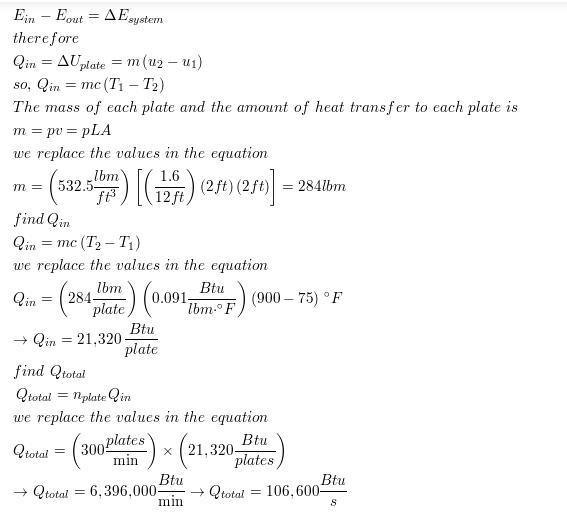
In a production facility, 1.6-in-thick 2-ft × 2-ft square brass plates (rho = 532.5 lbm/ft3 and cp = 0.091 Btu/lbm·°F) that are
Gnoma [55]

Answer:

106600 btu/s

<u>note: </u>

<u><em> solution is attached due to error in mathematical equation. please find the attachment</em></u>

8 0
2 years ago
A cylindrical part of diameter d is loaded by an axial force P. This causes a stress of P/A, where A = πd2/4. If the load is kno
Afina-wow [57]

Answer:

1.505

Explanation:

cylindrical part of diameter d is loaded by an axial force P. This causes a stress of P/A, where A = πd2/4. If the load is known with an uncertainty of ±11 percent, the diameter is known within ±4 percent (tolerances), and the stress that causes failure (strength) is known within ±20 percent, determine the minimum design factor that will guarantee that the part will not fail.

stress is force per unit area

stress=P/A

A = πd^2/4.

uncertainty of axial force P= +/-.11

s=+/-.20, strength

d=+/-.04 diameter

fail load/max allowed

minimum design=fail load/max allowed

minimum design =s/(P/A)

sA/P

A=(\pi.96d^2)/4, so Amin=

0.96^{2} (because the diameter  at minimum is (1-0.04=0.96)

minimum design=Pmax/(sminxAmin)

1.11/(.80*.96^2)=

1.505

8 0
2 years ago
Other questions:
  • Let Deterministic Quicksort be the non-randomized Quicksort which takes the first element as a pivot, using the partition routin
    13·1 answer
  • The purification of hydrogen gas is possible by diffusion through a thin palladium sheet. Calculate the number of kilograms of h
    8·1 answer
  • A desktop computer is to be cooled by a fan whose flow rate is 0.34 m3/min. Determine the mass flow rate of air through the fan
    12·1 answer
  • air at 600 kPa, 330 K enters a well-insulated, horizontal pipe having a diameter of 1.2 cm and exits at 120 kPa, 300 K. Applying
    10·1 answer
  • Water (cp = 4180 J/kg·°C) enters the 2.5 cm internal diameter tube of a double-pipe counter-flow heat exchanger at 17°C at a rat
    7·1 answer
  • A pair of spur gears with 20 degree pressure angle, full-depth, involute teeth transmits 65 hp. The pinion is mounted on a shaft
    5·1 answer
  • what is the advantage of decreasing the field current of a separately excited dc motor below its nominal value
    7·1 answer
  • Technician A says that TSBs are typically updates to the owner's manual. Technician B says that TSBs are generally
    11·1 answer
  • When encountering low visibility from rain or fog, you should use your ____.
    12·1 answer
  • What should always be done before beginning any diagnosis?
    9·1 answer
Add answer
Login
Not registered? Fast signup
Signup
Login Signup
Ask question!