answer.
Ask question
Login Signup
Ask question
All categories
  • English
  • Mathematics
  • Social Studies
  • Business
  • History
  • Health
  • Geography
  • Biology
  • Physics
  • Chemistry
  • Computers and Technology
  • Arts
  • World Languages
  • Spanish
  • French
  • German
  • Advanced Placement (AP)
  • SAT
  • Medicine
  • Law
  • Engineering
matrenka [14]
2 years ago
7

A thick steel sheet of area 150 in.2 is exposed to air near the ocean. After a one-year period it was found to experience a weig

ht loss of 485 g due to corrosion. To what rate of corrosion, in (a) mpy and (b) mm/yr, does this correspond? The density of steel is 7.9 g/cm3.
Engineering
1 answer:
Bingel [31]2 years ago
5 0

Answer:

Rate of corrosion = 24.95 mpy

Rate of corrosion = 0.63 mm/yr

Explanation:

given data

steel sheet area = 150 in²

weight loss = 485 g

density of steel = 7.9 g/cm³

time taken = 1 year

to find out

rate of corrosion in (a) mpy and (b) mm/yr

solution

we get here the rate of corrosion that is express as

rate of corrosion = (k × W) ÷ (D × A × T)     ..................1

here k is constant  and w is total weight lost and t is time taken for loss and A is surface area and D is density of steel

so put her value in equation 1 we get

Rate of corrosion = \frac{534*485*1000}{7.9*150*24hr*365day/yr}

Rate of corrosion = 24.95 mpy

and

Rate of corrosion = \frac{87.6*485*1000}{7.9*150*2.54^2*24hr*365days/yr}

Rate of corrosion = 0.63 mm/yr

You might be interested in
Which of the following is NOT true about hydraulic valves? A. Directional control valves determine the path of a fluid in a give
Lelechka [254]

Answer: Option D is not true of hydraulic valves. A hydraulic valve is a device that can change the opening degree of liquid flow path

Explanation:

The pilot check valve allows flow of liquid in one direction and blocks flow in the opposite direction

5 0
2 years ago
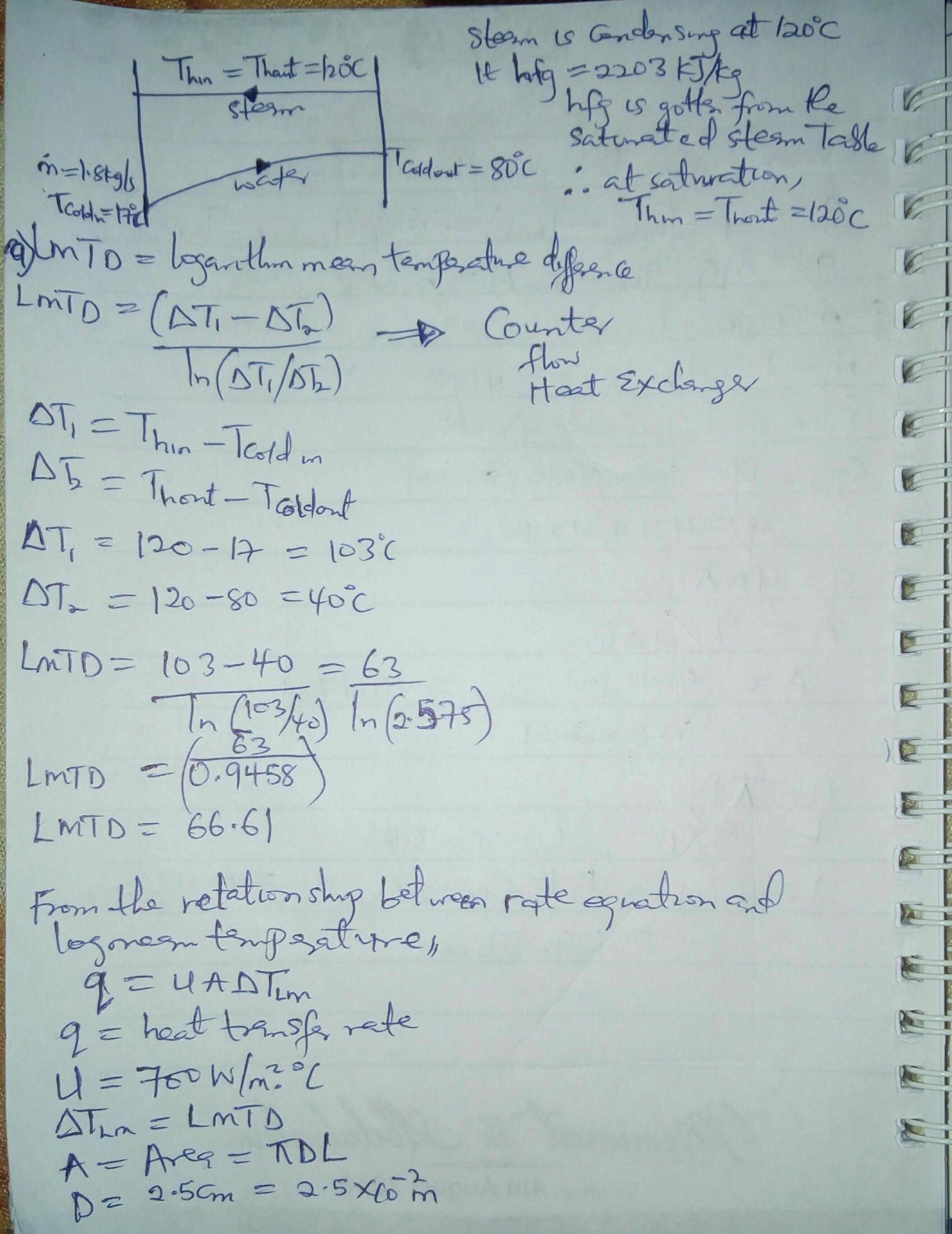
Water (cp = 4180 J/kg·°C) enters the 2.5 cm internal diameter tube of a double-pipe counter-flow heat exchanger at 17°C at a rat
aksik [14]

Answer:

Length = 129.55m, 129.55m

Explanation:

Given:

cp of water = 4180 J/kg·°C

Diameter, D = 2.5 cm

Temperature of water in =  17°C

Temperature of water out = 80°C

mass rate of water =1.8 kg/s.

Steam condensing at 120°C

Temperature at saturation = 120°C

hfg of steam at 120°C = 2203 kJ/kg

overall heat transfer coefficient of the heat exchanger = 700 W/m2 ·°C

U = 700 W/m2 ·°C

Since Temperature of steam is at saturation,

temperature of steam going in = temperature of steam out = 120°C

Energy balance:

Heat gained by water = Heat loss by steam

Let specific capacity of steam = 2010kJ/Kg .°C

Find attached the full solution to the question.

3 0
2 years ago
A cylindrical specimen of a brass alloy having a length of 60 mm (2.36 in.) must elongate only 10.8 mm (0.425 in.) when a tensil
Gemiola [76]

The radius of the specimen is 60 mm

<u>Explanation:</u>

Given-

Length, L = 60 mm

Elongated length, l = 10.8 mm

Load, F = 50,000 N

radius, r = ?

We are supposed to calculate the radius of a cylindrical brass specimen in order to produce an elongation of 10.8 mm when a load of 50,000 N is applied. It is necessary to compute the strain corresponding to this

elongation using Equation:

ε = Δl / l₀

ε = 10.8 / 60

ε = 0.18

We know,

σ = F / A

Where A = πr²

According to the stress-strain curve of brass alloy,

σ = 440 MPa

Thus,

sigma = 50,000 / \pi  (r)^2\\\\440 X 10^6 = \frac{50,000}{3.14 X (r)^2}\\\\r = 0.06m\\r = 60mm\\\\\\

Therefore, the radius of the specimen is 60 mm

3 0
2 years ago
A thermal energy storage unit consists of a large rectangular channel, which is well insulated on its outer surface and encloses
yaroslaw [1]

Answer:

the temperature of the aluminum at this time is 456.25° C

Explanation:

Given that:

width w of the aluminium slab = 0.05 m

the initial temperature T_1 = 25° C

T{\infty} =600^0C

h = 100 W/m²

The properties of Aluminium at temperature of 600° C by considering the conditions for which the storage unit is charged; we have ;

density ρ = 2702 kg/m³

thermal conductivity k = 231 W/m.K

Specific heat c = 1033 J/Kg.K

Let's first find the Biot Number Bi which can be expressed by the equation:

Bi = \dfrac{hL_c}{k} \\ \\ Bi = \dfrac{h \dfrac{w}{2}}{k}

Bi = \dfrac{hL_c}{k} \\ \\ Bi = \dfrac{100 \times \dfrac{0.05}{2}}{231}

Bi = \dfrac{2.5}{231}

Bi = 0.0108

The time constant value \tau_t is :

\tau_t = \dfrac{pL_cc}{h} \\ \\ \tau_t = \dfrac{p \dfrac{w}{2}c}{h}

\tau_t = \dfrac{2702* \dfrac{0.05}{2}*1033}{100}

\tau_t = \dfrac{2702* 0.025*1033}{100}

\tau_t = 697.79

Considering Lumped capacitance analysis since value for Bi is less than 1

Then;

Q= (pVc)\theta_1 [1-e^{\dfrac {-t}{ \tau_1}}]

where;

Q = -\Delta E _{st} which correlates with the change in the internal energy of the solid.

So;

Q= (pVc)\theta_1 [1-e^{\dfrac {-t}{ \tau_1}}]= -\Delta E _{st}

The maximum value for the change in the internal energy of the solid  is :

(pVc)\theta_1 = -\Delta E _{st}max

By equating the two previous equation together ; we have:

\dfrac{-\Delta E _{st}}{\Delta E _{st}{max}}= \dfrac{  (pVc)\theta_1 [1-e^{\dfrac {-t}{ \tau_1}}]} { (pVc)\theta_1}

Similarly; we need to understand that the ratio of the energy storage to the maximum possible energy storage = 0.75

Thus;

0.75=  [1-e^{\dfrac {-t}{ \tau_1}}]}

So;

0.75=  [1-e^{\dfrac {-t}{ 697.79}}]}

1-0.75=  [e^{\dfrac {-t}{ 697.79}}]}

0.25 =  e^{\dfrac {-t}{ 697.79}}

In(0.25) =  {\dfrac {-t}{ 697.79}}

-1.386294361= \dfrac{-t}{697.79}

t = 1.386294361 × 697.79

t = 967.34 s

Finally; the temperature of Aluminium is determined as follows;

\dfrac{T - T _{\infty}}{T_1-T_{\infty}}= e ^ {\dfrac{-t}{\tau_t}}

\dfrac{T - 600}{25-600}= e ^ {\dfrac{-967.34}{697.79}

\dfrac{T - 600}{25-600}= 0.25

\dfrac{T - 600}{-575}= 0.25

T - 600 = -575 × 0.25

T - 600 = -143.75

T = -143.75 + 600

T = 456.25° C

Hence; the temperature of the aluminum at this time is 456.25° C

3 0
2 years ago
Instructions given by traffic police or construction flaggers _____. A. Are sometimes important to follow B. Are usually not imp
Anestetic [448]

Answer:

D. Overrule any other laws and traffic control devices.

Explanation:

Laws and traffic control devices are undoubtedly compulsory to be followed at every point in time to control traffic and other related situations. However, there are cases when certain instructions overrule these laws and traffic control devices. For example, when a traffic police is giving instructions, and though the traffic control devices too (such as traffic lights) are displaying their own preset lights to control some traffic, the instructions from the traffic police take more priority. This is because at that point in time, the instructions from the traffic control devices might not be just applicable or sufficient.

Also, in the case of instructions given by construction flaggers, these instructions have priority over those from controlling devices. This is because during construction traffic controls are redirected from the norms. Therefore, the flaggers such be given more importance.

6 0
2 years ago
Other questions:
  • a. Replacing standard incandescent lightbulbs with energy-efficient compact fluorescent lightbulbs can save a lot of energy. Cal
    9·1 answer
  • A square loop of wire surrounds a solenoid. The side of the square is 0.1 m, while the radius of the solenoid is 0.025 m. The sq
    6·1 answer
  • A charge of 2.0 × 10⁻¹⁰ C is to be stored on each plate of a parallel-plate capacitor having an area of 650 mm2 (1.0 in.2 ) and
    14·1 answer
  • Write multiple if statements: If carYear is before 1967, print "Probably has few safety features." (without quotes). If after 19
    6·1 answer
  • A particle has an initial velocity of v0 = 14 ft/s to the right, at s0 = 0, and a = 2 ft/s2 to the left. determine its position
    5·1 answer
  • Given a 5x5 matrix for Playfair cipher a. How many possible keys does the Playfair cipher have? Ignore the fact that some keys m
    6·1 answer
  • Use the predicate specifications(x, y): x beats yF (x): x is an (American) football teamQ(x, y): x is quarterback of yL(x,y): x
    13·1 answer
  • "From the earth to the moon". In Jules Verne’s 1865 story with this title, three men went to the moon in a shell fired from a gi
    5·1 answer
  • Solid spherical particles having a diameter of 0.090 mm and a density of 2002 kg/m3 are settling in a solution of water at 26.7C
    8·1 answer
  • Find the velocity and rate of flow of water through a rectangular channel of 6m wide and 3m deep when it's running full. The cha
    13·1 answer
Add answer
Login
Not registered? Fast signup
Signup
Login Signup
Ask question!