answer.
Ask question
Login Signup
Ask question
All categories
  • English
  • Mathematics
  • Social Studies
  • Business
  • History
  • Health
  • Geography
  • Biology
  • Physics
  • Chemistry
  • Computers and Technology
  • Arts
  • World Languages
  • Spanish
  • French
  • German
  • Advanced Placement (AP)
  • SAT
  • Medicine
  • Law
  • Engineering
denpristay [2]
2 years ago
9

(a) In your own words, explain how donor impurities in semiconductors give rise to free electrons in numbers in excess of those

generated by valence band–conduction band excitations.
(b) Also, explain how acceptor impurities give rise to holes in numbers in excess of those generated by valence band–conduction band excitations.
Engineering
1 answer:
Kazeer [188]2 years ago
8 0

Answer:

A. N type impurities

B. P type impurities

Explanation:

A. The impurities contribute free electrons and changing the conducting property of the semi conductor. When a pentavalent impurities in a semi conductor( impurities with five valence electron) , the impurity atom replace some of the semi conductor atoms in the crystal structure where 4 of the valence electron would be involved in bonding of 4 neighbouring semiconductor while leaving the fifth electron to be free(negative charge carrier) which is available for detachment.

B. When a trivalence impurity is added to semiconductor, instead of excess electron, there will be excess hole created by crystals. Reason for this attribute is the trivalence atom will replace some tetra valence semiconductor atom, when three valence electrons of the 3 valence electrons of the trivalent impurity atom make bond with three neighbouring semiconductor which gives rise to lack of electron in the bond of the fourth neighbouring semiconductor which contribute a whole to the crystalline since trivalent impurity contribute excess holes to the crystal of semi conductor, this holes can accept electrons.

You might be interested in
The closed tank of a fire engine is partly filled with water, the air space above being under pressure. A 6 cm bore connected to
skelet666 [1.2K]

Answer:

The air pressure in the tank is 53.9 kN/m^{2}

Solution:

As per the question:

Discharge rate, Q = 20 litres/ sec = 0.02\ m^{3}/s

(Since, 1 litre = 10^{-3} m^{3})

Diameter of the bore, d = 6 cm = 0.06 m

Head loss due to friction, H_{loss} = 45 cm = 0.45\ m

Height, h_{roof} = 2.5\ m

Now,

The velocity in the bore is given by:

v = \frac{Q}{\pi (\frac{d}{2})^{2}}

v = \frac{0.02}{\pi (\frac{0.06}{2})^{2}} = 7.07\ m/s

Now, using Bernoulli's eqn:

\frac{P}{\rho g} + \frac{v^{2}}{2g} + h = k                  (1)

The velocity head is given by:

\frac{v_{roof}^{2}}{2g} = \frac{7.07^{2}}{2\times 9.8} = 2.553

Now, by using energy conservation on the surface of water on the roof and that in the tank :

\frac{P_{tank}}{\rho g} + \frac{v_{tank}^{2}}{2g} + h_{tank} = \frac{P_{roof}}{\rho g} + \frac{v_{tank}^{2}}{2g} + h_{roof} + H_{loss}

\frac{P_{tank}}{\rho g} + 0 + 0 = \0 + 2.553 + 2.5 + 0.45

P_{tank} = 5.5\times \rho \times g

P_{tank} = 5.5\times 1\times 9.8 = 53.9\ kN/m^{2}

4 0
2 years ago
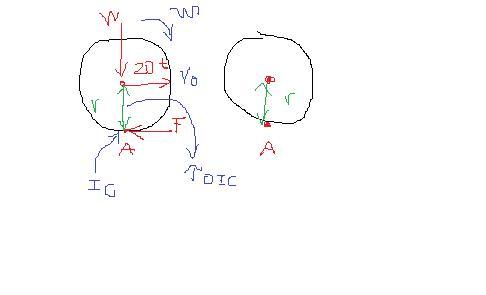
The 30-kg gear is subjected to a force of P=(20t)N where t is in seconds. Determine the angular velocity of the gear at t=4s sta
tatyana61 [14]

Answer:

\omega =\frac{24}{1.14375}=20.983\frac{rad}{s}

Explanation:

Previous concepts

Angular momentum. If we consider a particle of mass m, with velocity v, moving under the influence of a force F. The angular  momentum about point O is defined as the “moment” of the particle’s linear momentum, L, about O. And the correct formula is:

H_o =r x mv=rxL

Applying Newton’s second law to the right hand side of the above equation, we have that r ×ma = r ×F =

MO, where MO is the moment of the force F about point O. The equation expressing the rate of change  of angular momentum is this one:

MO = H˙ O

Principle of Angular Impulse and Momentum

The equation MO = H˙ O gives us the instantaneous relation between the moment and the time rate of change of angular  momentum. Imagine now that the force considered acts on a particle between time t1 and time t2. The equation MO = H˙ O can then be integrated in time to obtain this:

\int_{t_1}^{t_2}M_O dt = \int_{t_1}^{t_2}H_O dt=H_0t2 -H_0t1

Solution to the problem

For this case we can use the principle of angular impulse and momentum that states "The mass moment of inertia of a gear about its mass center is I_o =mK^2_o =30kg(0.125m)^2 =0.46875 kgm^2".

If we analyze the staritning point we see that the initial velocity can be founded like this:

v_o =\omega r_{OIC}=\omega (0.15m)

And if we look the figure attached we can use the point A as a reference to calculate the angular impulse and momentum equation, like this:

H_Ai +\sum \int_{t_i}^{t_f} M_A dt =H_Af

0+\sum \int_{0}^{4} 20t (0.15m) dt =0.46875 \omega + 30kg[\omega(0.15m)](0.15m)

And if we integrate the left part and we simplify the right part we have

1.5(4^2)-1.5(0^2) = 0.46875\omega +0.675\omega=1.14375\omega

And if we solve for \omega we got:

\omega =\frac{24}{1.14375}=20.983\frac{rad}{s}

8 0
2 years ago
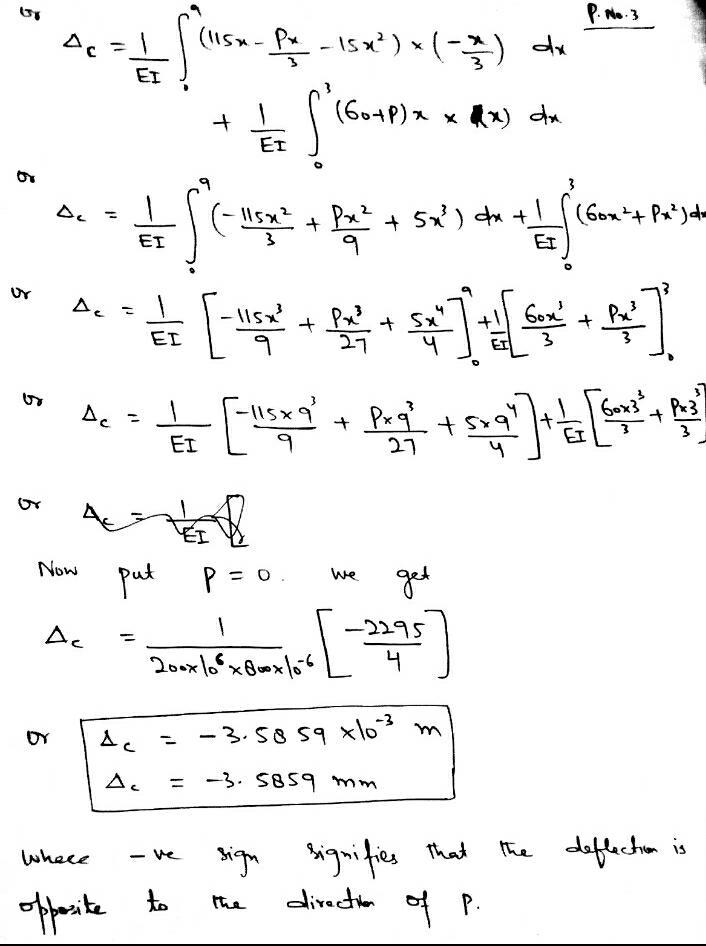
Determine the deflection at the center of the beam. Express your answer in terms of some or all of the variables LLL, EEE, III,
Rom4ik [11]

Answer:

See explanations for step by step procedures to get answer.

Explanation:

Given that;

Determine the deflection at the center of the beam. Express your answer in terms of some or all of the variables LLL, EEE, III, and M0M0M_0. Enter positive value if the deflection is upward and negative value if the deflection is downward.

4 0
2 years ago
Bananas are to be cooled from 28°C to 12°C at a rate of 1140 kg/h by a refrigerator that operates on a vapor-compression refrige
Lera25 [3.4K]

Answer:

A) COP = \frac{16.97}{9.8} = 1.731

B) P_{IN} = 0.4763

C) Second law efficiency 4.85%

exergy destruction for the cycle = 9.3237 kW

Explanation:

Given data:

T_1 = 28 degree celcius

T_2 = 12 degree celcius

\dot m = 1140 kg/h

Power to refrigerator = 9.8 kW

Cp = 3.35 kJ/kg degree C

A) Q = \dot m Cp \Delta T

        = 1140 \times 3.35\times (28-12) = 61,104 kJ/h

Q_{abs} = 61,104 kJ/h = 16.97 kJ/sec

COP = \frac{16.97}{9.8} = 1.731

b)

COP ∝ \frac{1}{P_{in}}

P_{in} wil be max when COP maximum

taking surrounding temperature T_H = 20 degree celcius

COP_{max} = \frac{T_L}{T_H- T_L} = \frac{285}{293 - 285} = 35.625

we know that

COP = \frac{heat\ obsorbed}{P_{in}}

P_{IN} = \frac{16.97}{35.62} = 0.4763

c) second law efficiency

\eta_{11} = \frac{COP_R}{(COP)_max} = \frac{1.731}{35.625} = 4.85\%

exergy destruction os given as X = W_{IN} - X_{Q2}

                                                         = 9.8 - 0.473 = 9.3237 kW

8 0
2 years ago
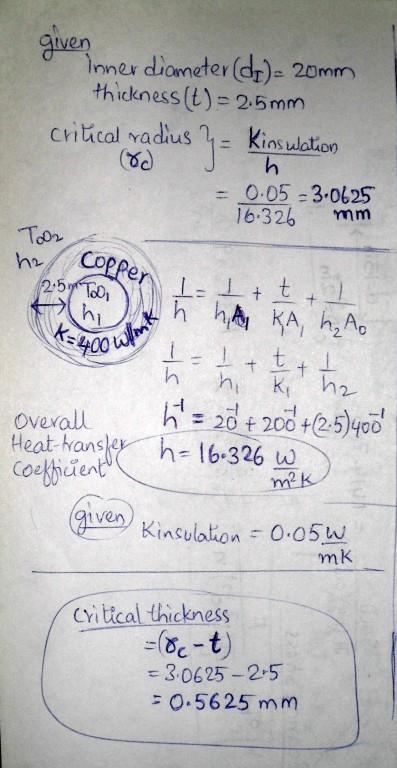
In a pharmaceutical plant, a copper pipe (kc = 400 W/mK) with inner diameter of 20 mm and wall thickness of 2.5 mm is used for c
GaryK [48]

Answer:

See explaination

Explanation:

Please kindly check attachment for the step by step solution of the given problem.

8 0
2 years ago
Other questions:
  • Radioactive wastes are temporarily stored in a spherical container, the center of which is buried a distance of 10 m below the e
    13·1 answer
  • As shown, a load of mass 10 kg is situated on a piston of diameter D1 = 140 mm. The piston rides on a reservoir of oil of depth
    9·1 answer
  • A 0.2-m^3 rigid tank equipped with a pressure regulator contains steam at 2MPa and 320C. The steam in the tank is now heated. Th
    9·1 answer
  • Which statement concerning symbols used on plans is true?
    10·1 answer
  • 13–27. The conveyor belt is moving downward at 4 m>s. If the coefficient of static friction between the conveyor and the 15-k
    11·1 answer
  • Why is it that dislocations play an important role in controlling the mechanical properties of metallic materials, however, they
    10·1 answer
  • Refrigerant-134a is compressed from 2 bar, saturated vapor, to 10 bar, 90o C in a compressor operating at steady state. The mass
    11·1 answer
  • Interlocking stacked material is done by​ _____.
    10·2 answers
  • Link BD consists of a single bar 36 mm wide and 18 mm thick. Knowing that each pin has a 12-mm diameter, determine the maximum v
    7·1 answer
  • The rate of flow through an ideal clarifier is 8000m3 /d, the detention time is 1h and the depth is 3m. If a full-length movable
    5·1 answer
Add answer
Login
Not registered? Fast signup
Signup
Login Signup
Ask question!