answer.
Ask question
Login Signup
Ask question
All categories
  • English
  • Mathematics
  • Social Studies
  • Business
  • History
  • Health
  • Geography
  • Biology
  • Physics
  • Chemistry
  • Computers and Technology
  • Arts
  • World Languages
  • Spanish
  • French
  • German
  • Advanced Placement (AP)
  • SAT
  • Medicine
  • Law
  • Engineering
Shkiper50 [21]
2 years ago
15

Assume that an attacker knows that a user’s password is either p1 = abcd or p2 = bedg. Say the user encrypts his password using

the Vigen´ere cipher, and the attacker sees the resulting ciphertext c. Show how the attacker can determine the user’s password, or explain why this is not possible, when the period t used by cipher is 1, 2, 3, or 4 respectively.
Engineering
1 answer:
denis23 [38]2 years ago
8 0

Answer: I will Show how the attacker can determine the user’s password

Explanation:

If we assume an attacker knows that a user’s password is either abcd or bedg. Say the user encrypts his password using the shift cipher, and the attacker sees the resulting ciphertext. Show how the attacker can determine the user’s password, or explain why this is not possible.  

The alphabet{A, B, . . . , Z}is identified  with the set Σ = {0, 1, . . . 25} and all additions are implicitly taken mod26.  

Then, the possible passwords are p0 = abcd = (0, 1, 2, 3) and p1 = bedg = (1, 4, 3, 6).  

All possible encryptions of p0 are C0 = {(k, k + 1, k + 2, k + 3) | k ∈ Σ} and the ones of p1 are C1 = {(k + 1, k + 4, k + 3, k + 6) | k ∈ Σ}.  

These two sets are disjoint and so in order to obtain the password  it is necessary to check in which set the ciphertext lies.

You might be interested in
(3) Calculate the heat flux through a sheet of brass 7.5 mm (0.30 in.) thick if the temperatures at the two faces are 150°Cand 5
bezimeni [28]

Answer:

a.) 1.453MW/m2,  b.)  2,477,933.33 BTU/hr  c.) 22,733.33 BTU/hr  d.) 1,238,966.67 BTU/hr

Explanation:

Heat flux is the rate at which thermal (heat) energy is transferred per unit surface area. It is measured in W/m2

Heat transfer(loss or gain) is unit of energy per unit time. It is measured in W or BTU/hr

1W = 3.41 BTU/hr

Given parameters:

thickness, t = 7.5mm = 7.5/1000 = 0.0075m

Temperatures 150 C = 150 + 273 = 423 K

                        50 C = 50 + 273 = 323 K

Temperature difference, T = 423 - 323 = 100 K

We are assuming steady heat flow;

a.) Heat flux, Q" = kT/t

K= thermal conductivity of the material

The thermal conductivity of brass, k = 109.0 W/m.K

Heat flux, Q" = \frac{109 * 100}{0.0075} = 1,453,333.33 W/m^{2} \\ Heat flux, Q" = 1.453MW/m^{2} \\

b.) Area of sheet, A = 0.5m2

Heat loss, Q = kAT/t

Heat loss, Q = \frac{109*0.5*100}{0.0075} = 726,666.667W

Heat loss, Q = 726,666.667 * 3.41 = 2,477,933.33 BTU/hr

c.) Material is now given as soda lime glass.

Thermal conductivity of soda lime glass, k is approximately 1W/m.K

Heat loss, Q=\frac{1*0.5*100}{0.0075} = 6,666.67W

Heat loss, Q = 6,666.67 * 3.41 = 22,733.33 BTU/hr

d.) Thickness, t is given as 15mm = 15/1000 = 0.015m

Heat loss, Q=\frac{109*0.5*100}{0.015} =363,333.33W

Heat loss, Q = 363,333.33 * 3.41 = 1,238,966.67 BTU/hr

5 0
2 years ago
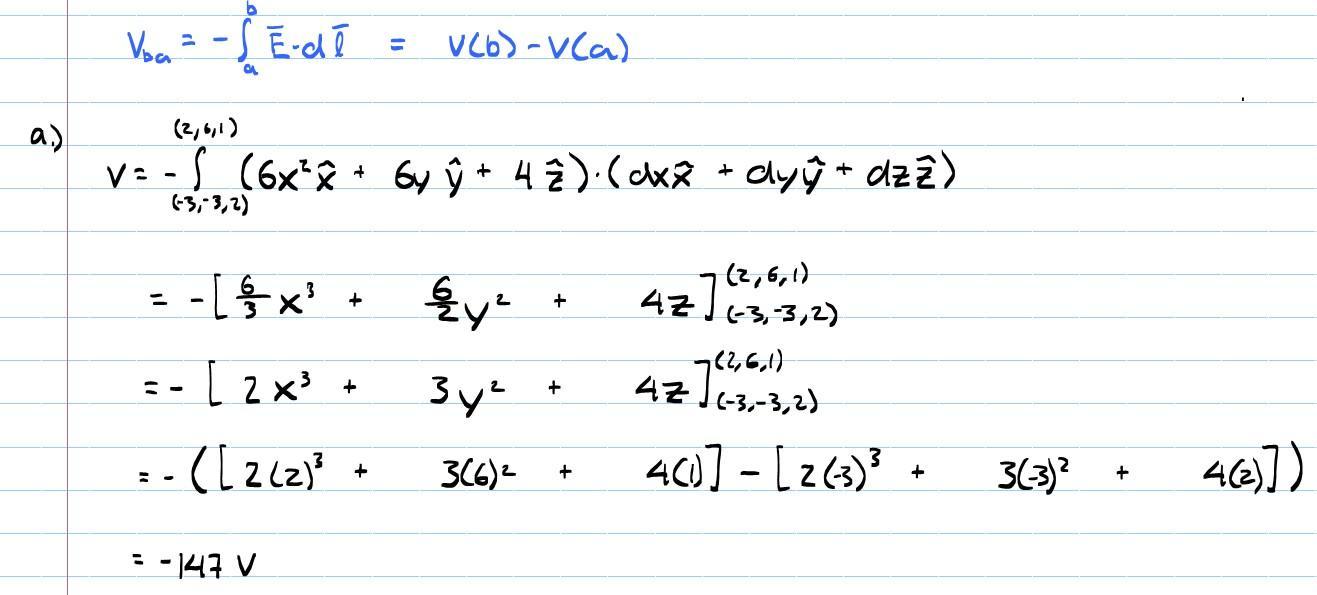
An electric field is expressed in rectangular coordinates by E = 6x2ax + 6y ay +4az V/m.Find:a) VMN if point M and N are specifi
Fittoniya [83]

Answer:

a.) -147V

b.) -120V

c.) 51V

Explanation:

a.) Equation for potential difference is the integral of the electrical field from a to b for the voltage V_ba = V(b)-V(a).

b.) The problem becomes easier to solve if you draw out the circuit. Since potential at Q is 0, then Q is at ground. So voltage across V_MQ is the same as potential at V_M.

c.) Same process as part b. Draw out the circuit and you'll see that the potential a point V_N is the same as the voltage across V_NP added with the 2V from the other box.

Honestly, these things take practice to get used to. It's really hard to explain this.

3 0
2 years ago
Poles are values of Laplace transform variable, s, that make denominator of transfer function zero. Zeros are values of Laplace
Ostrovityanka [42]

Answer:

Zero 1 = -1

Zero 2 = -3

Pole 1 = 0

Pole 2 = -2

Pole 3 = -4

Pole 4 = -6

Gain = 4

Explanation:

For any given transfer function, the general form is given as

T.F = k [N(s)] ÷ [D(s)]

where k = gain of the transfer function

N(s) is the numerator polynomial of the transfer function whose roots are the zeros of the transfer function.

D(s) is the denominator polynomial of the transfer function whose roots are the poles of the transfer function.

k [N(s)] = 4s² + 16s + 12 = 4[s² + 4s + 3]

it is evident that

Gain = k = 4

N(s) = (s² + 4s + 3) = (s² + s + 3s + 3)

= s(s + 1) + 3 (s + 1) = (s + 1)(s + 3)

The zeros are -1 and -3

D(s) = s⁴ + 12s³ + 44s² + 48s

= s(s³ + 12s² + 44s + 48)

= s(s + 2)(s + 4)(s + 6)

The roots are then, 0, -2, -4 and -6.

Hope this Helps!!!

3 0
2 years ago
A steel rotating-beam test specimen has an ultimate strength Sut of 1600 MPa. Estimate the life (N) of the specimen if it is tes
ziro4ka [17]

Answer:

the life (N) of the specimen is 46400 cycles

Explanation:

given data

ultimate strength Su = 1600 MPa

stress amplitude σa = 900 MPa

to find out

life (N) of the specimen

solution

we first calculate the endurance limit of specimen Se i.e

Se = 0.5× Su   .............1

Se = 0.5 × 1600

Se = 800 Mpa

and we know

Se for steel is 700 Mpa for Su ≥ 1400 Mpa

so we take endurance limit Se is = 700 Mpa

and strength of friction f  = 0.77 for 232 ksi

because for Se 0.5 Su at 10^{6} cycle = (1600 × 0.145 ksi ) = 232

so here coefficient value (a) will be

a = \frac{(f*Su)^2}{Se}    

a = \frac{(0.77*1600)^2}{700}  

a = 2168.3 Mpa

so

coefficient value (b) will be

a = -\frac{1}{3}log\frac{(f*Su)}{Se}

b =  -\frac{1}{3}log\frac{(0.77*1600)}{700}

b = -0.0818

so no of cycle N is

N =  (\frac{ \sigma a}{a})^{1/b}

put here value

N =  (\frac{ 900}{2168.3})^{1/-0.0818}

N = 46400

the life (N) of the specimen is 46400 cycles

5 0
2 years ago
Hot exhaust gases of an internal combustion engine are to be used to produce saturated water vapor at 2 MPa pressure. The exhaus
Anastaziya [24]

Answer:

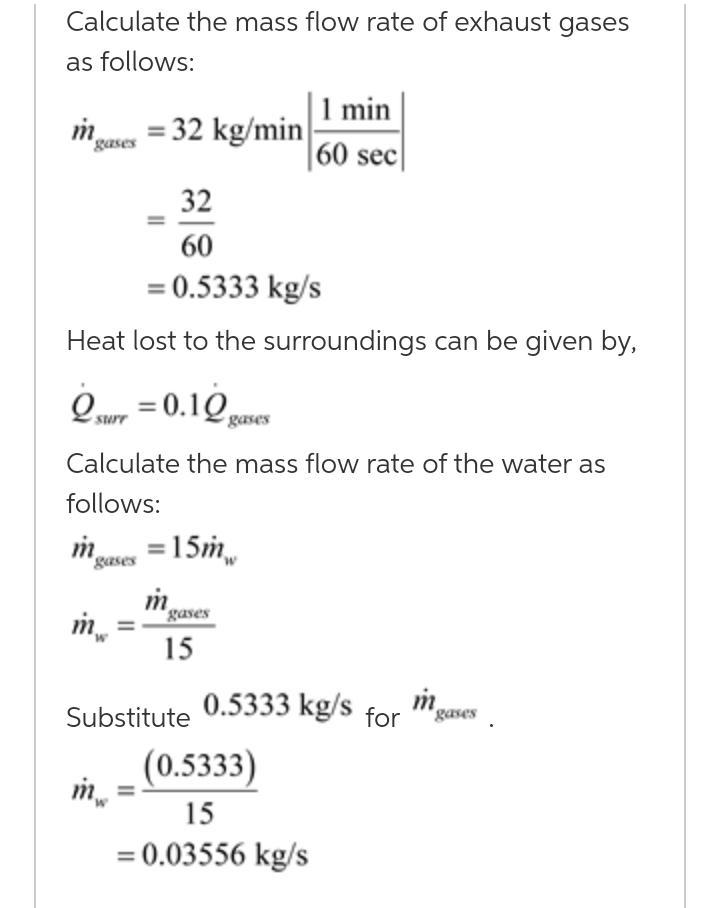
The flowrate of water is 0.03556kg/s

Explanation:

Exhaust gases inlet temperature T1=4000C

Water inlet temperature T3=150C Exit Pressure of water as saturated vapor P4=2MPa

Mass flow rate of exhaust gases Heat lost to the surroundings Qgases=32kg/min

Mass flow rate of exhaust gases is 15 times that of the water

Heat exchangers typically involve no work interactions (w = 0) and negligible...

7 0
2 years ago
Read 2 more answers
Other questions:
  • a. Replacing standard incandescent lightbulbs with energy-efficient compact fluorescent lightbulbs can save a lot of energy. Cal
    9·1 answer
  • Water is the working fluid in an ideal Rankine cycle. The condenser pressure is 8 kPa, and saturated vapor enters the turbine at
    10·1 answer
  • Some states have osha programs, but you should always defer to the federal program.
    8·2 answers
  • An excavation is at risk for cave-in and water accumulation because of the excess soil that has accumulated. What type of excava
    12·1 answer
  • The driving force for fluid flow is the pressure difference, and a pump operates by raising the pressure of a fluid (by converti
    13·1 answer
  • Water is to be withdrawn from an 8-m-high water reservoir by drilling a 2.2-cm-diameter hole at the bottom surface. Disregarding
    12·2 answers
  • Can crushers help us recycle in a space efficient way which is good for saving the earth and for giving you more room in your ap
    7·1 answer
  • With thermodynamics, one cannot determine ________.
    14·1 answer
  • A 10-m long steel linkage is to be designed so that it can transmit 2 kN of force without stretching more than 5 mm nor having a
    9·1 answer
  • technician A says that in any circuit, electrical current takes the path of least resistance. technician B says that while this
    13·1 answer
Add answer
Login
Not registered? Fast signup
Signup
Login Signup
Ask question!